 EN
EN

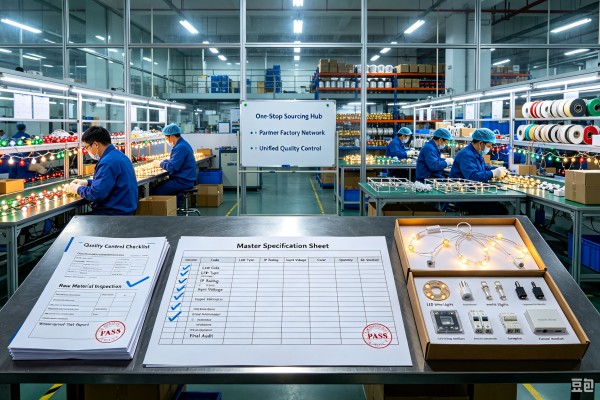
Who supplies commercial Christmas lights for large projects?
Commercial Christmas lights look simple, but sourcing them for a mall, city street, resort, or retail chain can become risky. Buyers often ask who sells the lights. The bigger issue is missed deadlines, product failures, and unclear supplier roles.
Commercial Christmas lights for large projects are usually supplied by manufacturers, importers, distributors, project contractors, or local installation teams. The best model is often to source products from a commercial-grade manufacturer with customization and quality-control capability, then coordinate installation, local compliance[^1], and maintenance through qualified local partners.
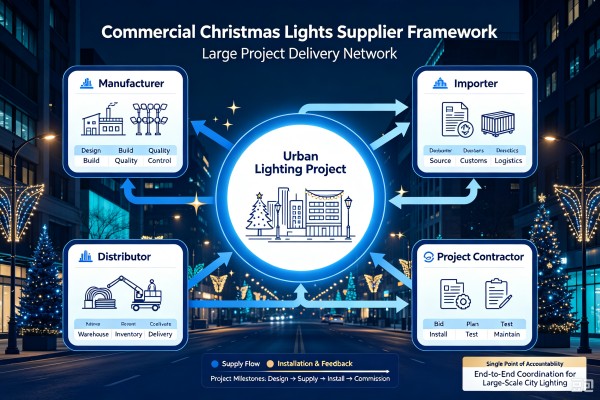
Buyers lose time when they treat every “supplier” as if each one did the same job. Product supply, electrical approval, installation, and after-sales maintenance are different responsibilities. Once these roles are separated, supplier selection becomes clearer.
Who actually supplies commercial Christmas lights?
Large projects involve many teams. A buyer may speak with a factory, local contractor, wholesaler, and importer in the same week. If responsibility is not defined early, the project can face delays, duplicated costs, and unclear accountability.
Commercial Christmas lights are supplied through several channels: direct manufacturers, trading companies, importers, distributors, project contractors, and local installation teams. Manufacturers usually supply customized products. Contractors and installers handle site work. Importers and distributors support stock, logistics, and local market access.
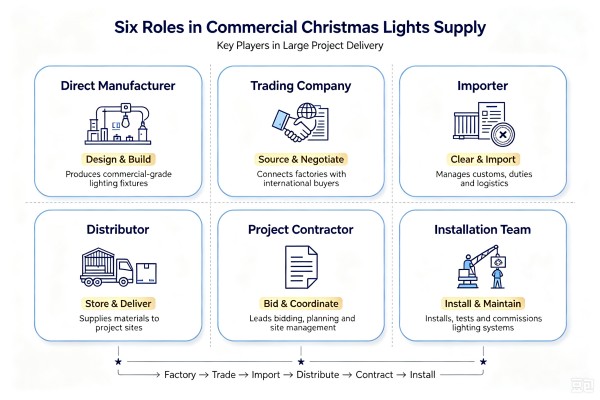
“Supplier” can mean different things
A large commercial Christmas lights project normally includes these roles:
| Role | Main responsibility | Strength | Common limitation |
|---|---|---|---|
| Direct manufacturer | Product design, production, customization, batch quality | Best for custom designs and controlled manufacturing | Usually not responsible for local installation |
| Trading company | Sourcing from different factories | Convenient product variety | Less control over factory process |
| Importer | Import process, regional supply, stock programs | Local market knowledge | May have limited customization |
| Distributor | Stock availability, smaller replenishment, local sales | Fast access to standard items | Less suitable for unique large displays |
| Project contractor | Project management and site coordination | Strong local execution | May outsource products |
| Installation team | On-site installation, repair, safety checks | Local technical execution | Usually does not manufacture products |
Product supplier vs. project contractor
A product supplier provides physical Christmas light products, such as:
- LED string light curtains
- Tree wrapping lights
- 2D and 3D motif light frames
- Street pole decorations
- Festive archways
- Large custom holiday signs
- Commercial outdoor decorative lighting
- Custom festive light displays
A project contractor may handle:
- Site surveys
- Structural fixing methods
- Local electrical work
- Installation labor
- Safety barricades
- Maintenance during the event
- Removal and storage after the season
These roles overlap sometimes, but they are not the same. A manufacturer may provide installation drawings, packing lists, replacement parts, and product guidance. A local licensed team should still evaluate the site, power supply, load conditions, fixing method, and legal requirements[^2].
Buyers should confirm who is responsible for product supply, installation, and local compliance before placing any purchase order.
Why this distinction matters
Large projects usually run against a fixed opening date. A city lighting ceremony, mall campaign, or hotel Christmas event cannot easily move by three weeks because a shipment was late or the wrong voltage was ordered.
When buyers know which supplier does what, they reduce four common risks:
- Wrong product expectations — indoor decorative items may not suit outdoor commercial use[^3].
- Unclear warranty responsibility — failure may come from product quality, installation damage, or local power conditions.
- Late technical decisions — cable color, plug type, voltage, waterproof rating[^4], controller method, and packaging affect production.
- Poor replacement planning — large projects need spare parts and batch-matched replacements.
The best supplier is not always the one with the lowest quote. The best supplier is the one whose role matches the buyer’s risk.
Which supplier role is best?
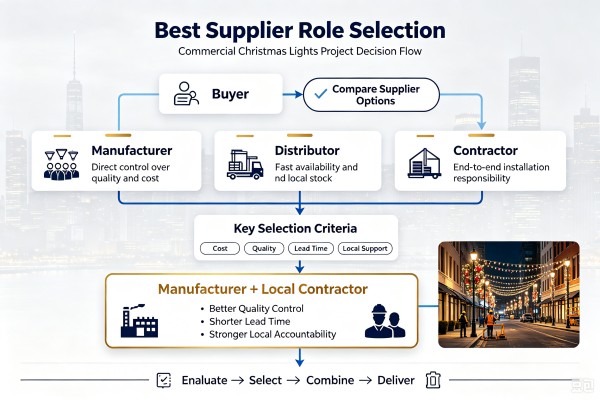
The best supplier depends on project scope. For custom or large-volume projects, a direct manufacturer with commercial project experience is often the best product source. For installation, inspection, and local regulations, buyers should work with qualified local contractors or electrical professionals.
When a manufacturer is the right choice
A manufacturer is strongest when the project needs product control, especially custom design, consistent batches, or several product categories made to the same visual standard.
A direct manufacturer can usually support:
- Custom LED color temperature
- Specific wire color and cable length
- Project-based voltage and plug options
- Commercial outdoor waterproof designs
- Branded packaging or neutral export cartons
- Replacement parts prepared before shipment
- Custom motif light drawings and samples
- Coordinated production across product types
Some factories are strong in small consumer items. Others are better at export wholesale. A smaller group is ready for commercial Christmas lights used in public spaces, malls, municipal streets, and large decorative installations.
When a distributor or importer is the right choice
A distributor can be better when the buyer needs standard goods quickly. If the project uses common Christmas light designs and the timeline is short, local stock may be safer than overseas production.
A distributor or importer can help when:
- The buyer needs immediate delivery
- The project uses standard designs
- The order quantity is moderate
- Local after-sales service is required
- The buyer prefers regional stock replenishment
- Import paperwork is easier through a local partner
However, distributors may have limited customization. They may not change LED spacing, frame size, controller programming, wire color, or packaging. If the project is visually unique, ask early whether the distributor is holding stock or placing a custom factory order.
When a contractor is the right choice
A project contractor is often the best partner for local execution. Contractors understand the site. They can review fixing points, access equipment, traffic control, weather exposure, building requirements, and on-site safety.
A contractor is especially important for:
- Municipal streets
- Shopping centers
- Outdoor building facades
- Theme parks
- Large hotels and resorts
- Public plazas
- Tall trees and difficult access points
The contractor may buy from a manufacturer, importer, or distributor. Some contractors source products themselves. Others allow the buyer to nominate a product supplier. Either model can work, but responsibilities must be written clearly.
A practical selection framework
| Project need | Preferred product source | Local partner needed? |
|---|---|---|
| Large custom displays | Manufacturer | Yes |
| Standard retail shelf items | Importer or distributor | Sometimes |
| City street installation | Manufacturer or contractor sourcing | Yes |
| Fast replacement stock | Local distributor | Sometimes |
| Unique motif light design | Manufacturer | Yes |
| Full turnkey local event | Project contractor | Yes |
The strongest model is often a combination: source from a manufacturer that controls product quality and customization, then work with a local contractor for installation and compliance. This keeps each party in the area where it is strongest.
Why manufacturing quality matters
Commercial buyers face a hard problem. Lights may look fine in a sample room, but they must survive outdoor exposure, transport handling, repeated installation, and long operating hours. A low price becomes expensive if failures appear after the display opens.
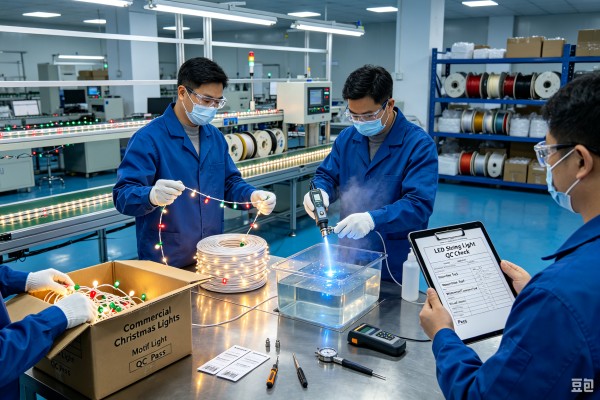
Manufacturing quality matters because commercial Christmas lights must perform consistently across large batches and demanding environments. Buyers should evaluate LED quality, cable construction, waterproof design, frame finishing, testing records, packaging, spare parts, and supplier quality systems.
Commercial-grade does not only mean “brighter”
Brightness matters, but durability is usually more important for outdoor holiday lighting. A commercial product should be reviewed for:
- LED consistency[^5]: color and brightness should match across batches.
- Cable quality: insulation should suit the environment and handling.
- Water resistance: outdoor products need suitable protection.
- Connector reliability: weak connections create failure points.
- Frame strength: motif light frames should resist deformation.
- Surface treatment: metal frames should resist corrosion where required[^6].
- Controller stability: dynamic effects should run reliably.
- Packaging strength: cartons and inner supports should protect the product during export.
A string light for a home tree is not the same as a commercial string light used across hundreds of trees in a public district.
Batch consistency is a project issue
Large projects often need hundreds or thousands of items that look identical. If the first container and second container do not match, the difference may be visible after installation. Buyers should ask how suppliers control LED binning[^7], cable materials, frame dimensions, and production records.
A retail chain may need the same warm white tone across many stores. A city contractor may need identical snowflake decorations on dozens of lamp posts. A hotel group may need matching entrance arches, tree lights, and hanging elements. In these cases, “almost the same” may not be good enough.
Useful quality-control documents to request
Buyers should not rely only on catalog photos. Useful documents may include:
- Product specification sheet — voltage, wattage, LED quantity, dimensions, cable type, intended use.
- Sample approval record — confirms what was accepted before mass production.
- Production inspection report — appearance, function, quantity, and packaging checks.
- Testing or compliance documents — checked against destination market and actual model.
- Factory quality system documents — for example, ISO9001 and BSCI documentation[^8]. Buyers should verify certificates, scope, validity, and relevance.
- Packing list and spare parts list — large projects should plan replacements before shipment.
Quality control should match application risk
| Application | Risk level | Buyer focus |
|---|---|---|
| Indoor retail display | Medium | visual consistency, plug type, packaging |
| Outdoor mall facade | High | waterproof design, connectors[^9], fixing method |
| Municipal street décor | High | durability, batch consistency, local approval |
| Event stage décor | Medium | quick installation, controller reliability |
| Large tree lighting | High | cable quality, LED spacing, replacement plan |
A strong quote is not just a price sheet. It explains what the product is designed for, what it is not designed for, and what the buyer still needs to confirm locally.
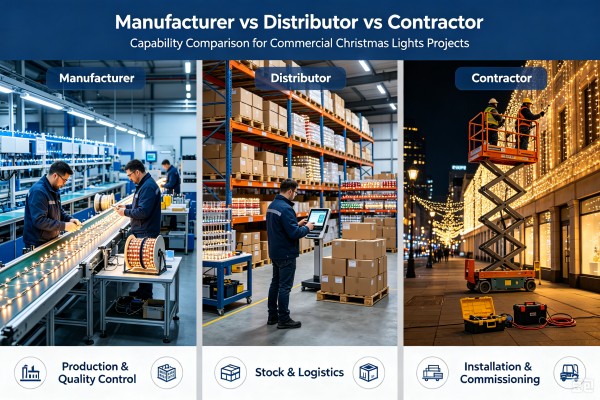
When should buyers choose a manufacturer, distributor, or contractor?
Sourcing becomes confusing when buyers try to force one supplier to solve every problem. A manufacturer may be excellent at production but unsuitable for local installation. A contractor may be strong on-site but dependent on another company for product quality.
Buyers should choose:
- A manufacturer when product customization and production control matter most.
- A distributor when fast local stock is the priority.
- A local contractor when installation, site safety, and local approvals are central.
Choose a manufacturer when the product defines the project
A manufacturer is usually the better product source when the buyer has a clear design target, such as custom shapes, project colors, large quantities, or branded seasonal themes.
A manufacturer fits well when the buyer needs:
- A custom motif light based on a drawing or concept
- Matching LED color across many product types
- Project-specific dimensions
- Controlled production lead time
- Factory-direct communication on technical details
- Export packing designed for container shipment
- Commercial Christmas lights produced in planned batches
Choose a distributor when speed is more important than uniqueness
A distributor can be practical when the project is close and the buyer needs available products. This often happens when a customer adds decorations late or needs quick replenishment.
A distributor fits well when:
- Standard models are acceptable
- Local stock is available
- The buyer wants shorter transport time
- Order quantity is not large enough for custom production
- The buyer needs local invoicing or regional logistics
The trade-off is limited control. The buyer may need to accept existing sizes, colors, plug types, and packaging.
Choose a local contractor when the site is complex
A contractor is essential when the project involves public access, height work, electrical connections, or structural fixing[^10]. Product supply is only one part of the project. The site may require cranes, permits, safety planning, cable routing, waterproof junctions, and emergency access.
A qualified local contractor should evaluate:
- Electrical load and power distribution
- Local code requirements
- Fixing points and wind exposure
- Height access and installation method
- Pedestrian and vehicle safety
- Maintenance access during the season
- Removal and storage after the event
A manufacturer can support product specifications and manufacturing guidance. The buyer should still rely on qualified local professionals for application-specific decisions.
The combined model usually works best
For many large projects, the best model is a coordinated supply chain:
- Buyer or designer defines the visual concept.
- Manufacturer develops product drawings and samples.
- Buyer approves specifications and quality requirements.
- Local contractor checks site conditions and installation feasibility.
- Manufacturer produces and packs the goods.
- Importer or logistics partner handles shipping and customs if needed.
- Local contractor installs, tests, and maintains the display.
This gives buyers better control and avoids asking one supplier to handle responsibilities outside its expertise.
How early should buyers source?
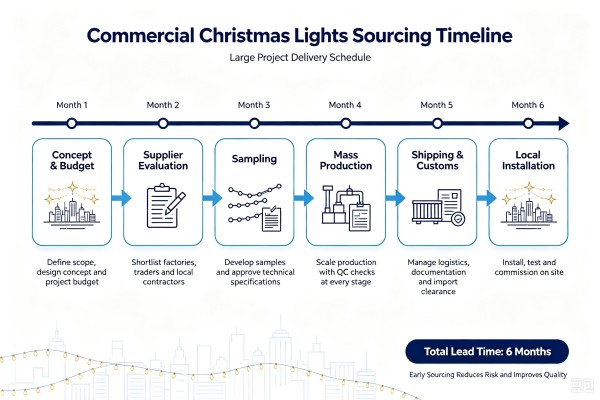
Buyers should source commercial Christmas lights several months before installation[^11], especially for custom outdoor projects. Early sourcing gives time for design approval, sampling, production, testing, shipping, customs clearance, local inspection, installation planning, and spare-part preparation.
The two biggest risks are time and failure
In large Christmas lighting projects, two risks appear again and again:
- Missed seasonal deadlines
- Product failure in outdoor or commercial environments
Both become harder to manage when sourcing starts late. A rushed order may skip sample approval. A late shipment may arrive after the installation window. A weak product may fail after the opening ceremony, when repairs are public and expensive.
A realistic sourcing timeline
| Stage | Suggested timing before installation | Key tasks |
|---|---|---|
| Concept and budget | 6–9 months | define scope, design style, product categories |
| Supplier evaluation | 5–8 months | compare manufacturer, distributor, contractor roles |
| Sampling and quotation | 4–6 months | approve materials, colors, dimensions, packaging |
| Mass production | 2–4 months | manufacture, inspect, prepare spare parts |
| Shipping and customs[^12] | 1–2 months | sea or air freight, import clearance |
| Local installation | 2–6 weeks | site installation, testing, adjustment |
| Event operation | during season | maintenance, replacement, safety checks |
Standard products can move faster. Custom motif light projects, municipal decorations, and large commercial Christmas lights programs usually need more time.
What buyers should confirm before placing an order
Important details include:
- Product dimensions
- LED color and brightness level
- Voltage and power consumption
- Plug or connector type
- Indoor or outdoor application
- Waterproof requirements
- Cable color and length
- Frame material and finishing
- Controller mode
- Mounting or hanging points
- Labeling and packaging
- Spare parts ratio
- Inspection requirements
- Shipment method and delivery deadline
A simple checklist prevents many avoidable problems. Projects are often slowed down because one basic detail, such as cable color or plug type, was not confirmed early.
Delivery planning is part of quality planning
Many buyers treat logistics as separate. It is part of project quality. If goods arrive late, the installation team has less time to work carefully. If packing is weak, the contractor may discover damage only at the site. If spare parts are missing, small failures become visible problems.
For large projects, buyers should ask:
- Will each carton be labeled by area or product type?
- Will installation teams identify items quickly?
- Are fragile motif light frames protected inside the carton?
- Are replacement LEDs, connectors, or power accessories included?
- Are product photos or packing diagrams available?
- Is there a plan if customs clearance takes longer than expected?
Commercial Christmas lights are seasonal products, but the sourcing process should not be seasonal panic. It should be a planned procurement process.
Frequently Asked Questions
Are manufacturers the best suppliers for commercial Christmas lights?
Manufacturers are often best when the project needs customization, batch consistency, and controlled production. However, they are not a substitute for local installers or compliance professionals. A strong project usually combines a capable manufacturer with qualified local contractors.
What is the difference between residential and commercial Christmas lights?
Residential lights are usually designed for smaller, lighter use. Commercial Christmas lights are evaluated for larger quantities, outdoor suitability, stronger construction, consistent appearance, and project-based replacement planning. Buyers should check specifications rather than relying only on product photos.
Should I buy directly from China for a large Christmas lighting project?
Direct sourcing from China can work well when the buyer can manage specifications, approvals, logistics, and local installation separately. Buyers should evaluate factory capability, quality-control process, export experience, and documentation. Local contractors should still review installation and compliance requirements.
How do I compare quotations for commercial holiday lighting?
Buyers should compare more than unit price. They should review materials, dimensions, LED quality, waterproof design, packaging, spare parts, production lead time, inspection standards, and supplier role. A lower price may carry higher project risk if specifications are unclear.
Can one supplier handle product supply and installation?
Sometimes a local contractor offers a turnkey package, including products and installation. A manufacturer may support product design and production, but local installation and regulatory approval should be handled by qualified local professionals. Buyers should define each responsibility in writing.
Conclusion
Commercial Christmas lights for large projects are supplied by different types of companies, and each role solves a different part of the project. Buyers get the best results when they source commercial-grade products from an experienced manufacturer, then coordinate local installation, safety, and compliance with qualified project partners. If you are planning a large holiday lighting program, start early, define responsibilities clearly, and request product specifications before comparing prices. For custom string light, motif light, Christmas light, or festive light projects, contact us to discuss manufacturing options and project-ready supply planning.

[^1]: "1910.305 - Wiring methods, components, and equipment ...", http://www.osha.gov/laws-regs/regulations/standardnumber/1910/1910.305. Electrical-safety and permitting authorities describe temporary and outdoor lighting installations as subject to code-based requirements and local inspection, supporting the need to treat compliance as a separate project responsibility. Evidence role: general_support; source type: government. Supports: Outdoor or temporary lighting installations can be subject to electrical safety rules, permits, and local inspection requirements.. Scope note: The source may address temporary electrical installations generally rather than commercial Christmas lighting specifically.
[^2]: "1915.82 - Lighting. | Occupational Safety and Health ...", http://www.osha.gov/laws-regs/regulations/standardnumber/1915/1915.82. Occupational-safety and electrical-code guidance requires competent assessment of electrical loads, working conditions, access hazards, and applicable legal duties before temporary or outdoor electrical installations are used. Evidence role: expert_consensus; source type: government. Supports: Electrical load, site conditions, access, and legal safety duties should be assessed by qualified persons before installation work.. Scope note: The evidence supports the general safety principle and may not mention decorative holiday lighting by name.
[^3]: "CPSC Urges Consumers to Decorate Safely for the Holidays", https://www.cpsc.gov/Newsroom/News-Releases/2003/CPSC-Urges-Consumers-to-Decorate-Safely-for-the-Holidays. Consumer and electrical-safety guidance distinguishes indoor-rated from outdoor-rated holiday lights and states that lights should be used only in environments covered by their rating. Evidence role: general_support; source type: institution. Supports: Decorative lights should be used only in locations for which they are rated, and indoor-rated lights may not be appropriate outdoors..
[^4]: "IP code", https://en.wikipedia.org/wiki/IP_code. The IEC 60529 ingress-protection system defines degrees of protection against dust and water intrusion, providing the technical basis for specifying waterproof ratings in outdoor electrical products. Evidence role: definition; source type: institution. Supports: IP or enclosure ratings classify protection against solid objects and water ingress for electrical equipment.. Scope note: The standard defines rating categories but does not by itself verify that a particular product meets a stated rating.
[^5]: "[PDF] ANSI_NEMA_ANSLG C78.377-2008 American National Standard", https://ptacts.uspto.gov/ptacts/public-informations/petitions/1553636/download-documents?artifactId=uT6ZhRErO6Ggr0AebIdnW7bjhgs_wpt-_GXHf5vg37F2KTPDAteY72g. Lighting standards and colorimetry guidance define chromaticity tolerances for LED products, supporting the need to manage color consistency when multiple batches are installed together. Evidence role: definition; source type: institution. Supports: LED products can vary in chromaticity and are commonly categorized or specified using color-consistency systems.. Scope note: The source explains measurable color variation but does not prove that a given project will show visible mismatch.
[^6]: "Coatings - the first line of defense in protecting structural steel", https://www.ampp.org/technical-research/what-is-corrosion/protective-coatings-learning-center/coatings-first-line-of-defense-in-protecting-structural-steel. Corrosion-protection standards for steel structures describe atmospheric exposure as a cause of metal deterioration and set out coating and surface-treatment approaches for reducing corrosion risk. Evidence role: mechanism; source type: institution. Supports: Outdoor metal structures can corrode in atmospheric exposure and may require appropriate protective coatings or surface treatments.. Scope note: The standards address metal structures generally rather than motif-light frames specifically. [^7]: "ASSIST Publications", https://www.lrc.rpi.edu/assist-publications. Research and technical guidance on LED manufacturing describe binning as the grouping of LEDs by luminous flux and chromaticity, explaining why bin control is relevant to visual consistency across large installations. Evidence role: mechanism; source type: research. Supports: LED binning groups LEDs by properties such as luminous flux and chromaticity, which affects uniform appearance in installations..
[^8]: "ISO 9001:2015 - Quality management systems", https://www.iso.org/standard/62085.html. ISO and accreditation guidance explain that management-system certification is issued for a defined scope and period, supporting the practice of checking certificate validity and relevance before relying on it. Evidence role: definition; source type: institution. Supports: Quality-management and social-compliance certificates or audits have defined scopes and validity conditions that buyers should verify.. Scope note: The source supports certificate verification generally and does not assess any specific factory.
[^9]: "A Review of Wiring System Safety in Space Power Systems", https://ntrs.nasa.gov/api/citations/19940019159/downloads/19940019159.pdf. Reliability literature on electrical contacts and connectors identifies moisture, corrosion, contact resistance, and mechanical stress as mechanisms that can degrade connector performance in service. Evidence role: mechanism; source type: research. Supports: Electrical connectors can fail through moisture ingress, corrosion, poor contact resistance, or mechanical stress.. Scope note: The evidence concerns electrical connectors broadly and must be applied contextually to decorative lighting products.
[^10]: "Fall Protection - Overview | Occupational Safety and Health ...", http://www.osha.gov/fall-protection. Government occupational-safety guidance identifies falls from height, electrical hazards, and site-access risks as significant construction hazards requiring competent planning, controls, and qualified execution. Evidence role: expert_consensus; source type: government. Supports: Work at height, electrical work, and public-site construction activities involve recognized hazards requiring competent planning and controls.. Scope note: The guidance applies broadly to construction and installation work rather than only to holiday-light displays.
[^11]: "Supply Chain Project Management: The Complete Guide ...", https://www.celoxis.com/article/supply-chain-project-management. Project-management guidance treats procurement lead time and long-lead items as schedule risks that must be planned early, supporting the article’s recommendation to begin customized sourcing months before installation. Evidence role: general_support; source type: institution. Supports: Projects with custom procurement, production, shipping, and installation dependencies require early schedule planning and attention to long-lead items.. Scope note: The evidence supports procurement scheduling principles rather than a Christmas-light-specific number of months.
[^12]: "Logistics performance index - Glossary | DataBank - World Bank", https://databank.worldbank.org/metadataglossary/world-development-indicators/series/LP.LPI.CUST.XQ. International logistics data from institutions such as the World Bank, UNCTAD, or the International Trade Centre documents that maritime transit and customs procedures can add substantial time to import schedules. Evidence role: statistic; source type: institution. Supports: International shipments can involve significant transit and customs-clearance time that should be included in procurement schedules.. Scope note: Transit and clearance times vary by origin, destination, season, port congestion, and shipment method, so the evidence provides contextual support rather than a fixed universal timeline.
Table of Contents
- Who supplies commercial Christmas lights for large projects?
- Who actually supplies commercial Christmas lights?
- Which supplier role is best?
- Why manufacturing quality matters
- When should buyers choose a manufacturer, distributor, or contractor?
- How early should buyers source?
-
Frequently Asked Questions
- Are manufacturers the best suppliers for commercial Christmas lights?
- What is the difference between residential and commercial Christmas lights?
- Should I buy directly from China for a large Christmas lighting project?
- How do I compare quotations for commercial holiday lighting?
- Can one supplier handle product supply and installation?
- Conclusion