 EN
EN


One-Stop vs Multi-Supplier Sourcing for Urban Lighting Projects — Which Model Actually Works?
Sourcing urban lighting projects is deceptively complex.[^1] Buyers assembling mixed-product deployments — string lights for canopy fill, Christmas lights for tree wraps, motif lights for landmarks — often discover their supplier structure is their biggest risk, not their product spec. The wrong sourcing model can collapse a project timeline before installation day.
The honest answer is that neither one-stop nor multi-supplier sourcing is universally superior for urban lighting projects. The right model depends on three variables: project scale, delivery timeline, and your team's coordination capacity[^2]. A municipal Christmas light rollout has near-zero tolerance for spec mismatches across suppliers. A phased retail string light deployment may absorb more sourcing flexibility. The decision is a logistics and accountability question before it becomes a price question.
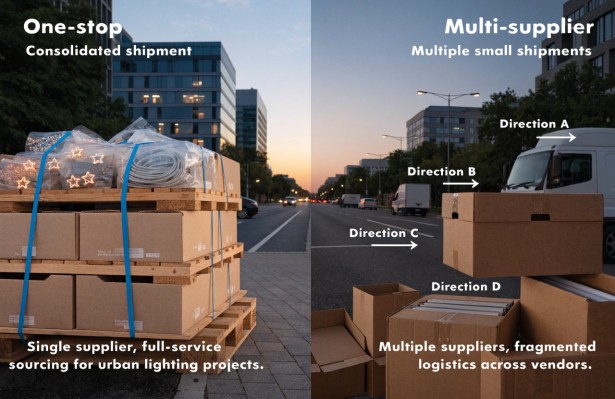
Most sourcing guides offer a generic pros-and-cons table and leave buyers exactly where they started. This article takes a different approach. I'll walk through the real variables — product by product, buyer type by buyer type — so you can identify which model fits your specific project conditions.
Does Project Scale Change Which Sourcing Model You Need?
Large projects punish misaligned sourcing structures faster than small ones. When a municipal contractor is deploying Christmas lights across street trees, festival lights on building facades, and motif lights on landmark structures simultaneously, a single delayed shipment or mismatched IP rating batch creates downstream installation failures[^3] that are expensive to fix on-site.
Project scale is the first filter for sourcing model decisions. High-volume, multi-SKU deployments with compressed installation windows — such as a city-wide seasonal lighting activation — require unified spec control and consolidated shipment documentation across all product categories.[^4] Smaller, phased deployments, like a rolling string light refresh for a retail chain, can tolerate more sourcing flexibility without absorbing significant coordination risk.
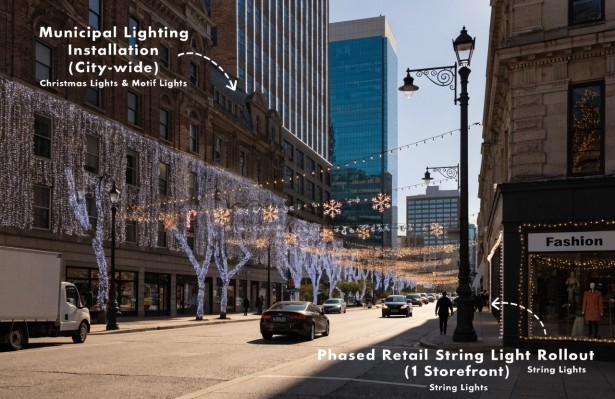
Understanding why scale matters requires looking at what actually breaks down when sourcing isn't matched to project size.
Why Large Deployments Amplify Coordination Risk
In projects we've supported, the most common failure point in large mixed-product sourcing isn't the product quality itself — it's spec divergence between product categories sourced from different suppliers.
Consider a typical urban holiday activation:
- String lights for canopy fill across retail precincts — often sourced by the reel, requiring consistent color temperature (warm white 2700K or 3000K) across hundreds of units
- Christmas lights for municipal tree wraps — typically specified with outdoor IP ratings (IP44 or IP65[^5]) and specific plug standards for the destination market
- Festival lights for facade decoration — often custom-shaped or themed, requiring matched power supply specs across large surface areas
- Motif lights for landmark features — frequently 3D fabricated structures with individual wiring diagrams and installation briefs
Each of these product categories has its own spec sheet, QC criteria, and lead time profile. When they arrive from different suppliers, the following friction points accumulate:
- Color temperature tolerances — Warm white string lights from Supplier A may measure 2850K; warm white Christmas lights from Supplier B may measure 3100K. Both are "within spec" on their individual datasheets. Side by side on-site, the color mismatch is visible and contractually difficult to dispute.
- IP rating inconsistency — Festival lights rated IP65 and motif lights rated IP44 from different suppliers cannot share the same outdoor installation zone without a redesign conversation nobody budgeted for.
- Plug and voltage standards — Export documentation for mixed-SKU shipments to markets like the UAE, Australia, or South Africa requires careful coordination.[^6] When two suppliers each prepare their own documents, certification gaps appear at customs.
- Shipment timing gaps — If string lights arrive on schedule and motif lights are delayed by two weeks, installation crews are either idle or forced to sequence work around missing components.
When Smaller Deployments Allow More Flexibility
A procurement manager sourcing string lights for a national retail chain — rolling out store-by-store across six months — faces a different risk profile. Each store deployment is relatively self-contained. A color temperature variance of 150K between one batch and the next is unlikely to be noticed across geographically separate locations. Lead time flexibility exists because the rollout is phased. In this scenario, splitting string light sourcing between two suppliers to manage supply risk or negotiate better pricing is a reasonable decision.
| Project Type | Scale | Timeline Pressure | Sourcing Model Recommendation |
|---|---|---|---|
| Municipal holiday activation (mixed SKUs) | High | High | One-stop or unified accountability model |
| Retail chain string light rollout | Medium | Low–Medium | Multi-supplier acceptable with clear spec standards |
| Single landmark motif light installation | Low | Medium | Specialist supplier preferred |
| Festival light program — annual recurring | High | High | One-stop with approved vendor list backup |
Does "One-Stop" Actually Mean One Factory?
Buyers sourcing a full project kit often assume a one-stop supplier manufactures every product category under one roof. This assumption creates a false sense of accountability. Understanding what "one-stop" actually means in the LED decoration lighting supply chain changes the questions buyers should be asking.
"One-stop" sourcing means unified commercial accountability — not necessarily unified manufacturing.[^7] Most suppliers offering full project kits for string lights, Christmas lights, festival lights, and motif lights coordinate across partner factories. The critical accountability question is not how many factories are involved, but who owns spec alignment, QC consistency, and unified export documentation across all SKUs.

This distinction matters practically, not just conceptually.
What Buyers Should Actually Verify
When a supplier offers a "one-stop" solution for a mixed deployment — say, string lights, Christmas lights, and motif lights for the same urban project — buyers should verify the following before treating the arrangement as genuinely consolidated:
Spec Alignment Ownership
- Who writes and controls the master spec sheet across all SKUs?
- If the motif light manufacturer uses a different LED bin than the string light line, who catches that before production starts?
- Is there a single QC signoff document that covers all product categories?
Production Visibility
- Which product categories are manufactured in-house vs. co-sourced from partner factories?
- Can the supplier provide factory audit documentation (e.g., ISO 9001, BSCI[^8]) for each production site?
- For motif lights specifically — which are often fabricated at smaller specialty workshops — who holds the wiring and structural QA responsibility?
Shipment Consolidation
- Are all product categories shipped under a single export declaration and commercial invoice?
- Does the supplier manage consolidation logistics, or does the buyer need to coordinate a freight forwarder across multiple origin points?
Warranty and After-Sales Coverage
- If Christmas lights from one partner factory fail and string lights from another partner factory perform well, does the one-stop supplier hold warranty liability for both?
- Is there a single point of contact for warranty claims, or does the buyer end up negotiating with multiple factories independently?
In our experience with RFQ patterns for mixed-SKU municipal programs, buyers who ask these questions early consistently report fewer post-delivery disputes than those who accept "one-stop" as a self-evident guarantee.
Where Do Multi-Supplier Setups Actually Break Down?
Multi-supplier sourcing feels controlled — each supplier is accountable for their specific product category. In practice, the accountability gaps appear at the interfaces between suppliers, not within each supplier's scope. This is where buyers absorb costs they didn't budget for.
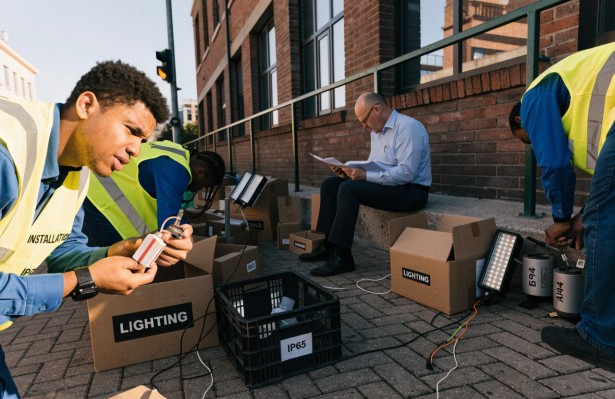
Multi-supplier setups for urban lighting projects create hidden coordination costs[^9] that accumulate at the points where product categories intersect. Spec gaps between festival lights and motif lights from different suppliers, mismatched certification documents for mixed-SKU shipments, and staggered delivery schedules are the three most common cost drivers. These costs are absorbed by installation crews and project managers, not reflected in the original supplier pricing.
The Three Interface Problems
1. Spec Gaps Between Product Categories
Clients sourcing motif lights for municipal contracts have described this scenario to us: the motif light supplier specifies IP65 for the external shell but IP44 for the internal driver housing. The festival light supplier specifies IP65 end-to-end. Both meet the buyer's stated "IP65 requirement." But the installation crew discovers mid-project that the motif light driver housing requires a weatherproof enclosure that wasn't in the installation brief or the budget. Neither supplier is technically at fault. The buyer absorbs the gap.
This pattern repeats with:
- Color rendering index (CRI) differences between string light batches and Christmas light batches installed in adjacent zones
- Connector compatibility between power supplies sourced from different manufacturers for festival lights and motif lights on the same circuit
- Voltage tolerance ranges that are individually within spec but create flicker at the junction point
2. Warranty and Insurance Coverage Gaps
When a project uses Christmas lights from Supplier A and motif lights from Supplier B, a product failure in a shared installation zone creates an immediate dispute: whose product failed, and whose warranty covers the remediation?
In permanent municipal installations, this question intersects with public liability insurance. Some installation contractors require a single-supplier product warranty to maintain their insurance coverage for a public space installation. A multi-supplier arrangement may void that coverage without the buyer realizing it until a claim is filed.
3. Staggered Delivery and Documentation Fragmentation
Mixed-SKU shipments from multiple suppliers rarely consolidate cleanly. String lights may ship FOB from one port; motif lights may require air freight due to structural fragility; festival lights may be held at origin due to a certification document revision. Each delay affects the others because installation sequences are interdependent.
Export documentation fragmentation is equally disruptive. A buyer importing Christmas lights and festival lights into Australia or the UAE under a multi-supplier arrangement must manage separate certificates of conformity, packing lists, and commercial invoices[^10] — each reflecting different product categories. Customs queries against one document set can hold an entire shipment.
How Does the Buyer's Role Shape the Risk Profile?
Not every buyer faces the same consequences when a sourcing model underperforms. The risk profile shifts significantly depending on whether the buyer is a procurement manager for a retail chain, a municipal contractor, or an import distributor. Matching the sourcing model to the buyer's specific risk exposure is more useful than applying a universal framework.
The buyer's role determines which failure mode is most damaging. A procurement manager sourcing Christmas lights for a national retail chain faces brand and inventory risk. A municipal contractor specifying motif lights for a public installation faces public liability and contractual performance risk. An import distributor sourcing festival lights for seasonal wholesale faces margin compression and returns risk. Each risk profile favors a different sourcing structure.

Procurement Managers — Retail and Commercial Chains
Procurement managers sourcing string lights and Christmas lights for national retail deployments typically prioritize:
- Consistent in-store visual presentation across many locations — color temperature variance matters
- Reliable replenishment cycles — the sourcing model must support mid-season reorders without spec drift
- Competitive unit pricing at volume — multi-supplier tension is a legitimate negotiating tool if spec standards are enforced consistently
The primary risk is inventory and brand coherence. A multi-supplier model is viable here if the procurement team has the bandwidth to maintain a master spec document and enforce it across suppliers. If that bandwidth doesn't exist, a one-stop arrangement with a supplier who holds consolidated QC records is the lower-risk option.
Municipal Contractors and Public Works Specifiers
Municipal contractors specifying motif lights for landmark installations and Christmas lights for street tree programs operate under different constraints:
- Public liability exposure[^11] — product failures in public spaces carry regulatory and insurance consequences
- Contractual performance deadlines — city contracts often include penalties for incomplete installation by specific dates[^12] (Christmas lighting must be operational by November 30, not December 15)
- Multi-year maintenance obligations — replacement parts must be available and spec-consistent for 3–5 years post-installation
For this buyer type, a one-stop sourcing model with a supplier who can provide unified warranty documentation, consolidated product certification, and long-term parts availability is strongly preferable — even at a modest price premium over a multi-supplier arrangement.
Import Distributors and Wholesale Buyers
Distributors sourcing festival lights and motif lights for seasonal wholesale face margin pressure combined with high return rate risk. Their sourcing model decision is partly about unit cost and partly about after-sales exposure.
A multi-supplier approach allows distributors to source festival lights at competitive prices from specialized factories. But if motif lights from a second supplier generate disproportionate returns due to connector failures or IP rating failures in the field, the margin gain from the split-sourcing strategy disappears quickly.
Frequently Asked Questions
What should I ask a one-stop supplier to verify they actually control quality across all product categories?
Ask for a single master QC document covering all SKUs in your project — not separate datasheets per product. Request factory audit certificates (ISO 9001 or BSCI) for each production site involved, including partner factories for motif lights and festival lights. Confirm that warranty liability sits with the consolidating supplier, not the individual factories.
Is multi-supplier sourcing always riskier for municipal Christmas light programs?
Not always, but the risk threshold is lower. Municipal programs involve public liability, hard installation deadlines, and multi-year maintenance requirements. These conditions reduce the tolerance for spec gaps and delivery delays that a well-managed multi-supplier setup would otherwise handle. Most municipal contractors we work with prefer unified accountability for exactly this reason.
How do I manage color temperature consistency across string light batches from different suppliers?
Require all suppliers to specify LED bin codes — not just color temperature descriptions — in their product datasheets. Request physical samples from production batches before shipment approval, not just from pre-production samples. Color temperature tolerance should be written into the purchase order as an acceptance criterion, typically ±100K for adjacent installations.
What export documentation should I expect for a mixed-SKU shipment of festival lights and motif lights?
At minimum: a consolidated commercial invoice listing all SKUs, a unified packing list, certificates of conformity relevant to the destination market (CE for Europe, SAA for Australia, SASO for Saudi Arabia), and a single bill of lading or airway bill. If your one-stop supplier cannot provide consolidated documentation, the shipment is not truly consolidated — it is a coordinated multi-supplier arrangement with shared logistics.
When does a phased retail string light rollout justify a multi-supplier approach?
When the rollout is geographically distributed over several months, each deployment is self-contained, and the visual consistency requirement between locations is low. In this scenario, using two approved suppliers with shared spec standards reduces supply concentration risk without creating meaningful coordination costs. Require consistent color temperature and IP rating standards in writing from both suppliers before the first order.

Conclusion
There is no single correct sourcing model for urban lighting projects. The right structure emerges from an honest assessment of project scale, installation timeline, coordination capacity, and buyer risk exposure — not from a generic cost comparison. One-stop sourcing for a multi-SKU municipal Christmas light and motif light deployment provides unified accountability that is genuinely difficult to replicate across multiple suppliers. Multi-supplier sourcing for a phased retail string light program can deliver legitimate supply flexibility when spec standards are enforced. The decision framework is always: who owns accountability when specs, delivery, or quality breaks down? If you cannot answer that question clearly under your current sourcing structure, that is the problem to solve first.
If you are currently evaluating sourcing structure for an upcoming urban or seasonal lighting project — whether that involves string lights, Christmas lights, festival lights, motif lights, or a combination — we are happy to walk through your specific project conditions and be direct about where our capabilities fit and where they don't. Contact our team to start that conversation.
[^1]: "proven delivery models for led public lighting", https://documents1.worldbank.org/curated/en/869131477561325418/pdf/Proven-delivery-models-for-LED-public-lighting-synthesis-of-six-case-studies.pdf. Research on public and urban lighting procurement characterizes lighting projects as multidisciplinary undertakings involving technical, logistical, contractual, and operational coordination; this supports the article's framing of sourcing complexity, although it does not prove that every urban lighting project is equally complex. Evidence role: general_support; source type: research. Supports: Urban or public lighting projects require coordination across technical specifications, procurement processes, delivery schedules, and implementation responsibilities.. Scope note: Contextual support rather than direct evidence about decorative urban lighting sourcing specifically.
[^2]: "Supply chain management in times of crisis: a systematic review", https://pmc.ncbi.nlm.nih.gov/articles/PMC9362030/. Project-management guidance identifies project size, schedule constraints, stakeholder coordination, and organizational capability as major determinants of delivery risk, supporting the use of scale, timeline, and coordination capacity as sourcing-model variables. Evidence role: expert_consensus; source type: institution. Supports: Project scale, schedule constraints, and organizational coordination capacity are recognized factors affecting project risk and procurement structure.. Scope note: The support is drawn from general project-management practice and may not be specific to urban decorative lighting.
[^3]: "How Lead Time in Construction Affects Timelines", https://cmicglobal.com/resources/article/Supply-Chain-Disruptions-and-their-Impacts-for-Construction-Project-Timelines. Construction logistics studies show that delayed material deliveries disrupt downstream installation sequencing, while ingress-protection standards establish that outdoor electrical equipment must be matched to environmental exposure; together, these sources support the claim that shipment delays and IP-rating mismatches can cause installation failures. Evidence role: mechanism; source type: paper. Supports: Installation schedules are vulnerable to delayed materials, and inappropriate ingress-protection ratings can make outdoor electrical products unsuitable for their installation environment.. Scope note: The evidence combines logistics and technical-standard support rather than documenting a single decorative-lighting case.
[^4]: "Construction Manager at Risk (CMAR) Delivery Method", https://www.campbellcountywy.gov/DocumentCenter/View/3238/CMAR-Information. Supply-chain coordination research links multi-item, time-constrained projects to higher interface and documentation risk, and describes centralized specification and logistics control as a mechanism for reducing such failures. Evidence role: mechanism; source type: research. Supports: Complex multi-item deployments are more vulnerable to coordination failures, and centralized specification and documentation control can reduce interface and logistics risks.. Scope note: The evidence is likely to support the coordination mechanism generally, not the exact threshold at which a lighting project requires one-stop sourcing.
[^5]: "IP code", https://en.wikipedia.org/wiki/IP_code. IEC 60529 defines the IP code system, under which IP44 and IP65 denote specified levels of protection against solid-object ingress and water exposure, providing the technical basis for using these ratings in outdoor lighting specifications. Evidence role: definition; source type: institution. Supports: IP44 and IP65 are standardized ingress-protection codes indicating different degrees of protection against solids and water..
[^6]: "United Arab Emirates - Import Requirements and ...", https://www.trade.gov/country-commercial-guides/united-arab-emirates-import-requirements-and-documentation. Government customs and product-compliance guidance for markets such as Australia, the UAE, and South Africa describes import documentation requirements including invoices, packing lists, transport documents, and applicable conformity evidence, supporting the need for coordination in mixed-SKU shipments. Evidence role: general_support; source type: government. Supports: Importing electrical or lighting products generally requires coordinated commercial, packing, transport, and conformity documentation that can vary by destination market.. Scope note: Documentation requirements vary by product classification, shipment route, and importer status.
[^7]: "Outsourcing Corporate Accountability", https://scholarlycommons.law.wlu.edu/cgi/viewcontent.cgi?article=1494&context=wlufac. Supply-chain literature describes lead-firm and integrator models in which production may be distributed across contracted manufacturers while commercial coordination and buyer-facing accountability remain centralized. Evidence role: definition; source type: research. Supports: In supply chains, a lead firm or integrator can coordinate production across multiple manufacturers while serving as the buyer's primary commercial counterparty.. Scope note: The source would define the business model generally rather than verify the practices of any specific lighting supplier.
[^8]: "ISO 9001:2015 - Quality management systems", https://www.iso.org/standard/62085.html. ISO describes ISO 9001 as a quality management system standard, while amfori describes BSCI as a framework for monitoring social performance in global supply chains; these definitions support their use as factory-verification references. Evidence role: definition; source type: institution. Supports: ISO 9001 is a quality management system standard, and BSCI is a supply-chain social compliance auditing framework used for production-site assessment.. Scope note: Certification or participation indicates a management or audit framework, not conclusive proof of product quality for a specific lighting order.
[^9]: "Transaction Cost Economics As a Theory of Supply Chain ...", https://journals.sagepub.com/doi/10.1111/poms.13148. Transaction-cost and supply-chain management research shows that fragmented supplier structures can increase coordination, monitoring, and integration costs beyond quoted purchase prices, supporting the article's reference to hidden coordination costs. Evidence role: expert_consensus; source type: paper. Supports: Managing multiple suppliers can increase coordination, monitoring, integration, and transaction costs that are not captured in unit prices.. Scope note: The evidence supports the economic mechanism generally and may not quantify costs for decorative lighting projects.
[^10]: "Common Export Documents", https://www.trade.gov/common-export-documents. Customs and product-compliance authorities commonly identify commercial invoices, packing lists, and applicable certificates of conformity as documents used to clear imported goods and demonstrate regulatory compliance. Evidence role: definition; source type: government. Supports: Commercial invoices, packing lists, and conformity certificates are recognized import-clearance or compliance documents for cross-border goods, including regulated electrical products where applicable.. Scope note: The exact document set depends on destination country, product classification, and applicable electrical-safety rules.
[^11]: "regulation for the authorization, oversight, and ...", https://energia.pr.gov/wp-content/uploads/sites/7/2026/04/2026-04-02-ENGLISH-DRAFT-REGULATION-ON-MUNICIPAL-PARTICIPATION-IN-PUBLIC-STREET-LIGHTING-04152026.pdf. Public works and electrical-safety guidance treats electrical installations in public spaces as regulated safety assets, supporting the article's statement that product failures in such settings can create public liability exposure. Evidence role: general_support; source type: government. Supports: Public-space electrical installations are subject to safety obligations and can create liability exposure if failures cause injury or property damage.. Scope note: Liability rules vary by jurisdiction and contract terms. [^12]: "Subpart 11.5 - Liquidated Damages", https://www.acquisition.gov/far/subpart-11.5. Government public-works contract guidance commonly provides for fixed completion dates and liquidated damages for delay, supporting the article's claim that municipal lighting contractors may face penalties for incomplete installation by specified dates. Evidence role: general_support; source type: government. Supports: Public works contracts commonly set completion dates and may include liquidated damages or penalties for late performance.. Scope note: The existence and amount of penalties depend on the individual contract and governing law.
Table of Contents
- One-Stop vs Multi-Supplier Sourcing for Urban Lighting Projects — Which Model Actually Works?
- Does Project Scale Change Which Sourcing Model You Need?
- Does "One-Stop" Actually Mean One Factory?
- Where Do Multi-Supplier Setups Actually Break Down?
- How Does the Buyer's Role Shape the Risk Profile?
-
Frequently Asked Questions
- What should I ask a one-stop supplier to verify they actually control quality across all product categories?
- Is multi-supplier sourcing always riskier for municipal Christmas light programs?
- How do I manage color temperature consistency across string light batches from different suppliers?
- What export documentation should I expect for a mixed-SKU shipment of festival lights and motif lights?
- When does a phased retail string light rollout justify a multi-supplier approach?
- Conclusion