 EN
EN

What Are Commercial Grade Christmas Lights?
Buyers searching for commercial grade Christmas lights often hit a wall of vague marketing claims — "heavy duty," "professional quality," "ultra-bright." These phrases sound reassuring but tell you almost nothing about whether the product will survive a real project. The wrong choice leads to field failures, costly replacements, and damaged client relationships.
Commercial grade Christmas lights are lighting products engineered to reduce failure risk across demanding, large-scale, or long-running installations. They differ from consumer lights not in one single parameter but across wire construction, connector reliability, waterproofing, LED consistency, controller stability, and supply chain capability. The right specification depends on where the lights will be installed, how long they will run, who will maintain them, and what happens when one section fails.

That answer is a starting point, not the whole picture. Understanding why each of those factors matters — and how they apply to your specific project type — is what separates a confident procurement decision from an expensive mistake. Let me walk through the real framework buyers should use.
Are Commercial Grade Christmas Lights Just Brighter or More Expensive?
Many buyers walk into their first commercial project with a consumer mindset. They ask for "the brightest" or "the most expensive" option, assuming that maps to commercial quality. It rarely does.
Commercial grade Christmas lights are defined by use-case fit and risk reduction, not by a price point or a single specification like wattage or LED count. A light designed for a short-term retail display has different requirements than one built for a municipal streetscape running eight hours a night for three consecutive months.
Why the "Better = Brighter" Assumption Fails in the Field
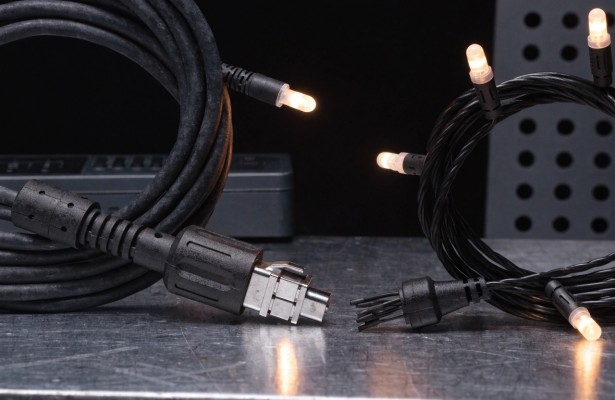
In project discussions, the real concern is almost never brightness alone. It is consistency. A retail chain purchasing 2,000 sets needs every set to look identical on the shelf and in the store. A municipal contractor installing lights across 50 city blocks needs every strand to produce the same color temperature under the same conditions. A subtle variation in LED bin — the manufacturing batch that determines precise color and brightness — can make an entire installation look uneven.[^1]
Brightness also costs energy. Outdoor commercial installations often run on circuits shared with other infrastructure. An overlighting specification can trip breakers, overheat connectors, or violate local electrical codes. Buyers should verify local power and electrical compliance requirements with their supplier and relevant local authority.
The Real Differentiators: A Quick Overview
| Factor | Consumer Grade | Commercial Grade |
|---|---|---|
| Wire gauge | Thin, optimized for cost | Heavier gauge, rated for daisy-chain loads |
| Connector type | Basic push-fit | Locking or weatherproof connectors |
| Waterproofing | IPX2–IPX4 typical | IP44–IP65+ for outdoor/exposed use |
| LED consistency | Mixed bins acceptable | Matched bins for color/brightness uniformity |
| Controller | Basic on/off or simple flash | Stable programmable or sync-capable |
| Replacement parts | Usually unavailable | Spare bulbs, fuses, connectors often supplied |
| Batch uniformity | Variable | Production-controlled for repeat orders |
None of those factors exist in isolation. They interact. A heavy-gauge wire connected to a poorly sealed connector is still a waterproofing failure waiting to happen.
How Does Installation Environment Change the Specification?
This is the question we find most buyers underestimate. The installation environment — indoor, semi-outdoor, fully exposed outdoor, coastal, or high-traffic — determines almost every meaningful specification in a commercial Christmas light product.
The same product that performs reliably in a covered shopping mall atrium will fail within weeks on an exposed coastal promenade. A light suitable for a three-week retail pop-up may not survive a three-month municipal display. Matching the product to the environment is the foundation of commercial grade procurement.
Breaking Down the Key Environments
Indoor commercial (retail stores, hotel lobbies, event venues):
- Waterproofing is lower priority; aesthetics and LED color consistency matter most
- Cable management and connector discretion become important
- Short installation periods mean cycle life is less critical
- Fire safety ratings may apply — buyers should confirm with local fire safety authorities[^2]
Semi-outdoor (covered arcades, canopied streetscapes, sheltered structures):
- Moisture resistance matters even without direct rain exposure — condensation and humidity create slow damage
- IP44 rating is generally a reasonable baseline, but buyers should verify this against their specific local environment and standards
- UV-stabilized cable jacketing extends service life significantly[^3]
Fully exposed outdoor (open streetscapes, parks, building facades):
- This is where commercial grade requirements become non-negotiable
- IP65 or higher is commonly specified; buyers must confirm what applies under their local standards[^4]
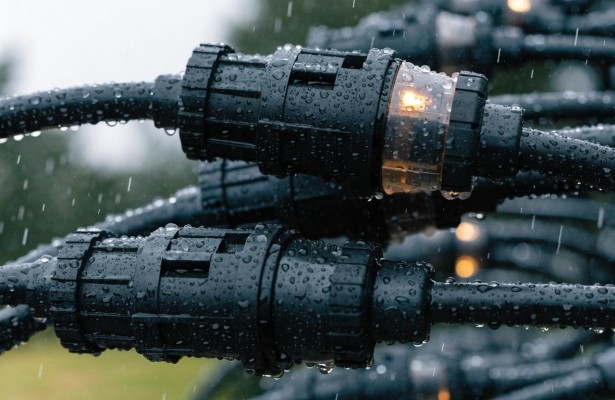
- Wind load on connectors and mounting points creates mechanical stress that consumer-grade products are not designed for[^5]
- Salt air in coastal environments accelerates cable jacket and connector degradation[^6]
Long-run installations (30+ days, multiple seasons):
- LED quality and driver stability determine whether the product looks the same in week twelve as it did in week one
- Thermal management inside the LED module affects lumen depreciation over time[^7]
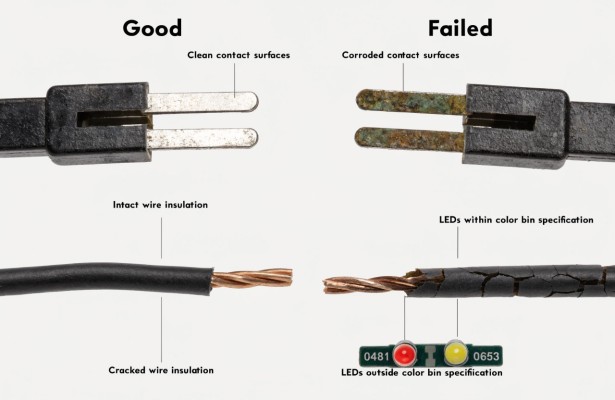
- Connector oxidation is a slow-build failure mode that only appears after extended use[^8]
The Connection Count Question
One of the most common field failures we see described by buyers involves connection overload. Consumer-grade light strings are designed with a maximum daisy-chain count — often three to five sets end-to-end. Commercial projects routinely exceed this without realizing the wire gauge cannot carry the cumulative load.
Commercial grade products are designed with heavier conductors and clearly documented maximum connection runs. Always confirm the rated end-to-end connection capacity with your supplier before designing the installation layout.
What Are the Practical Failure Points That Separate the Two Grades?
Understanding failure modes is more useful than memorizing specifications. When a buyer tells me a product "stopped working after two weeks," the failure usually traces back to one of a predictable set of causes. Each one is addressable through commercial grade design — but only if you know to ask.
Wire Quality and Gauge
Consumer lights use thin wire to minimize material cost. This is fine for a short run at low load. In commercial use, thin wire under sustained load generates heat. Heat accelerates insulation degradation.[^9] Degraded insulation creates shorts. This is not a dramatic failure — it is a slow, invisible one that appears mid-season.
What to check:
- Stated wire gauge (AWG or mm²) and whether it matches the actual product
- Whether the gauge is consistent along the full length of the string, including the lead wire
- Whether the insulation material is PVC or a higher-grade compound with better heat and UV resistance
Connector Reliability
The connector is consistently the weakest point in any light string system. In consumer products, connectors are designed to be assembled once in a controlled retail environment. Commercial installations involve repeated connection and disconnection, sometimes in the rain, sometimes by workers who are not electricians.
From a manufacturing perspective, the difference between a connector that costs marginally more per unit and one that fails mid-installation is significant. Locking connectors, rubber-sealed connection points, and corrosion-resistant contacts are not premium add-ons in commercial grade products — they are baseline requirements.
Waterproof Structure
IP ratings describe a product's protection against ingress of solid particles and water. They are tested under controlled laboratory conditions. Field performance depends on how well the product maintains that rating after mechanical stress, repeated connection cycling, and temperature variation.
A product rated IP65 at the factory may not perform to IP65 after two weeks of installation and daily temperature cycling if the sealant compound degrades quickly.[^10] Ask suppliers how the IP rating is maintained over time, not just at the point of manufacture. Buyers should verify IP ratings against their local applicable standards.
LED Consistency and Binning
LEDs are manufactured in batches. Within each batch, individual LEDs vary slightly in color temperature and luminous flux — this variance is measured and categorized into "bins." Consumer products tolerate wider bin variance. Commercial products, especially for retail chains or synchronized public displays, require tighter binning.
Why this matters in practice:
- A retail chain receiving 500 sets from two different production batches may find visible color differences between sets on the same shelf
- A streetscape display with mixed bins looks patchy under photography, which matters for city branding and event documentation
- Tighter binning increases unit cost slightly but eliminates the much larger cost of returns, complaints, and reinstallation
Controller Stability
Animated or programmable displays require stable controllers. In our experience handling project inquiries, controller failure is the most frustrating failure mode because it disrupts an entire connected segment, not just one point. Consumer-grade controllers are not designed for extended daily run cycles.[^11] Commercial controllers should support stable operation across the full installation season and, ideally, be replaceable in the field without dismantling the wiring.
Does "Commercial Grade" Include the Supplier's Capabilities?
This is the insight that surprises most first-time commercial buyers. The product specification matters, but so does the supplier behind it. For importers, wholesalers, contractors, and retail chains, a supplier who cannot support the commercial relationship is as much a risk as a product that fails in the field.
What Supplier Capability Means in Practice
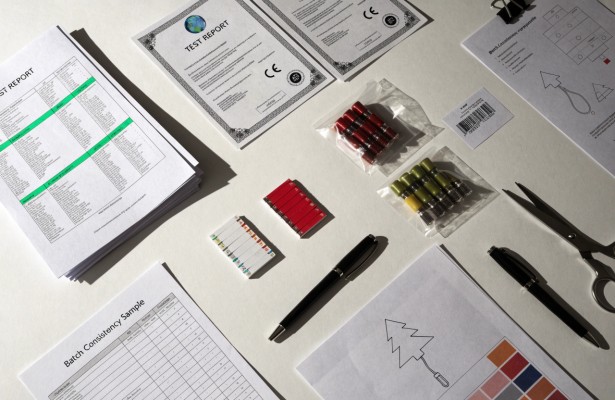
Batch-to-batch consistency: A retail chain placing three separate orders across a season needs identical products each time. This requires documented production controls, not just a sample match. Ask suppliers how they ensure color, brightness, and packaging consistency across repeat production runs.
Documentation support: Commercial buyers — especially importers — need product documentation: test reports, certification documents, safety data, country-of-origin documentation, and customs-relevant specifications. Suppliers who cannot provide organized, accurate documentation create delays and compliance risk at customs or in retail channel approval processes. Any certification claims should be verified directly with the supplier and confirmed against the requirements of your specific market.
Spare parts availability: A large outdoor installation with a failed section mid-season needs replacement components now, not in six to eight weeks on the next container. Ask suppliers whether spare bulbs, connectors, fuses, and replacement controllers are stocked or available on short lead times.
Packaging consistency: For retail resale, packaging is not cosmetic. Shelf presentation, barcode placement, labeling language, and language compliance all affect whether a product can be sold in a given market without rework. Commercial-grade supplier relationships include packaging specification control.
After-sales response: From our experience handling after-sales issues across markets including Europe, Australia, South Africa, and the Middle East, the speed and quality of supplier response to field failures determines whether a buyer relationship survives the first season. This is not something visible in a product sample.
Frequently Asked Questions
What IP rating should commercial outdoor Christmas lights have?
For fully exposed outdoor installations, IP65 is commonly specified as a baseline, as it protects against low-pressure water jets from any direction. However, the appropriate rating depends on your specific installation environment and local standards. Buyers should confirm the applicable requirements with their supplier and local authority before procurement.
How many commercial Christmas light sets can I connect end-to-end?
This depends on the product's rated maximum connection run, which varies by wire gauge, LED load, and controller type. Consumer products are often limited to three to five sets. Commercial products are designed for longer runs, but buyers must confirm the documented maximum with the supplier and design the installation layout accordingly.
How do I verify that a commercial Christmas light product is truly commercial grade?
Request test reports, sample production documentation, and evidence of batch consistency from previous orders. Ask about wire gauge, connector type, IP rating test method, and LED bin tolerance. Evaluate the supplier's ability to provide spare parts and after-sales support. Physical inspection of samples against stated specifications is strongly recommended before large orders.
Do commercial grade Christmas lights require special certifications?
Certification requirements depend on the destination market. CE marking applies in the European Economic Area, SAA applies in Australia, and other markets have their own requirements.[^12] Buyers must verify which certifications are legally required for their market and installation type, and confirm those certifications with their supplier. Do not assume that a product certified for one market meets the requirements of another.
Can commercial grade Christmas lights be customized for a specific project?
Yes. Many commercial applications require custom cable lengths, specific color temperatures, branded packaging, or non-standard connection configurations. Discuss project requirements with your supplier early, as custom production typically requires longer lead times and minimum order quantities. Suppliers with manufacturing capability — rather than pure trading companies — are generally better positioned to accommodate customization.
Conclusion
Commercial grade Christmas lights are not a single product type — they are a category of solutions matched to risk, environment, and operational context. The key takeaways: define your installation environment before specifying products; evaluate wire gauge, connectors, waterproofing, LED consistency, and controller stability as a system; and treat supplier capability as part of the commercial grade standard. As a manufacturer with direct experience across import, wholesale, retail, municipal, and event projects, we consistently find that buyers who ask the right questions early avoid the most costly problems later. If you are evaluating commercial grade Christmas lights for your next project or product line, we welcome the conversation — bring your installation context and let us work through the specification together.

[^1]: "Why is LED binning so important?", https://solais.com/why-is-led-binning-so-important/. LED manufacturers sort individual emitters into bins based on measured chromaticity and luminous flux; studies on color perception in lighting installations indicate that differences exceeding one to two MacAdam ellipses are detectable by the human eye under typical viewing conditions, making bin tolerance a critical specification for visually uniform arrays. Evidence role: mechanism; source type: research. Supports: LED manufacturing produces units with measurable variation in color temperature and luminous flux; binning categorizes these variations, and wider bin tolerances produce perceptible color differences in adjacent fixtures. Scope note: Perceptibility thresholds vary with viewing distance, ambient light, and observer sensitivity; a direct citation to string-light applications specifically may not be available
[^2]: "Deck the Halls with Fire Safety - Fire Prevention Services", https://fireprevention.utexas.edu/fire-safety/deck-halls-fire-safety. Fire safety regulations for commercial occupancies, such as those derived from NFPA 1 (Fire Code) and NFPA 701 (Standard Methods of Fire Tests for Flame Propagation Evidence role: general_support; source type: government. Supports: Commercial building fire codes in multiple jurisdictions impose flame resistance or fire safety requirements on decorative materials and lighting used in public or commercial occupancies.
[^3]: "Modifications of Polymers through the Addition of Ultraviolet ...", https://pmc.ncbi.nlm.nih.gov/articles/PMC8747282/. Polymer degradation studies demonstrate that unprotected PVC cable jackets exposed to UV radiation undergo chain scission leading to embrittlement and cracking; the addition of UV stabilizers such as hindered amine light stabilizers (HALS) or UV absorbers significantly retards this process, extending outdoor service life in accelerated weathering tests. Evidence role: mechanism; source type: research. Supports: Ultraviolet radiation causes photodegradation of PVC and other polymer cable jackets through chain scission and crosslinking; UV stabilizer additives absorb or quench UV energy, slowing this process and extending outdoor service life. Scope note: Quantitative service life extension depends on stabilizer concentration, UV intensity at the installation location, and operating temperature; general polymer literature may not be specific to decorative lighting cable
[^4]: "IP code", https://en.wikipedia.org/wiki/IP_code. Under IEC 60529, the IP65 designation indicates total protection against dust ingress (first digit: 6) and protection against water projected from a nozzle in any direction (second digit: 5), making it a commonly referenced threshold for outdoor luminaires subject to rain and hosing. Evidence role: definition; source type: institution. Supports: IP65 designates complete dust protection and resistance to low-pressure water jets from any direction under IEC 60529, the international standard governing ingress protection ratings. Scope note: IEC 60529 defines laboratory test conditions; the article correctly notes that field performance after mechanical stress and thermal cycling may differ from tested ratings
[^5]: "Wind Load Considerations for Outdoor Lighting", https://www.agcled.com/blog/wind-load-considerations-outdoor-lighting.html. Engineering literature on outdoor luminaire installation recognizes wind-induced dynamic loading as a source of mechanical fatigue in mounting hardware and cable connections; standards for outdoor luminaires such as IEC 60598-2-3 address mechanical strength requirements partly in response to environmental loading conditions including wind. Evidence role: general_support; source type: research. Supports: Outdoor lighting installations are subject to wind-induced mechanical loads that create cyclic stress on mounting points and cable connections, potentially causing fatigue failure in components not designed for repeated mechanical loading. Scope note: Standards for outdoor luminaires may not specifically address low-voltage decorative string lights; the mechanical stress argument is supported by general structural fatigue principles rather than product-specific testing data
[^6]: "5 Signs Salt Air Is Corroding Your Electrical System", https://www.trinityinspectionsllc.com/post/salt-air-corrosion-electrical-system-signs. Research on marine atmospheric corrosion documents that chloride ions in coastal salt spray accelerate oxidation of copper and tin-plated contacts and can degrade plasticizer stability in PVC cable jackets; standardized salt spray tests (e.g., IEC 60068-2-11) are used to evaluate component resistance to these conditions. Evidence role: mechanism; source type: research. Supports: Salt-laden air promotes electrochemical corrosion on metal connector contacts and can accelerate surface degradation of polymer cable jackets through chloride ion interaction. Scope note: Degradation rates depend on specific alloy composition, coating type, and local salt concentration; general corrosion literature may not directly address low-voltage decorative lighting connectors
[^7]: "LED Luminaire Reliability: Impact of Color Shift", https://www.energy.gov/sites/prod/files/2017/04/f34/lsrc_colorshift_apr2017.pdf. The Illuminating Engineering Society's TM-21 standard for projecting long-term lumen maintenance of LED light sources is predicated on the established relationship between LED junction temperature and lumen depreciation rate; laboratory studies confirm that elevated junction temperatures accelerate the degradation of phosphor and encapsulant materials, increasing the rate of lumen loss over time. Evidence role: mechanism; source type: research. Supports: LED lumen output decreases over operating hours at a rate strongly influenced by junction temperature; higher operating temperatures accelerate lumen depreciation, and thermal management design directly controls junction temperature. Scope note: TM-21 projections are derived from controlled laboratory testing; field conditions including ambient temperature variation and duty cycle affect actual depreciation rates
[^8]: "Mechanisms of failure and state analysis of electrical ...", https://www.sciencedirect.com/science/article/pii/S1350630725001682. Electrochemical studies of electrical connector reliability document that oxide layer formation on copper and brass contact surfaces increases contact resistance progressively; in low-voltage applications, even modest resistance increases can cause measurable voltage drop and localized heating, with failure typically manifesting after extended service rather than immediately, particularly in connectors exposed to humidity and temperature cycling. Evidence role: mechanism; source type: research. Supports: Oxidation of metal contact surfaces in electrical connectors increases contact resistance over time, leading to voltage drop, localized heating, and eventual intermittent or complete circuit failure. Scope note: Oxidation rate depends heavily on contact material, plating, contact force, and environmental conditions; general connector reliability literature may not be specific to decorative lighting connector geometries
[^9]: "Wire Gauge Chart and Ampacity | Guide for Electricians", https://www.uti.edu/blog/electrical/wire-gauge-chart-awg-ampacity. Ohm's law and Joule heating principles establish that power dissipated as heat in a conductor equals I²R; electrical codes such as the National Electrical Code (NEC) specify ampacity ratings for conductor gauges partly to limit insulation temperature rise, as sustained overtemperature accelerates polymer insulation degradation. Evidence role: mechanism; source type: government. Supports: Electrical current flowing through a conductor generates heat proportional to the square of the current and the conductor's resistance; undersized conductors operating near or above their rated ampacity accelerate insulation thermal degradation. Scope note: NEC ampacity tables are specific to North American wiring practice; equivalent standards apply in other jurisdictions and may differ in specific values
[^10]: "Cross Comparison Between Thermal Cycling and High ... - PMC", https://pmc.ncbi.nlm.nih.gov/articles/PMC12843911/. IEC 60529 specifies test procedures for ingress protection ratings conducted on new specimens under controlled conditions; the standard explicitly does not address the durability of protection over the product's service life, meaning that sealant degradation, connector cycling, and thermal expansion effects in field installations may reduce effective protection below the rated level over time. Evidence role: general_support; source type: institution. Supports: IEC 60529 IP ratings are assigned based on standardized laboratory tests performed on new products; the standard does not certify long-term maintenance of the rating under field conditions involving thermal cycling, mechanical stress, or aging of sealing materials. Scope note: Direct empirical data on IP rating degradation rates for decorative lighting products specifically is limited in published literature; the limitation of IEC 60529 scope is documented in the standard itself
[^11]: "Purchasing Energy-Efficient Commercial and Industrial ...", https://www.energy.gov/cmei/femp/purchasing-energy-efficient-commercial-and-industrial-led-luminaires. Reliability engineering principles establish that electronic component failure rates increase with operating temperature and cumulative operating hours; consumer-grade controllers are generally designed and tested to seasonal use patterns, and operation at commercial duty cycles—such as eight or more hours per night over multiple months—may exceed the thermal and cycle assumptions embedded in their design. Evidence role: general_support; source type: research. Supports: Electronic controllers designed for consumer use are typically rated for intermittent or seasonal duty cycles; extended continuous operation increases thermal stress on components, reducing mean time between failures relative to controllers designed for commercial duty cycles. Scope note: Published duty cycle specifications for consumer decorative lighting controllers are rarely disclosed by manufacturers, making direct empirical comparison with commercial-grade products difficult to source
[^12]: "CE marking", https://en.wikipedia.org/wiki/CE_marking. The European Union's Low Voltage Directive (2014/35/EU) requires CE marking for electrical equipment operating within specified voltage ranges before it may be placed on the EEA market; in Australia, electrical equipment must comply with applicable Australian Standards and obtain regulatory approval, with Standards Australia (SAA) historically associated with the relevant standards framework. Evidence role: general_support; source type: government. Supports: CE marking is required for electrical products placed on the market in the European Economic Area under directives including the Low Voltage Directive; Australian electrical products require approval under state and territory electrical safety legislation, with SAA being a recognized testing body. Scope note: Regulatory frameworks are subject to revision; buyers should consult current official sources for their specific market and product category rather than relying on general descriptions
Table of Contents
- What Are Commercial Grade Christmas Lights?
- Are Commercial Grade Christmas Lights Just Brighter or More Expensive?
- How Does Installation Environment Change the Specification?
- What Are the Practical Failure Points That Separate the Two Grades?
- Does "Commercial Grade" Include the Supplier's Capabilities?
-
Frequently Asked Questions
- What IP rating should commercial outdoor Christmas lights have?
- How many commercial Christmas light sets can I connect end-to-end?
- How do I verify that a commercial Christmas light product is truly commercial grade?
- Do commercial grade Christmas lights require special certifications?
- Can commercial grade Christmas lights be customized for a specific project?
- Conclusion