 EN
EN
FRP Landscape Lighting: Why Material Choice Beats Design Alone?
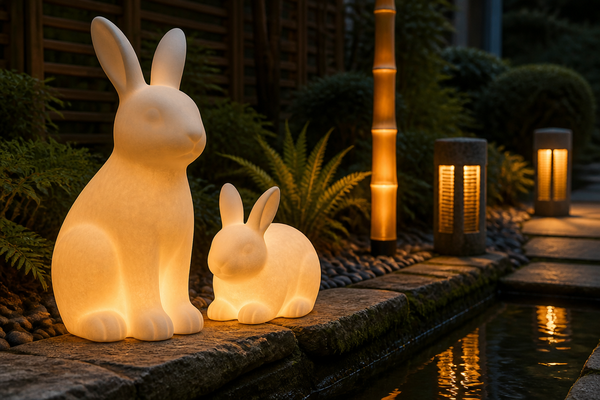
FRP Landscape Lighting often looks like a design purchase, but it is really a durability decision. Buyers see a beautiful shape, a smooth surface, and a good catalog photo. Then UV exposure, salt air, and poor resin formulation turn that good-looking fixture into a complaint.[^1] The solution is to evaluate material structure before appearance.
FRP Landscape Lighting should be selected by resin formulation, glass fiber ratio, surface treatment, and climate suitability before design style. A good shape cannot compensate for weak material. For municipal contractors, importers, and scenic-area projects, the right FRP specification reduces fading, cracking, surface chalking, and replacement risk after installation.
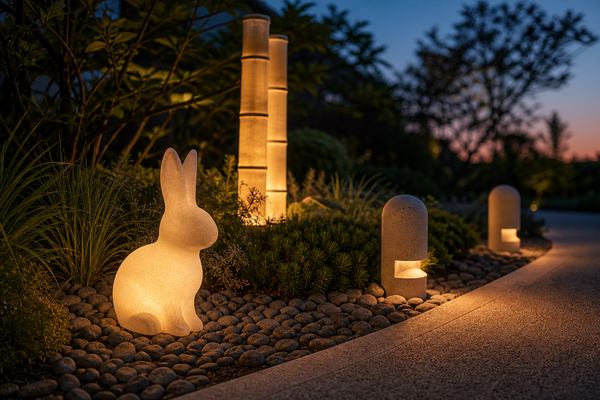
I have had many pre-sales conversations where buyers first ask about shape, color, and price. Those details matter. However, the more important questions are usually hidden inside the material sheet, inspection report, and supplier process. That is where long-term outdoor performance starts.
Why Does FRP Landscape Lighting Fail When the Design Still Looks Good?
A molded fixture can look perfect during approval, but the wrong material system can start failing after installation. Buyers often feel safe because the sample looks solid. The risk is that outdoor degradation begins inside the resin and surface layer long before the design appears damaged.
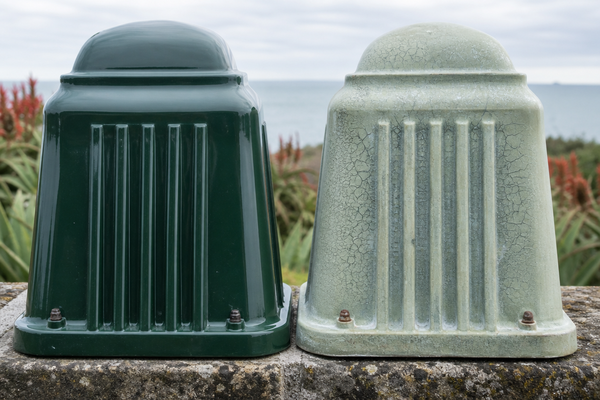
FRP Landscape Lighting fails when resin quality, glass fiber content, gelcoat protection, or curing control does not match the outdoor environment. The design may remain attractive at delivery, but weak material selection can lead to fading, cracking, chalking, water absorption, and structural softening under UV, heat, humidity, or salt fog.
The mistake starts with the word “FRP”
In many procurement discussions, I hear buyers use FRP and ordinary fiberglass as if they mean the same thing. That is where a lot of risk enters the order. The label tells me very little unless I also know:
- Resin type
- Glass fiber ratio
- Fiber distribution
- Gelcoat or surface coating system
- Curing process
- UV resistance expectation
- Outdoor climate target
FRP means fiber-reinforced plastic.[^2] That sounds simple. However, the outdoor performance of a decorative lighting housing depends on the complete composite system, not the name alone.[^3]
A low-cost molded piece can use less fiber, weaker resin, or a thin surface layer. It can still look smooth in a showroom. It can still photograph well for a catalog. It can still pass a quick visual inspection. But once it is installed in a seaside walkway, a desert resort, or a hot public square, the weak points begin to show.
What buyers usually see vs. what actually matters
| What buyers see first | What actually affects lifespan | Procurement action |
|---|---|---|
| Shape and size | Resin formulation | Ask what resin system is used and why it fits the climate |
| Smooth surface | Gelcoat thickness and UV resistance | Request surface treatment details and inspection criteria |
| Low unit price | Fiber ratio and curing quality | Compare material specs, not only FOB price |
| Bright color | Pigment stability and coating system | Ask how color retention is controlled |
| Sample strength by hand | Long-term exposure resistance | Request test parameters or supplier QC records |
I do not suggest that every lower-cost fixture is wrong. Some projects are temporary. Some decorative installations only need one season of use, especially for short-term christmas light displays or event-based festivel light projects. In those cases, a lighter specification can be reasonable.
The problem appears when a buyer sources a fixture for a multi-year municipal or commercial installation but evaluates it like a short-term decorative item. That mismatch creates the failure timeline.
Surface beauty can hide internal shortcuts
FRP decorative fixtures, including animal shapes, floral sculptures, garden lamps, and motif light structures, often depend on hand lay-up or molded composite processing.[^4] The outer layer can be polished, painted, or coated. This makes weak and strong versions look similar before installation.
When I review incoming quality specifications, I look for signs that the buyer has defined performance needs, not only visual requirements. A complete request should answer questions such as:
- Where will the product be installed?
- How many years of outdoor use does the buyer expect?
- Will it face salt fog, high UV, sand, or heavy rain?
- Will visitors touch or climb near the fixture?
- Will the fixture include internal LED modules, wiring, or access panels?
These questions decide the material standard. They also decide the risk level for the supplier and the buyer. A scenic-area contractor may face public complaints if a fixture fades quickly. An importer may face returns from distributors. A municipal contractor may be responsible for replacement labor, not just product cost.
That is why I treat design as the visible result, not the main specification. The real specification is the material system behind the design.
What FRP Landscape Lighting Material Specs Should Buyers Verify Before Ordering?
A buyer cannot verify long-term quality by looking at a photo or touching one sample. The problem is that the most important variables are internal. If the supplier cannot explain them clearly, the buyer may be accepting unknown outdoor risk.
Buyers should verify resin type, glass fiber ratio, gelcoat or coating thickness, UV protection, curing control, wall thickness, water resistance, and inspection records before ordering FRP Landscape Lighting. These details help buyers compare suppliers on durability, not just design and price.
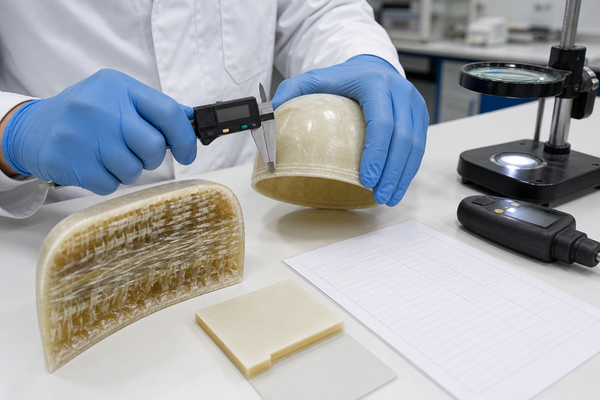
Resin formulation is not a small detail
Resin is the matrix that holds the fiber reinforcement together.[^5] If the resin is not suitable for outdoor exposure, the fixture can lose surface quality and structural stability faster than the buyer expects.[^6] In our experience with clients in the Middle East, Southeast Asia, coastal markets, and Europe, resin questions often separate serious procurement teams from price-only buyers.
A supplier does not need to reveal a proprietary formula. However, the supplier should explain the category and performance logic. For example, buyers can ask:
- What resin type is used for the housing?
- Is the resin selected for outdoor decorative lighting?
- Is the formulation adjusted for high-UV or coastal markets?
- How is curing controlled during production?
- What surface layer protects the resin from direct exposure?
The next step is practical. If the project is in a high-UV region, the buyer should request a higher outdoor-grade system or at least written confirmation that the product is designed for that climate. If the project is near the sea, the buyer should discuss salt fog, fastener materials, wiring protection, and coating integrity.
Fiber ratio affects strength and deformation
Glass fiber gives FRP its reinforcement.[^7] Too little fiber can reduce strength. Poor fiber distribution can create weak points. Too much poorly wetted fiber can also cause quality issues.[^8] So the goal is not simply “more fiber.” The goal is a controlled ratio and consistent lay-up.
In our internal inspection approach, we usually pay attention to the relationship between wall thickness, weight, fiber reinforcement, and product size. A large decorative lamp body needs a different structure than a small garden stake. A tall public-space sculpture needs more attention to fixing points and wind load than a small seasonal display.
Buyers should not ask only, “Is it FRP?” They should ask:
- What is the target wall thickness?
- Where are reinforcement points added?
- How is fiber placed around curves, corners, and mounting points?
- How is product weight controlled between batches?
- What inspection tolerance is used?
These questions force the discussion into production reality.
Surface treatment controls first-visible failure
The first customer complaint is often not structural collapse. It is usually surface change.[^9] The fixture may become dull, chalky, yellowed, faded, or cracked. That is why gelcoat and paint systems matter.
A strong surface system should match the installation environment. For outdoor decorative lighting, I usually focus on:
| Surface factor | Why it matters | Buyer question |
|---|---|---|
| Gelcoat thickness | Helps protect the composite surface | What thickness range is controlled? |
| UV-resistant coating | Reduces fading and chalking | Is the coating specified for outdoor use? |
| Pigment stability | Keeps color consistent | How is color difference checked? |
| Edge sealing | Reduces moisture entry | How are cut edges and holes treated? |
| Repair method | Supports after-sales maintenance | Can the surface be repaired on site? |
Per our inspection reports, surface checks often include visual finish, coating uniformity, edge condition, and color consistency against approved samples. For some orders, buyers request additional environmental checks. I treat those requests as useful, especially when the project has a long warranty expectation.
Documentation should support, not replace, evaluation
Documents are useful, but they are not magic. ISO9001 and BSCI certifications, for example, can show that a factory has management and social compliance systems.[^10] Buyers should verify those documents directly. However, certifications do not automatically prove that one specific FRP outdoor light is suitable for a coastal promenade or desert resort.
For application-specific decisions, I always recommend that buyers involve qualified engineers, lighting consultants, or project technical teams. A supplier can explain material choices and production controls. The project team must still confirm site loads, installation methods, electrical standards, and local regulations.
That balanced approach protects everyone.
How Should FRP Landscape Lighting Be Evaluated for Coastal, Desert, and Humid Climates?
Climate can turn a small material weakness into a major project problem. Buyers in mild regions may underestimate this because they do not see rapid degradation during sample review. But harsh climates do not forgive weak resin, poor sealing, or low-grade surface protection.
FRP Landscape Lighting should be evaluated by matching the material system to the climate zone. Coastal areas require salt and moisture resistance. Desert markets require stronger UV and heat stability. Humid tropical regions require sealing, drainage, and electrical protection.[^11] Buyers should define the environment before confirming the specification.
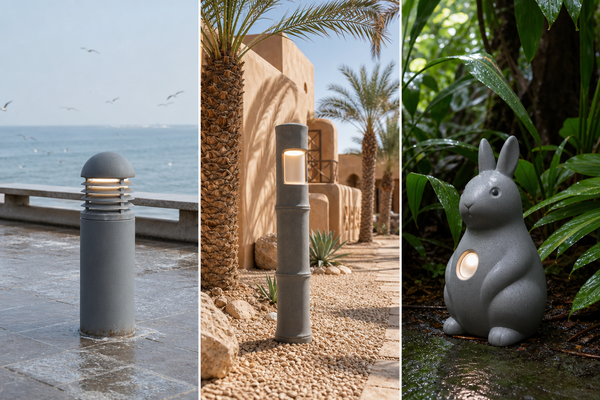
Middle East sunlight changes the conversation
In our experience with clients in the UAE, Saudi Arabia, and other Gulf-region markets, UV intensity is often the first concern. A fixture that performs acceptably in a temperate European garden may not behave the same way in a desert resort or public plaza.
High UV exposure can cause:[^12]
- Surface chalking
- Color fading
- Gelcoat cracking
- Loss of gloss
- Resin embrittlement
- Higher surface temperatures
This is why I ask Middle East buyers about expected installation duration. A one-month festival installation has different requirements than a three-year outdoor landmark. The buyer should not pay for unnecessary performance. However, the buyer also should not buy a seasonal-grade fixture for a permanent public-space project.
Coastal sites add salt fog and moisture stress
Coastal environments create a different risk profile. Salt air can attack metal parts, wiring connections, fasteners, and poorly sealed openings. The FRP body may be resistant, but the complete lighting product is more than the body.
For coastal FRP landscape lighting, I recommend that buyers review:
- Fastener material
- Access door sealing
- Cable entry protection
- LED module waterproofing
- Drainage design
- Surface coating continuity
- Mounting base treatment
A product can have a good FRP shell and still fail because the electrical cavity is not protected. That distinction matters for contractors. The owner will not separate “body quality” from “lighting failure” when a complaint occurs.
Humid tropical markets need drainage thinking
Southeast Asian markets often bring heavy rain, humidity, heat, and biological growth. In these conditions, water management becomes a design and material issue. If water can enter but cannot leave, the fixture becomes a moisture trap.
A buyer should ask:
- Are there drainage points?
- Are internal LED components separated from possible water paths?
- Are seams sealed after assembly?
- Are access panels gasketed?
- Can maintenance teams open and reseal the fixture easily?
These questions are not only technical. They affect service cost. If a municipal contractor needs to send a team repeatedly to fix water-related issues, the original unit price becomes less important.
Climate-zone decision table
| Installation climate | Main risk | Specification priority | Buyer action |
|---|---|---|---|
| Desert / Gulf region | UV, heat, sand | UV-resistant gelcoat, stable pigment, heat-aware LED layout | Request climate-specific material confirmation |
| Coastal promenade | Salt fog, moisture, corrosion | Sealing, stainless or treated fasteners, protected wiring | Review full assembly, not only FRP shell |
| Tropical garden / theme park | Rain, humidity, mold | Drainage, waterproofing, maintainable access | Ask for water path and maintenance details |
| Temperate city center | Seasonal weather, public contact | Balanced durability, impact resistance, repairability | Define warranty and inspection standards |
| Temporary festival site | Short service life, fast install | Cost control, safe wiring, acceptable finish | Avoid over-specifying if use is short-term |
A buyer should define “outdoor” more precisely
The word “outdoor” is too broad. Outdoor in Germany is not the same as outdoor in Dubai. Outdoor in a coastal city is not the same as outdoor in an inland shopping street. This is why I prefer procurement documents that describe the site clearly.
A better specification says:
“The fixture will be installed outdoors, 500 meters from the coastline, exposed to direct sun and seasonal rain, with an expected service period of three years.”
That sentence helps a supplier propose a more suitable material system. It also helps both sides avoid vague claims. If the supplier cannot explain how the product fits that environment, the buyer should slow down before placing the order.
This is especially important for decorative categories that cross between lighting and public art. A christmas light display, a festivel light installation, and a motif light sculpture may all use FRP housings, but the service expectation can be completely different. Procurement should reflect that difference.
When Does Cheaper FRP Landscape Lighting Become a Procurement Risk?
A low unit price is attractive, especially when a project includes many fixtures. The problem is that outdoor decorative lighting has visible failure. When the fixture fades, cracks, leaks, or loses shape, the buyer cannot hide the issue inside a warehouse.
Cheaper FRP Landscape Lighting becomes a procurement risk when the lower price comes from weaker resin, reduced fiber reinforcement, thin surface coating, poor sealing, or unclear quality control. The real cost includes replacement labor, owner disputes, return handling, lost reputation, and delayed project acceptance.
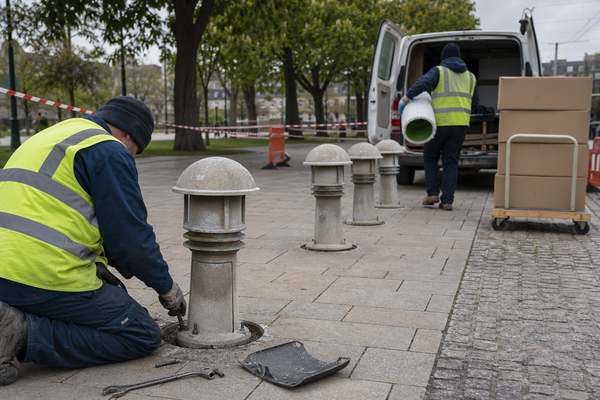
Unit price is only one line in the cost table
Importers and contractors often compare suppliers by FOB price. I understand why. Price affects margins. It also decides whether a bid is competitive. However, for installed lighting products, the cost after delivery can be much larger than the price difference at purchase.
A cheaper fixture may create costs such as:
- Replacement product cost
- International freight for claims
- Site labor for removal and reinstallation
- Project delay penalties
- Owner dissatisfaction
- Distributor return handling
- Reputation loss in a market
- Extra inspection on future orders
For municipal or scenic-area contractors, labor and public complaints can be more painful than the fixture cost. For importers, repeated replacement cycles reduce trust with downstream dealers. The buyer may save 8% on the purchase order and lose much more during after-sales handling.
The “same design” is not the same product
This is one of the most common misunderstandings I see. A buyer sends a photo and asks several suppliers to quote the same FRP decorative light. The quotes look comparable because the design looks comparable. But the material behind each quote may be different.
Two suppliers can quote the same shape with different choices:
| Cost area | Higher-durability choice | Lower-cost choice | Possible consequence |
|---|---|---|---|
| Resin | Outdoor-suitable formulation | Cost-cut general resin | Faster chalking or brittleness |
| Fiber | Controlled reinforcement | Reduced or uneven fiber | Weak corners or deformation |
| Surface | UV-resistant gelcoat/coating | Thin coating or basic paint | Fading and cracking |
| Sealing | Treated seams and entries | Minimal sealing | Water ingress |
| Hardware | Better corrosion resistance | Basic metal parts | Rust and staining |
| QC | Batch inspection records | Visual check only | Inconsistent shipments |
The buyer should use this table during supplier comparison. If one quote is much lower, the buyer should ask which cost area changed. A good supplier should be able to answer without becoming defensive.
Claims exposure changes the sourcing decision
For a retail seasonal product, the buyer may accept a shorter service life if the price and use case match. For a city plaza, resort entrance, amusement park, or scenic trail, the exposure is different. The fixture becomes part of the public environment.
If it degrades quickly, the question is not only “Who pays for replacement?” The bigger questions are:
- Who handles the owner complaint?
- Who sends workers to the site?
- Who pays for access equipment?
- Who explains the failure to the end client?
- Who protects the importer’s reputation?
These questions should be asked before the order, not after the first complaint.
A practical supplier evaluation checklist
When I help buyers compare FRP decorative lighting suppliers, I suggest a simple framework:
1. Ask for material clarity
- What resin system is used?
- What surface protection is applied?
- What wall thickness range is controlled?
- What reinforcement is used at mounting points?
2. Ask for climate fit
- Has the product been specified for high UV, coastal, or humid areas?
- What changes are recommended for harsh environments?
- What components besides FRP need upgrading?
3. Ask for inspection evidence
- Can the supplier provide inspection reports for dimensions, surface, wiring, and assembly?
- Are photos taken during production?
- Are batch samples retained?
- Are incoming materials checked?
4. Ask for realistic warranty language
- What does the warranty cover?
- What conditions are excluded?
- What maintenance is expected?
- What installation mistakes can void support?
5. Ask for compliance documents
- Can ISO9001, BSCI, or other documents be verified?
- Do electrical components meet the target market requirements?
- Are certificates product-specific or factory-system documents?
This checklist does not guarantee a perfect purchase. No checklist can. But it changes the conversation from “Who is cheapest?” to “Who understands the risk?” That shift usually improves the buying decision.
Frequently Asked Questions
Is FRP the same as fiberglass in landscape lighting?
FRP and fiberglass are often used interchangeably in sales conversations, but buyers should not treat them as identical specifications. Outdoor performance depends on resin type, fiber ratio, surface treatment, curing, and sealing. The name alone does not confirm durability.
How long should FRP Landscape Lighting last outdoors?
Service life depends on climate, material formulation, surface protection, installation quality, and maintenance. A seasonal decorative fixture may only need short-term use, while a municipal installation may require several years. Buyers should define the expected service period before requesting a quotation.
What should I ask suppliers before buying FRP decorative lights?
You should ask about resin type, glass fiber reinforcement, gelcoat or coating system, wall thickness, sealing, fasteners, wiring protection, inspection records, and climate suitability. You should also ask whether the supplier can adjust specifications for coastal, desert, or humid environments.
Is FRP suitable for motif light and holiday decoration projects?
FRP can be suitable for motif light structures, christmas light displays, and outdoor holiday decorations when the specification matches the service life and climate. Temporary projects may use a different standard than permanent scenic-area installations. Buyers should align material cost with expected exposure.
Do certifications prove that an FRP lighting product is durable?
Certifications can support supplier evaluation, but buyers should verify what each document covers. ISO9001 and BSCI relate to management and compliance systems, not automatically to one product’s outdoor lifespan. Product-specific inspection records and climate-fit specifications are still important.
Conclusion
FRP Landscape Lighting should never be judged by design alone. The real buying decision sits inside resin formulation, glass fiber ratio, surface protection, sealing, and climate compatibility. A beautiful fixture with weak material can become a future claim. A well-specified fixture can protect the contractor, importer, and end client. If you are sourcing outdoor decorative lighting for a municipal, scenic-area, retail, or festival project, I recommend reviewing the material specification before confirming the design. Contact us with your target climate, service life, and fixture concept, and we can help you evaluate a fit-for-purpose FRP solution.
[^1]: "Effects of UV radiation on natural and synthetic materials - PMC", https://pmc.ncbi.nlm.nih.gov/articles/PMC10088630/. A materials-science review of fiber-reinforced polymer weathering describes ultraviolet radiation, moisture, and saline exposure as environmental stressors that can accelerate resin degradation, surface deterioration, and loss of composite performance. Evidence role: mechanism; source type: paper. Supports: A source should support that UV radiation, salt-laden moisture, and resin formulation affect the durability and surface condition of fiber-reinforced polymer composites outdoors.. Scope note: Such evidence supports the degradation mechanism for FRP composites generally, not the failure rate of this specific lighting product category.
[^2]: "Fibre-reinforced plastic", https://en.wikipedia.org/wiki/Fibre-reinforced_plastic. A standard reference defines fiber-reinforced plastic as a composite material consisting of a polymer matrix reinforced with fibers, commonly abbreviated as FRP. Evidence role: definition; source type: encyclopedia. Supports: A source should define FRP as fiber-reinforced plastic or fiber-reinforced polymer composite..
[^3]: "Fiber-Reinforced Polymer Composites: Manufacturing, Properties ... - PMC", https://pmc.ncbi.nlm.nih.gov/articles/PMC6835861/. Educational materials on composite engineering explain that fiber-reinforced polymer properties depend on the combined behavior of the matrix, reinforcement, fiber fraction, interface, and manufacturing quality rather than on the generic material label alone. Evidence role: general_support; source type: education. Supports: A source should explain that composite properties are governed by the polymer matrix, fiber reinforcement, fiber content, interface, and manufacturing process.. Scope note: The source would establish the general composite-material principle, not a product-specific specification for landscape lighting.
[^4]: "Composite layup process", https://www.dofrp.com/hand-lay-frp-process/. Composite-manufacturing references identify hand lay-up and molding as conventional methods for producing fiber-reinforced polymer components with shaped surfaces and variable wall geometries. Evidence role: general_support; source type: education. Supports: A source should describe hand lay-up and molding as established manufacturing processes for fiber-reinforced polymer composite parts.. Scope note: This supports the manufacturing plausibility for FRP parts generally, not the frequency of these methods in the decorative-lighting sector specifically.
[^5]: "Fiber-Reinforced Polymer Composites: Manufacturing ... - PMC", https://pmc.ncbi.nlm.nih.gov/articles/PMC6835861/. Composite-materials references describe the polymer resin as the matrix phase that surrounds the reinforcement, holds fibers in position, protects them, and transfers load between fibers. Evidence role: definition; source type: education. Supports: A source should support that polymer resin forms the matrix phase in FRP composites and binds or transfers load among reinforcing fibers..
[^6]: "Deterioration of Basic Properties of the Materials in FRP ...", https://pmc.ncbi.nlm.nih.gov/articles/PMC6418672/. Studies of polymer-matrix composite weathering report that matrix chemistry affects resistance to ultraviolet exposure, moisture uptake, surface degradation, and retention of mechanical properties during outdoor service. Evidence role: mechanism; source type: paper. Supports: A source should support that the polymer matrix in FRP is vulnerable to weathering and that resin chemistry influences UV, moisture, and mechanical degradation.. Scope note: This supports the material mechanism generally; it does not quantify the expected service life of a particular lighting fixture.
[^7]: "Fibre-reinforced plastic", https://en.wikipedia.org/wiki/Fibre-reinforced_plastic. Reference sources describe glass-fiber-reinforced plastic as a composite material in which glass fibers serve as the reinforcing phase within a polymer matrix. Evidence role: definition; source type: encyclopedia. Supports: A source should define glass-fiber-reinforced plastic as a composite in which glass fibers reinforce a polymer matrix..
[^8]: "Effects of Fiber Volume Fraction and Length on the Mechanical ... - PMC", https://pmc.ncbi.nlm.nih.gov/articles/PMC9370809/. Composite-engineering studies show that mechanical properties are influenced by fiber volume fraction and fiber distribution, while inadequate resin impregnation and void formation can reduce strength and create local defects. Evidence role: mechanism; source type: paper. Supports: A source should support that fiber volume fraction, fiber distribution, resin impregnation, and voids influence composite strength and quality.. Scope note: The evidence would support general FRP manufacturing behavior, not the exact inspection thresholds for decorative lighting housings.
[^9]: "Metal Roof Color Chalking & Fading: What it is & How to Prevent it", https://sheffieldmetals.com/learning-center/metal-roof-color-chalking-fading/. Research on weathering of polymer composites and gelcoat surfaces identifies gloss loss, chalking, discoloration, and surface cracking as common visible effects of environmental exposure. Evidence role: mechanism; source type: paper. Supports: A source should support that weathering of polymer composites and gelcoats commonly produces visible surface changes such as gloss loss, chalking, yellowing, and cracking.. Scope note: This supports the occurrence of surface degradation but not the claim that customer complaints most often begin with surface change.
[^10]: "ISO 9000 family", https://en.wikipedia.org/wiki/ISO_9000_family. Institutional descriptions characterize ISO 9001 as a quality-management-system standard and amfori BSCI as a framework for monitoring social compliance in supply chains, rather than as direct proof of a specific product’s outdoor durability. Evidence role: definition; source type: institution. Supports: A source should support that ISO 9001 is a quality-management-system standard and BSCI is a social-compliance initiative..
[^11]: "Top Materials for UV Resistance in Outdoor Electrical Enclosures", https://terrapin-industrial.com/feeds/blog/enclosure-materials-uv-resistance-outdoor-electrical-projects. Government or standards-based guidance on outdoor environmental exposure distinguishes coastal salt corrosion, solar ultraviolet and heat exposure, and moisture ingress as separate design considerations for outdoor materials and electrical assemblies. Evidence role: general_support; source type: government. Supports: A source should support that salt-laden coastal environments, high-UV/high-heat desert environments, and humid rainy environments impose different material, corrosion, sealing, and electrical-protection requirements.. Scope note: Such guidance would support the environmental-risk categories generally, not a complete specification for FRP landscape lighting.
[^12]: "Effects of UV radiation on natural and synthetic materials - PMC", https://pmc.ncbi.nlm.nih.gov/articles/PMC10088630/. Polymer-weathering research reports that ultraviolet radiation can initiate photochemical degradation in polymer matrices and coatings, producing chalking, color change, gloss loss, surface cracking, and embrittlement. Evidence role: mechanism; source type: paper. Supports: A source should support that ultraviolet radiation can degrade polymer and gelcoat surfaces, causing chalking, discoloration, cracking, gloss loss, and embrittlement.. Scope note: The source would substantiate the UV-degradation mechanisms but may not address surface-temperature rise for specific fixture geometries.
Table of Contents
- FRP Landscape Lighting: Why Material Choice Beats Design Alone?
- Why Does FRP Landscape Lighting Fail When the Design Still Looks Good?
- What FRP Landscape Lighting Material Specs Should Buyers Verify Before Ordering?
- How Should FRP Landscape Lighting Be Evaluated for Coastal, Desert, and Humid Climates?
- When Does Cheaper FRP Landscape Lighting Become a Procurement Risk?
-
Frequently Asked Questions
- Is FRP the same as fiberglass in landscape lighting?
- How long should FRP Landscape Lighting last outdoors?
- What should I ask suppliers before buying FRP decorative lights?
- Is FRP suitable for motif light and holiday decoration projects?
- Do certifications prove that an FRP lighting product is durable?
- Conclusion