 EN
EN

Voltage Drop and Power Injection in Long LED String Light Runs: What Should Buyers Check?
Voltage drop and power injection become serious purchasing risks when a long LED string light run looks simple on paper but fails after installation. The problem starts with dim ends, flicker, or uneven color. It becomes worse when customers blame the product. The solution is to evaluate voltage, load, wiring path, and connection structure before ordering.
Voltage drop and power injection should be checked before buying long low-voltage LED string lights because length alone does not determine performance. Buyers should confirm operating voltage, total wattage, LED quantity, wire gauge, connector type, cable path, distance from the power source, and whether the product supports safe power injection.
Many buyers ask me, “How many meters can this string light run?” I understand the question, but I usually answer with more questions. A long run is not only a product length issue. It is also a system planning issue that affects purchasing, installation time, and after-sales risk.
Why Does Voltage Drop and Power Injection Matter in Long LED String Light Runs?
A long LED string light run can look correct in a catalog and still perform poorly on site. The buyer expects even brightness from beginning to end. The installer expects easy connection. The end user expects a clean christmas light or festivel light display. Voltage drop breaks those expectations.
Voltage drop and power injection matter because electrical resistance increases along wires, connectors, and long cable paths. As current travels farther, the far end may receive less voltage.[^1] Power injection helps by feeding power at planned points, but it must match the product design, polarity, controller structure, and safety requirements.
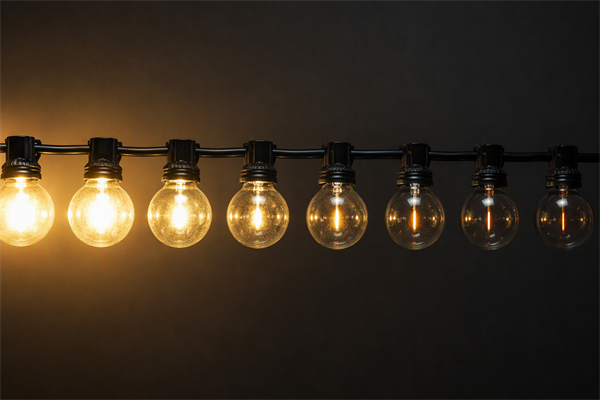
Voltage drop is visible, not only theoretical
In presales discussions, I often see buyers treat voltage drop as a small technical detail. In real purchasing work, it is more practical than that. It can decide whether a project is profitable or painful.
When voltage drop appears, the symptoms are usually easy to see:
- The far end becomes dimmer than the start of the run.
- The color looks inconsistent, especially on warm white, RGB, or low-voltage decorative products.
- The LEDs may flicker, especially when the load is high or the connection is weak.
- The controller may behave unpredictably in some dimming, flashing, or color-changing systems.
- The installation team may need rework, which increases labor cost and delays opening dates.
For importers and wholesalers, the risk appears after the goods arrive. A customer may say, “The string light is defective,” when the real issue is that the planned run was too long for the voltage, cable gauge, and load. For municipal contractors or event companies, the risk can be even higher. A public display may need to operate every night for several weeks. Uneven brightness can create complaints quickly.
Length alone is not enough
I try not to answer “maximum length” as a single number unless the product specification clearly supports it. A 50-meter run at one voltage and wattage can behave differently from a 50-meter run at another voltage and wattage.
Several factors work together:
| Factor | Why I check it | Buyer risk if ignored |
|---|---|---|
| Operating voltage | Lower voltage usually has higher current for the same power[^2] | More voltage loss over distance |
| Total wattage | More watts means more current | Dim ends, overheating risk in poor designs |
| Wire gauge | Thicker wire has lower resistance | Weak cable may limit the run |
| Connector resistance | Poor or small connectors add loss | Local heat, unstable connection |
| Distance from power supply | Cable before the first LED also matters | Brightness loss before the run starts |
| Product structure | Some strings are sectional, some are not | Wrong injection method may damage product |
| Controller type | RGB or flashing products need signal planning | Generic advice may not apply |
A simple way to think about it
I usually explain it like this:
A longer run is not only “more LEDs.” It is also “more current traveling through more resistance.”
This is why a buyer should not ask only, “How long can this christmas light string be?” A better question is:
“What voltage, wattage, distance, wiring route, and connection structure are we planning for?”
That question creates a better purchasing decision. It also gives the supplier enough information to recommend a suitable product, power supply, cable layout, or custom option.
How Should Buyers Evaluate Voltage Drop and Power Injection Before Ordering?
A buyer can reduce voltage drop and power injection problems by collecting project details before confirming the order. The issue is not solved by guessing the length. The buyer should define the working voltage, full load, cable route, installation distance, connection method, controller requirements, and allowable brightness difference.
I recommend buyers evaluate voltage drop and power injection by confirming six items: voltage, total wattage, run length, feed distance, wire gauge, and connection structure. If any item is unclear, the supplier should not promise reliable performance based only on total meters.
The presales questions I usually ask
When a customer sends me a drawing or a message about a long LED string light project, I usually ask for basic information before discussing power injection. These questions are simple, but they prevent many problems.
-
What is the operating voltage?
Is the product 5V, 12V, 24V, 31V, 36V, or another low-voltage system? -
What is the total wattage?
How many watts per meter, per string, or per decoration unit? -
How many LEDs are in the planned run?
LED quantity affects total load and brightness expectations. -
What is the distance from the power supply to the first LED?
Buyers often count only the lit length. The lead cable also creates voltage loss. -
What is the farthest distance from the power supply to the last LED?
The far end is where voltage drop is most visible. -
What wire gauge and connector type will be used?
Thin wires and small connectors can limit practical performance. -
Will the product be static, dimming, flashing, or color-changing?
A controller changes the power and signal structure. -
Does the product allow segmented feeding or injection?
Not every product is designed for field modification.
Why low-voltage products need more planning
This article mainly focuses on low-voltage LED string light products. Low voltage is widely used for decorative lighting because it can improve user safety when designed and certified properly.[^3] However, low voltage often means higher current for the same wattage.
The basic relationship is:
| Same power load | Voltage | Current trend |
|---|---|---|
| 120W load | 12V | About 10A |
| 120W load | 24V | About 5A |
| 120W load | 36V | About 3.3A |
Higher current creates more voltage loss through wire resistance.[^4] This does not mean 12V is “bad” or 24V is always “best.” It means the purchasing team must match voltage to run length, product design, power supply layout, and installation conditions.
The purchasing mistake I see most often
In presales discussions, customers often assume a larger power supply is the only fix. I understand why. If a project uses more lights, a bigger power supply sounds logical. However, a larger power supply does not automatically fix voltage drop at the far end.[^5]
A power supply provides available power. It does not remove resistance from long wires. If current still travels through the same thin cable and connectors, the far end can still receive lower voltage.
A better decision process is:
- First, confirm the product load.
- Second, confirm the practical cable path.
- Third, check the voltage drop risk.
- Fourth, decide whether the run should be shorter, thicker wire should be used, or power should be injected at planned points.
- Fifth, verify whether the product supports that method.
This process helps buyers avoid a common trap: ordering one long continuous string light system and trying to solve all problems after the container arrives.
What Is the Right Way to Think About Voltage Drop and Power Injection?
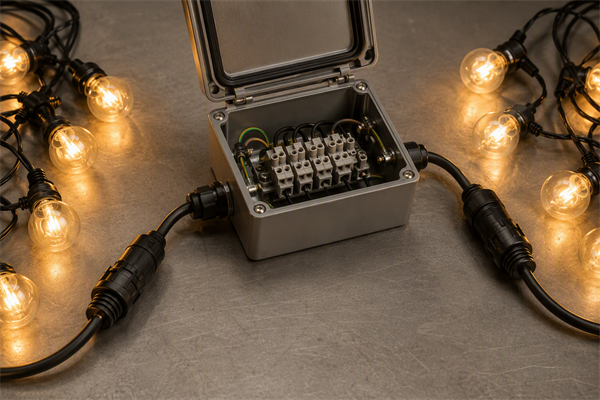
Voltage drop and power injection should not be treated as a shortcut or a field trick. A buyer may think injection means adding another power supply anywhere along the string. That idea is risky. Power injection is a planned feeding method, not a random connection.
The right way to think about voltage drop and power injection is to treat the lighting run as a complete power distribution path. The supplier and buyer should define where power enters, how current flows, where sections begin and end, and whether polarity, controllers, connectors, and protection devices support the design.
Power injection is not just “use a bigger power supply”
I want to be very clear here. Power injection does not simply mean connecting another power supply in parallel. It means feeding voltage to the lighting run at additional planned points so that long-distance current does not need to travel through the entire line.[^6]
Depending on the product, power injection may involve:
- Feeding power at both ends of a low-voltage run.
- Feeding power at intervals along a segmented product.
- Using heavier lead cables to reduce voltage loss before the LEDs.
- Using separate power zones with proper polarity.
- Matching injection points to controller output limits.
- Following the manufacturer’s wiring diagram.
- Adding appropriate protection if required by the design or local rules.
Polarity and compatibility matter
For DC low-voltage LED string lights, polarity usually matters. A wrong positive and negative connection may cause failure, no light, or product damage.[^7] For RGB or addressable products, the situation can become more complex because the system may include power lines, signal lines, controllers, amplifiers, or data direction.
This is why I do not recommend applying generic injection advice to every christmas light or festivel light product. A static two-wire low-voltage string is different from a controller-based color-changing system. A decorative motif light is different from a pixel-controlled installation. A product designed for indoor retail shelves is different from one planned for municipal outdoor decoration.
When injection may help
Power injection may be useful when:
- The product is low voltage.
- The total run is long.
- The far end becomes dimmer in planning calculations or sample checks.
- The supplier confirms that the product structure supports injection.
- The installer can follow polarity and connection requirements.
- The project has a clear wiring diagram before shipment.
Power injection may not be appropriate when:
- The product is mains-voltage and sealed.
- The product certification or construction does not allow field modification.
- The controller has a strict output and signal design.
- The installer does not have qualified electrical knowledge.
- The buyer cannot confirm local safety rules.
A practical comparison for buyers
| Option | How it helps | Main limitation | When I would discuss it |
|---|---|---|---|
| Shorter run sections | Reduces current path length | More connection points | Retail sets, modular displays |
| Higher voltage product | Reduces current for same wattage | Must match market requirements | Long decorative runs |
| Thicker lead cable | Reduces loss before the first LED | Adds cost and weight | Long distance from power supply |
| Planned power injection | Improves voltage at distant points | Needs compatible structure | Large low-voltage installations |
| More power supply capacity only | Prevents overload at supply | Does not fix wire drop alone | When load exceeds supply rating |
Keep mains-voltage products separate
This article is not a universal wiring guide for all lighting. For mains-voltage string lights, sealed plug-in products, dimming systems, flashing systems, and color-changing products, buyers should follow the manufacturer’s specification and qualified electrical advice.
As a supplier, I can help customers clarify product structure and purchasing options. However, application-specific electrical design should be reviewed by qualified professionals, especially for public spaces, outdoor municipal decorations, shopping mall installations, and high-traffic event sites.
Which Product Details Affect Voltage Drop and Power Injection Most?
Voltage drop and power injection decisions depend on product construction more than many buyers expect. Two LED strings with the same length can behave differently because they use different wire sizes, LED spacing, wattage, connectors, rectifiers, controllers, and section designs. A good purchase order should capture these details clearly.
The product details that most affect voltage drop and power injection are voltage, wattage per meter, wire gauge, LED spacing, connector quality, lead cable length, controller output, and whether the string is designed for end-to-end connection or segmented feeding. Buyers should verify these details before confirming mass production.
Wire gauge and cable path
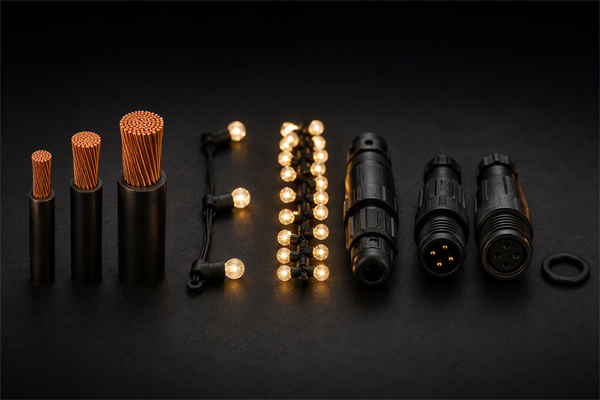
Wire gauge is one of the first details I check. A thicker conductor usually has lower resistance. Lower resistance helps reduce voltage drop.[^8] However, thicker wire also increases cost, weight, and sometimes visual impact. In decorative lighting, appearance matters, so buyers often need a balance.
The cable path also matters. A 20-meter lit section with a 10-meter lead cable may perform differently from the same 20-meter section with a 1.5-meter lead. Buyers sometimes forget that the lead cable is part of the electrical path.
For project quotation, I suggest buyers share:
- Distance from socket or power box to the first LED.
- Distance from first LED to last LED.
- Whether the cable runs in a straight line, tree wrap, façade outline, or roofline.
- Whether multiple strings connect end to end.
- Whether extension cables are required.
- Whether the installation is indoor, outdoor, temporary, or seasonal.
LED spacing and wattage
LED spacing affects total LED quantity. Total LED quantity affects total wattage. Total wattage affects current. Current affects voltage drop. This chain is simple, but it is easy to miss during product selection.
For example, a buyer may compare two 100-meter strings:
| Specification | Option A | Option B |
|---|---|---|
| LED spacing | 10 cm | 5 cm |
| Approx. LED quantity | 1,000 LEDs | 2,000 LEDs |
| Visual effect | Standard density | Higher density |
| Likely load | Lower | Higher |
| Voltage drop risk | Lower | Higher |
Option B may look richer and brighter at the start of the run. However, it may need stronger planning for power supply layout and injection points. The better option depends on the project goal, budget, viewing distance, and installation structure.
Connectors are not only accessories
Connectors can be a weak point in long runs. A connector has electrical resistance. A poor connection can create voltage loss, heat, or intermittent contact.[^9] Outdoor use also adds moisture and corrosion risk if the connector is not suitable for the environment.[^10]
For B2B buyers, I recommend asking about:
- Connector current rating.
- Waterproof rating, if outdoor use is planned.
- Locking method or anti-loosening design.
- Compatibility between batches.
- Availability of spare connectors.
- Whether connectors are molded, screw type, or custom.
Certification documents should be verified
Our company has ISO9001 and BSCI certification, and I always treat these as documents buyers should verify during supplier evaluation. For electrical products, buyers should also check market-specific compliance requirements. The exact documents may vary by destination market, voltage type, product category, and customer channel.
For example, an importer selling to a retail chain may need more structured documentation than a one-time event buyer. A municipal contractor may need installation drawings and product declarations. A professional distributor may need consistent labeling and batch traceability.
A reliable supplier should not only say “yes, we can make it.” The supplier should help clarify what product details affect the long run before production starts.
How Can Buyers Reduce After-Sales Risk From Voltage Drop and Power Injection?
Voltage drop and power injection problems often become after-sales disputes because they appear after installation. The supplier may think the product was misused. The buyer may think the product was defective. The installer may think the specification was unclear. A better presales process reduces this conflict.
Buyers can reduce after-sales risk by confirming the lighting layout, electrical load, power supply position, injection structure, sample expectations, and installation instructions before ordering. Clear drawings, written specifications, and supplier-approved connection methods help prevent dimming, flicker, unsafe wiring, and project delays.

Build the layout before the purchase order
I prefer to see a basic layout before quoting a long string light project. The drawing does not need to be perfect. Even a simple sketch is useful if it shows lengths, power points, and connection direction.
A helpful layout includes:
- Total lit length
- Number of separate strings or sections
- Power supply location
- Lead cable length
- Extension cable length
- Connection direction
- Controller location, if any
- Outdoor or indoor installation condition
- Expected operating hours
- Replacement or maintenance access
This layout helps the supplier judge whether a standard product is enough or a custom structure is safer.
Ask for written connection guidance
For long runs, I suggest that buyers request written connection guidance from the supplier. This is especially important when the product needs power injection, end-to-end linking, or special connectors.
The guidance should answer:
- How many sections may connect together?
- Where can power enter the run?
- Can power feed from both ends?
- Does polarity matter?
- What power supply rating is required?
- Does the controller limit the number of LEDs?
- Are extension cables allowed?
- Can the product be cut or modified?
- What actions void warranty or create safety risk?
A written answer is better than a chat message that says, “It should be fine.”
Use samples carefully
Samples can help, but they must represent the real project. A 5-meter sample does not prove that a 100-meter project will work.[^11] A short sample may show color, wire quality, connector style, and basic brightness. It does not always show long-run voltage behavior.
If a buyer wants to evaluate long-run performance, the sample plan should be closer to the final application. That may include:
- Similar voltage
- Similar wattage per meter
- Similar lead cable length
- Similar connector method
- Similar controller mode
- Similar end-to-end connection count
I avoid presenting sample observation as complete field engineering data. A sample is useful, but a project still needs qualified evaluation when the installation is complex or public-facing.
Separate product responsibility from installation responsibility
This point is sensitive, but it matters. A supplier controls product design, manufacturing quality, labeling, and agreed specifications. An installer controls site wiring, mounting, local electrical compliance, and final connection. A buyer controls procurement decisions, drawings, and project communication.
When voltage drop and power injection are not discussed before ordering, responsibility becomes unclear. That creates frustration for everyone.
A better B2B process includes:
| Responsibility area | Who usually leads | What should be documented |
|---|---|---|
| Product specification | Supplier and buyer | Voltage, wattage, length, wire, connector |
| Installation layout | Buyer, contractor, installer | Cable path, power locations, sections |
| Electrical safety review | Qualified professional | Local compliance, protection, load calculation |
| Production quality control | Supplier | Inspection records, batch consistency |
| After-sales reference | All parties | Approved connection method |
This structure protects the buyer and the supplier. It also helps professional distributors support their customers with clearer information.
Frequently Asked Questions
Does a bigger power supply fix voltage drop in a long LED string light?
A bigger power supply can help if the original supply is overloaded, but it does not automatically fix voltage drop along long wires. The far end may still be dim if current travels through thin cable, weak connectors, or a long path. Buyers should review the whole wiring structure.
How long can a low-voltage christmas light string run without power injection?
There is no universal safe length. The answer depends on voltage, wattage, wire gauge, LED quantity, connector resistance, power supply distance, and product structure.[^12] I recommend asking the supplier for the approved connection method instead of relying on a generic distance rule.
Can I inject power into any LED string light?
No. Power injection must match the product design. Polarity, controller type, section structure, connector rating, and safety requirements all matter. Some sealed, mains-voltage, or controller-based products should not be modified. Buyers should follow manufacturer specifications and qualified electrical advice.
What information should I send a supplier before ordering long string light runs?
You should send operating voltage, required length, LED spacing, wattage, power supply position, lead cable distance, installation layout, controller requirements, and outdoor or indoor conditions. A simple drawing is very helpful. This information allows the supplier to judge whether power injection or custom wiring is needed.
Why does the far end of my festivel light or LED string look dimmer?
The far end may be dimmer because voltage is lost through wire resistance, connectors, and long cable distance. Higher load and lower voltage can make the issue more visible. The solution may involve shorter sections, thicker cable, revised power supply position, or planned power injection if the product supports it.
Conclusion
Voltage drop and power injection should be evaluated before long LED string light runs are ordered, not after installation problems appear. Buyers should look beyond length and confirm voltage, total wattage, wire gauge, connector method, lead distance, controller structure, and product compatibility. I usually start presales discussions with these questions because they reduce complaints, rework, and unclear responsibility. If you are planning a long christmas light, string light, or custom festive lighting project, share your layout with us so we can help you review the purchasing and connection options before production.
[^1]: "Ohm's Law", https://farside.ph.utexas.edu/teaching/316/lectures/node55.html. A university-level circuit-theory source explains that voltage drop across a resistive path follows Ohm’s law, so current flowing through wire and connection resistance can reduce the voltage available downstream; this supports the general mechanism but does not determine the allowable length for any specific LED string. Evidence role: mechanism; source type: education. Supports: A circuit-theory source should support that voltage drop across conductors is related to current and resistance.. Scope note: The support is contextual because it explains the electrical principle, not a tested performance result for the specific product category.
[^2]: "22. Electric Power and Energy", https://openbooks.lib.msu.edu/collegephysics2/chapter/electric-power-and-energy-2/. An introductory physics or electrical-engineering source states that electrical power is the product of voltage and current, implying that, for a fixed power load, reducing voltage requires increased current; this supports the comparison as a circuit principle rather than a product-specific rating. Evidence role: mechanism; source type: education. Supports: A basic electrical engineering or physics source should support that power equals voltage multiplied by current in DC circuits.. Scope note: The source would support the mathematical relationship, not the suitability of any particular LED string voltage.
[^3]: "Extra-low voltage", https://en.wikipedia.org/wiki/Extra-low_voltage. Electrical safety standards describe separated or safety extra-low-voltage systems as a method for limiting electric-shock hazard under specified design conditions, supporting the article’s safety rationale; this does not mean every low-voltage decorative product is automatically safe without certification and correct installation. Evidence role: expert_consensus; source type: institution. Supports: A standards or safety source should support that extra-low-voltage systems are used as a measure to reduce electric shock risk when designed within defined limits.. Scope note: The support is contextual because formal standards define safety conditions but do not evaluate the article’s specific products.
[^4]: "Voltage Drop Test: Key Concepts & How To Do It", https://www.uti.edu/blog/electrical/voltage-drop-test-how-to. Ohm’s law, as presented in standard physics texts, defines the voltage across a resistance as proportional to current, supporting the statement that higher current increases voltage loss in wiring; it does not specify the threshold at which visible LED dimming occurs. Evidence role: mechanism; source type: education. Supports: A source should support that voltage drop across a resistance increases with current.. Scope note: The evidence is a general circuit-law basis, not direct photometric testing of decorative LED strings.
[^5]: "Electrical Power and Power Loss | Eclectic", https://eclectic.trincoll.edu/electrical-power-and-power-loss/. Circuit-analysis references show that load voltage depends on source voltage minus voltage drops in series wiring resistance, supporting the statement that a higher-capacity supply alone may not correct far-end voltage loss; the conclusion assumes the wiring path and load current remain materially unchanged. Evidence role: mechanism; source type: education. Supports: A circuit source should support that voltage at the load is affected by conductor resistance and load current, not only by the nominal capacity of the supply.. Scope note: The source would explain the circuit behavior generally, not diagnose a particular installation.
[^6]: "Electric Ship Design Lecture 2", https://www.aast.edu/pheed/staffadminview/pdf_retreive.php?url=45_6575_ee449_2011_1__2_1_EE%20449%20_lect_02.pdf&stafftype=staffcourses. Educational material on low-voltage DC distribution explains that voltage drop is reduced when current is supplied closer to the load or through shorter/lower-resistance paths, supporting the rationale for planned power injection; it does not validate any specific field-modification method for sealed LED products. Evidence role: mechanism; source type: education. Supports: A power-distribution source should support that feeding a load from additional points can reduce current through long conductor sections and therefore reduce voltage drop.. Scope note: The support is contextual because it addresses distribution principles, not the safety approval of a particular string-light construction.
[^7]: "Interface Control of Light-Emitting Devices Based on ...", http://polymer.chem.cmu.edu/~kmatweb/1999/April%201999/jerome/ar980052h.pdf. Semiconductor-device references describe LEDs as diodes that conduct primarily in the forward direction and may be damaged if reverse-voltage limits are exceeded, supporting the warning that DC LED strings require correct polarity; actual failure mode depends on the product’s internal protection circuit. Evidence role: mechanism; source type: education. Supports: A source should support that LEDs are diodes with polarity-dependent conduction and limited reverse-voltage tolerance.. Scope note: The source supports LED component behavior generally, not every assembled string-light design.
[^8]: "Electrical Tech Note — 227", https://www.maec.msu.edu/application/files/2916/4555/7423/Tech_Note_227_Voltage_Drop.pdf. Standard circuit texts define conductor resistance as proportional to length and inversely proportional to cross-sectional area, supporting the statement that thicker conductors generally reduce resistance and voltage drop; this does not account for connector resistance or installation temperature effects. Evidence role: mechanism; source type: education. Supports: A physics or electrical-engineering source should support that conductor resistance is inversely proportional to cross-sectional area.. Scope note: The support is a general conductor model and may not capture all real-world wiring variables.
[^9]: "Determination of Electrical Contact Resistivity ... - Purdue e-Pubs", https://docs.lib.purdue.edu/cgi/viewcontent.cgi?article=1169&context=coolingpubs. Research on electrical contact resistance shows that imperfect contacts can increase resistance, causing localized voltage drop, Joule heating, and unreliable conduction, supporting the article’s warning about connectors in long runs; the degree of risk depends on connector design, current, environment, and assembly quality. Evidence role: mechanism; source type: paper. Supports: A peer-reviewed or technical paper should support the relationship between contact resistance, voltage drop, localized heating, and connection reliability.. Scope note: The evidence is about connector contact physics generally, not a test of the specific connectors used in the article.
[^10]: "Corroded Contacts | Center for Advanced Life Cycle ...", https://calce.umd.edu/corroded-contacts. Connector-reliability and corrosion research reports that moisture and corrosive environments can degrade metallic contacts and increase contact resistance, supporting the article’s concern about outdoor connector suitability; the source would not determine the waterproof rating required for a particular installation. Evidence role: general_support; source type: research. Supports: A corrosion or connector-reliability source should support that moisture and corrosion can increase contact degradation and affect electrical continuity.. Scope note: The support is contextual because environmental severity and connector construction vary widely.
[^11]: "Voltage Drop Test: Key Concepts & How To Do It", https://www.uti.edu/blog/electrical/voltage-drop-test-how-to. Electrical-resistance theory states that conductor resistance increases with conductor length, which supports the article’s caution that a short sample cannot fully demonstrate the voltage-drop behavior of a much longer installation; it does not prove that every 100-meter project will fail. Evidence role: mechanism; source type: education. Supports: A source should support that conductor resistance increases with length, making long-run behavior different from short-sample behavior.. Scope note: The evidence supports the scaling concern, not a specific sample-testing protocol.
[^12]: "Voltage Drop", https://courses.ems.psu.edu/ae868/book/export/html/967. Electrical-design guidance treats voltage drop as a function of conductor length, conductor properties, and load current, supporting the article’s statement that no universal LED-string length can be specified without system details; the cited guidance may not address proprietary connector limits or product certification constraints. Evidence role: expert_consensus; source type: institution. Supports: An electrical-code, engineering, or standards source should support that voltage drop evaluation depends on load current, conductor resistance, conductor length, and system voltage.. Scope note: The support covers general electrical design variables, while product-specific limits still require manufacturer data.
Table of Contents
- Voltage Drop and Power Injection in Long LED String Light Runs: What Should Buyers Check?
- Why Does Voltage Drop and Power Injection Matter in Long LED String Light Runs?
- How Should Buyers Evaluate Voltage Drop and Power Injection Before Ordering?
- What Is the Right Way to Think About Voltage Drop and Power Injection?
- Which Product Details Affect Voltage Drop and Power Injection Most?
- How Can Buyers Reduce After-Sales Risk From Voltage Drop and Power Injection?
-
Frequently Asked Questions
- Does a bigger power supply fix voltage drop in a long LED string light?
- How long can a low-voltage christmas light string run without power injection?
- Can I inject power into any LED string light?
- What information should I send a supplier before ordering long string light runs?
- Why does the far end of my festivel light or LED string look dimmer?
- Conclusion