 EN
EN


One-Stop vs Multi-Supplier Sourcing for Urban Lighting Projects?
Urban lighting projects can look simple on a quotation sheet, but they become difficult when colors, structures, packaging, certificates, and delivery schedules do not match. If buyers only compare unit prices, they may miss the real risk. A better sourcing strategy helps control the whole project result, not just the purchase order.[^1]
For urban lighting projects, the better sourcing choice depends on who can control visual consistency, delivery coordination, documentation, inspection standards, and accountability. One-stop sourcing can reduce coordination risk for multi-category projects[^2], while multi-supplier sourcing can work well for simple products or buyers with strong internal project management teams[^3].

I discuss this topic often with contractors, importers, event groups, retailers, and professional decorative lighting distributors. The same question appears in different forms: “Can I save more by buying from several factories?” My answer is usually: “Maybe, but first check who will control the final effect.”
What Does One-Stop Sourcing Mean for Urban Lighting Projects?
One-stop sourcing for urban lighting projects can sound vague, and that creates confusion. Some buyers think it means one factory must physically produce every item. That idea can be too narrow. In real procurement, the larger problem is coordination. If nobody manages product matching, the project can become fragmented.
One-stop sourcing means using one integrated partner to coordinate product categories, visual matching, delivery rhythm, packaging, documents, inspection standards, and after-sales communication. It does not always mean every item is made under one roof. It means one responsible party controls the sourcing system for the buyer.[^4]
The practical meaning of “one-stop”
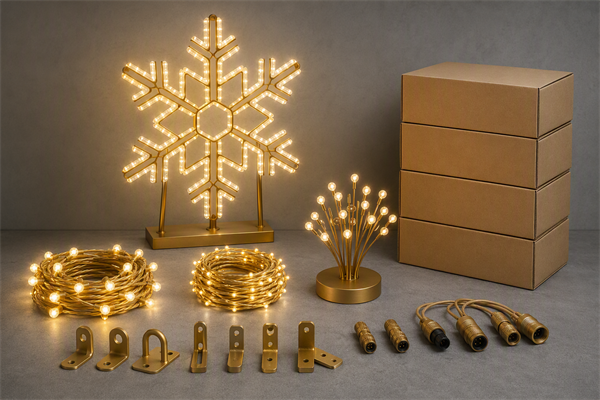
In my work as a China-based integrated manufacturer and trading supplier of festive decorative lighting, I see one-stop sourcing as a management model, not just a factory label. A supplier may manufacture LED string light products directly, produce or assemble christmas light items, and also coordinate matching decorative products from qualified partner factories when the project requires wider category coverage.
That matters because urban lighting projects often include many product types:
- Street crossing decorations
- Pole-mounted motif light designs
- Tree wrapping string light products
- Plaza sculptures or 3D decorative forms
- Building façade light curtains
- Commercial district christmas light displays
- Customized festive patterns for holidays or city events
- Control accessories, spare parts, packaging, and documents
A single production line rarely covers every category perfectly. So the buyer’s real question should not be, “Does this supplier make every screw?” The better question is:
“Can this supplier control the project package so the installed result looks unified and the paperwork stays aligned?”
What an integrated sourcing partner should control
For multi-zone urban lighting projects, I usually suggest buyers evaluate one-stop suppliers across several coordination points.
| Coordination Area | What Buyers Should Check | Why It Matters |
|---|---|---|
| Visual matching | Color temperature, brightness, decorative style, size proportions | The final installation must look like one project |
| Category coverage | String light, motif light, custom shapes, seasonal products | Urban projects often need mixed product types[^5] |
| Packaging | Labeling, carton marks, zone coding, installation grouping | Installers need to find the right items quickly |
| Documentation | Invoices, packing lists, certificates, test documents | Importers and contractors need consistent records |
| Inspection | Sample approval, pre-shipment checks, photo reports | Quality expectations need one standard |
| Delivery rhythm | Batch planning, consolidation, shipment timing | Delays in one category can affect the whole site |
| Communication | One project contact and clear responsibility | Buyers avoid chasing several suppliers separately |
Where one-stop sourcing adds value
One-stop sourcing is especially useful when the project has:
- Multiple product categories
- Several installation zones
- Customized decorative themes
- Strict delivery windows
- Retail or public-facing visual requirements
- Cross-border shipping and document needs
For example, a city square may need warm white tree lights, gold motif light shapes, cool white snowflake decorations, and a large entrance arch. If each item comes from a separate supplier without visual coordination, the final scene may look inconsistent. One product may be brighter. Another may look too blue. Another may use a different wire color or structure finish.
These problems may not appear on a quotation sheet. They appear when the products are installed together.
What one-stop sourcing should not promise
A responsible supplier should not say that one-stop sourcing is always cheaper. It is not always cheaper at the unit-price level. A multi-supplier strategy may produce lower prices for standard items. However, one-stop sourcing may reduce hidden project costs, such as repeated communication, sample remakes, mismatched packaging, document corrections, and responsibility disputes.
For technical decisions, buyers should still verify certifications, check samples, and request qualified professional evaluation for application-specific electrical or installation requirements. ISO9001 and BSCI certificates, for example, are useful management documents, but buyers should verify the certificate scope, validity, and relevance to the product and project.[^6]
When Does Multi-Supplier Sourcing Work for Urban Lighting Projects?
Multi-supplier sourcing for urban lighting projects is not automatically wrong. It becomes risky when the buyer expects several suppliers to act like one project team without giving them a clear coordination system. If the project is simple or the buyer has strong internal control, multiple suppliers can be reasonable.
Multi-supplier sourcing works best when products are standard, categories are limited, visual matching is not complex, and the buyer has an experienced team to manage samples, documents, inspections, packaging, and delivery schedules. It can reduce some unit costs, but it shifts more coordination responsibility to the buyer.

When multiple suppliers can make sense
I have seen buyers use multi-supplier sourcing successfully when they know exactly what they are doing. These buyers usually have mature supplier groups, clear technical standards, and internal staff who can compare product details carefully.
Multi-supplier sourcing can work well for:
- Simple repeat orders
- Standard catalog products
- Single-category purchases
- Projects with low visual complexity
- Buyers with strong inspection teams
- Long-term suppliers already familiar with buyer standards
- Large retail programs where each category is separated clearly
For example, a professional distributor may buy one type of LED string light from a long-term factory, one type of christmas light decoration from another factory, and spare parts from a third supplier. If the distributor already has approved samples, packaging templates, labeling rules, and testing requirements, the risk is controlled.
The key point is this: multi-supplier sourcing requires a strong buyer-side system.
The hidden work behind multi-supplier sourcing
Many buyers compare sourcing options through unit prices. That is understandable. However, in urban lighting projects, a lower unit price can create extra work in other areas[^7].
Here are common hidden tasks:
-
Sample comparison
- Does the warm white color match?
- Does the brightness feel balanced?
- Does the decorative style fit the same theme?
-
Packaging alignment
- Do carton marks follow the same format?
- Are products grouped by installation zone?
- Are spare parts labeled clearly?
-
Document coordination
- Are invoices and packing lists consistent?
- Are product descriptions aligned?
- Are certificates available and valid?
-
Inspection standard control
- Are suppliers using the same AQL or inspection criteria?
- Are photos and reports comparable?
- Are defect definitions clear?
-
Shipment planning
- Can all suppliers finish on time?
- Can goods be consolidated?
- Who handles changes when one batch is late?
A realistic comparison
| Factor | One-Stop Sourcing | Multi-Supplier Sourcing |
|---|---|---|
| Unit price | May be higher for some items | May be lower for standard items |
| Coordination burden | Lower for the buyer | Higher for the buyer |
| Visual consistency | Easier to manage centrally | Requires strict sample control |
| Documentation | More unified | Can vary by supplier |
| Delivery planning | Easier to consolidate | Needs careful tracking |
| Accountability | Clearer if one partner manages the package | Can become divided |
| Best fit | Multi-category, multi-zone projects | Simple or mature repeat purchases |
The buyer’s internal capability matters
Before choosing multi-supplier sourcing for urban lighting projects, buyers should ask themselves:
- Do I have someone to compare sample color and brightness?
- Do I have a standard packaging and labeling system?
- Do I have time to follow up with each supplier every week?
- Can I handle certificate verification and document corrections?
- Can my team manage consolidation or split shipments?
- If the final installation looks inconsistent, who will solve it?
If the buyer can answer these questions confidently, multi-supplier sourcing may be suitable. If not, one-stop sourcing may reduce risk because the supplier takes on more coordination work.
The balanced view
I do not see multi-supplier sourcing as a problem by itself. I see unmanaged multi-supplier sourcing as the problem. For simple festivel light purchasing, standard seasonal retail orders, or mature product lines, several suppliers may give flexibility. But for public streets, plazas, commercial blocks, and event spaces, the cost of inconsistency can be higher than the savings on a few line items.
The sourcing structure should match the project complexity.
How Do Visual Consistency Risks Appear in Urban Lighting Projects?
Visual consistency is one of the biggest risks in urban lighting projects because the final audience sees the full scene, not separate purchase orders. A quotation may look organized, but a street or plaza can look messy if color, brightness, shape, structure, and control effects do not work together.
Visual consistency risks appear when different products use unmatched color temperatures[^8], uneven brightness, different wire colors, inconsistent decorative styles, incompatible control effects, or mismatched structures. These differences may seem small during procurement, but they become obvious after installation in streets, plazas, commercial zones, or event spaces.

Why visual consistency is difficult
Urban lighting projects often combine many lighting elements across large public spaces. A contractor may install tree lights along one road, motif light decorations on lamp poles, curtain lights on buildings, and a large centerpiece in a plaza. Each item may look acceptable alone. The challenge begins when they appear together.
Common consistency issues include:
-
Warm white mismatch
- One product looks golden.
- Another product looks pale yellow.
- Another product looks slightly green or blue.
-
Brightness imbalance
- One zone looks too strong.
- Another zone looks weak.
- Photos and videos look uneven.
-
Style conflict
- Some items look modern.
- Others look traditional.
- The theme loses identity.
-
Structure differences
- Frame thickness varies too much.
- Surface finishing looks inconsistent.
- Mounting accessories do not match site needs.
-
Control effect mismatch
- Flashing speeds differ.
- Dimming curves feel different.
- Animation patterns do not coordinate.
Why samples matter more than catalog photos
Catalog photos are useful, but they can be misleading. Lighting products are affected by camera exposure, background, screen settings, and viewing distance.[^9] For urban lighting projects, buyers should request real samples or at least clear sample videos under similar conditions.
A practical sample review should include:
-
Color temperature comparison
- Place products side by side.
- Check them in dark and semi-lit environments.
- Compare warm white, cool white, RGB, and special colors.
-
Brightness comparison
- Review the perceived brightness, not only wattage.
- Ask whether LEDs, spacing, and lens design are similar.
- Consider viewing distance.
-
Material and finish review
- Compare wire color, frame coating, and decorative surface.
- Check whether day-time appearance is acceptable.
-
Control effect review
- Test flashing modes.
- Check synchronization expectations.
- Confirm whether controllers are compatible or independent.
-
Installation grouping
- Confirm which product belongs to which zone.
- Use clear labels and packing marks.
Example of how risk happens
A buyer may source tree string light items from one factory, pole motif light products from another, and a plaza centerpiece from a third. Each supplier sends a beautiful product photo. Each price looks competitive. Each production schedule looks acceptable.
Then the goods arrive. The tree lights are warm white, but they look soft yellow. The motif lights are warm white, but they look brighter and colder. The centerpiece uses a different golden tone and a different flashing rhythm. None of these issues is a serious defect by itself. However, the full project does not look unified.
That is the kind of problem that creates difficult conversations. The installer may say the products are not consistent. The suppliers may say they made what the buyer ordered. The buyer may struggle to assign responsibility because no single party controlled the full visual scheme.
How buyers can reduce visual risk
Buyers can reduce this risk through a clear approval process.
| Step | Buyer Action | Risk Reduced |
|---|---|---|
| Theme definition | Confirm color, style, and mood before sourcing | Prevents random product selection |
| Sample board | Compare key products together | Reveals visual mismatch early |
| Technical sheet review | Check LED type, spacing, color temperature range | Reduces hidden differences |
| Zone planning | Match each product to streets, plazas, or buildings | Improves installation logic |
| Pre-shipment review | Request photos and videos of production samples | Catches deviations before shipment |
| Packaging by zone | Label products by installation area | Reduces site confusion |
My practical rule
When I discuss urban lighting projects with buyers, I often use one simple rule:
If the products will be seen together, they should be approved together.
This rule applies to string light, christmas light, motif light, festivel light displays, and custom decorative structures. It does not replace professional electrical design or local installation review. However, it helps procurement teams avoid a common commercial mistake: buying separate items without judging the final visual composition.
How Should Buyers Compare Documentation, Inspection, and Accountability in Urban Lighting Projects?
Documentation and inspection can feel boring during urban lighting projects, but they become urgent when goods are ready to ship or when customs, contractors, or retailers request records. If every supplier uses a different format, the buyer may spend valuable time correcting documents instead of preparing installation.
Buyers should compare suppliers by checking whether certificates, packing lists, invoices, inspection standards, carton labels, sample approvals, and after-sales responsibilities are aligned. A lower unit price may not help if documentation is incomplete, inspection criteria are unclear, or nobody accepts responsibility for cross-category problems.

Documentation is part of delivery
For cross-border decorative lighting orders, documentation is not a small administrative detail. It is part of the delivery package.[^10] Importers, retailers, municipal contractors, and event groups may need different documents depending on market, product type, and project requirements.
Common documents may include:
- Commercial invoice
- Packing list
- Product specification sheet
- User instructions or installation notes
- Labeling information
- Certificate copies
- Test reports where applicable
- Inspection records
- Photos or videos before shipment
- Spare parts list
- Warranty or after-sales communication record
I always suggest buyers verify documents early. Certificates should not be treated as decoration in a sales presentation. Buyers should check the issuing body, validity date, product scope, model coverage, and market relevance. For application-specific compliance, buyers should consult qualified testing bodies, local authorities, or professional consultants.
Inspection standards need one language
Inspection problems often happen because different people define quality differently[^11]. One supplier may treat small scratches as acceptable. Another may reject them. One supplier may test lighting effects for a few seconds. Another may run longer aging checks. One supplier may provide detailed photos. Another may only say “finished.”
For urban lighting projects, buyers should define inspection expectations before production.
Useful inspection points include:
-
Appearance
- Frame shape
- Surface finish
- Wire color
- Decorative material condition
-
Lighting effect
- Color consistency
- Brightness
- LED function
- Control mode
-
Structure and accessories
- Mounting points
- Connectors
- Screws or brackets
- Spare parts
-
Packaging
- Inner protection
- Carton strength
- Label accuracy
- Zone grouping
-
Document match
- Quantity
- Model number
- Product name
- Packing details
Accountability is the real sourcing question
The most important sourcing question is not only “Who gives the lowest price?” It is also “Who solves the problem when several categories interact?”
Accountability becomes unclear when:
- One supplier provides the controller.
- Another supplier provides the light product.
- A third supplier provides the decorative frame.
- A fourth party handles packaging or consolidation.
- The buyer receives complaints about the combined effect.
In that case, each supplier may only defend its own part. This is natural. A factory usually takes responsibility for what it produces. But urban lighting projects are judged as complete scenes. The buyer needs someone to manage the connection between parts.
Questions buyers should ask suppliers
Before awarding a project, buyers can ask practical questions like these:
- Will these products look consistent in the same project?
- Can you help compare color temperature across categories?
- Can you provide sample photos or videos with products shown together?
- Can packaging be grouped by street, plaza, building, or installation zone?
- Can carton marks follow one format?
- Can documents use unified product descriptions?
- Can you coordinate inspection standards across all items?
- Who handles communication if one product affects another product’s installation or visual effect?
- Can you support spare parts planning?
- Can you explain what you manufacture directly and what you coordinate through partners?
These questions reveal whether a supplier is only selling items or actually managing the project package.
A simple evaluation table
| Evaluation Question | Strong Answer | Warning Sign |
|---|---|---|
| Product matching | Supplier compares samples across categories | Supplier only sends separate catalogs |
| Packaging | Supplier offers zone-based carton labels | Supplier uses random factory labels |
| Documents | Supplier aligns names, models, and quantities | Documents differ by factory format |
| Inspection | Supplier defines shared inspection points | Each supplier uses its own standard |
| Communication | One project contact coordinates issues | Buyer must chase many contacts |
| Responsibility | Supplier explains accountability boundaries clearly | Supplier gives vague promises |
How I would approach supplier selection
If I were buying for a multi-zone public project, I would not start with the cheapest single line item. I would start with a project map. Then I would divide the project into zones and product categories. After that, I would ask each sourcing option to explain how it would control the whole package.
For one-stop sourcing, I would ask the supplier to show coordination ability. For multi-supplier sourcing, I would check whether my own team could manage the same coordination internally. This approach keeps the decision fair. It also keeps the buyer focused on the final installed result.
Frequently Asked Questions
Is one-stop sourcing always cheaper for urban lighting projects?
No. One-stop sourcing is not always cheaper by unit price. Its value is usually in reducing coordination risk, visual mismatch, document inconsistency, duplicated communication, and unclear responsibility. Buyers should compare total project cost, not only item-by-item quotations.
Can I use multiple suppliers for decorative lighting projects?
Yes. Multiple suppliers can work well for simple products, repeat orders, or buyers with mature internal sourcing teams. The buyer must control samples, packaging, documents, inspection standards, and delivery schedules. Without that control, multi-supplier sourcing can create hidden project risks.
What should I check before buying motif light products for a city project?
You should check size, structure, color temperature, brightness, frame finish, mounting method, packaging, spare parts, certificates, and sample appearance. You should also compare the motif light with other products in the same project, such as tree lights, string light items, and plaza decorations.
Why does visual consistency matter so much in urban lighting projects?
Visual consistency matters because the public sees one complete scene. Different color temperatures, brightness levels, decorative styles, or control effects can make the project look unplanned. Buyers should approve key samples together before mass production to reduce this risk.
How should buyers verify certificates for christmas light or festive lighting products?
Buyers should request certificate copies and check validity, issuing body, product scope, model coverage, and market relevance. For local compliance or application-specific requirements, buyers should consult qualified testing bodies, local authorities, or professional compliance consultants before final approval.
Conclusion
Urban lighting projects should not be decided by a simple “one supplier vs many suppliers” argument. The real decision is about control. Buyers need to know who manages visual consistency, product matching, packaging, documentation, inspection standards, delivery coordination, and accountability. Multi-supplier sourcing can work when the buyer has strong internal control. One-stop sourcing can help when the project is complex and multi-category. If you are planning decorative lighting for streets, plazas, retail zones, or holiday events, I can help you review the sourcing structure and build a more coordinated project package.

[^1]: "Project Procurement | World Bank Group", https://www.worldbank.org/ext/en/what-we-do/project-procurement. Project-management procurement guidance describes procurement decisions as linked to project integration, risk, schedule, and quality management, supporting the view that sourcing affects overall project results rather than only purchase-order pricing. Evidence role: general_support; source type: institution. Supports: Procurement management is treated in project-management guidance as part of broader project delivery, risk, quality, and integration control.. Scope note: This support is contextual and applies to procurement management generally, not specifically to decorative urban lighting.
[^2]: "Risk assessment in supply chains: a state-of-the-art review ... - PMC - NIH", https://pmc.ncbi.nlm.nih.gov/articles/PMC9063627/. Supply-chain research on supplier integration and supply-base management indicates that fewer or better-integrated supplier interfaces can reduce coordination burdens and transaction complexity in multi-component purchasing. Evidence role: general_support; source type: paper. Supports: Research on supplier integration and supply-base coordination links integration or reduced interface complexity with lower coordination burden.. Scope note: The evidence is general supply-chain evidence and does not directly measure urban decorative lighting projects.
[^3]: "Supplier Strategy: The Complete Guide (2025) - Kodiak Hub", https://www.kodiakhub.com/blog/supplier-strategy. Procurement and supply-chain literature characterizes multiple sourcing as a strategy that can improve flexibility and bargaining options while increasing the buyer’s need to coordinate specifications, quality, and supplier performance. Evidence role: general_support; source type: paper. Supports: Multiple sourcing can provide flexibility and price leverage but requires buyer-side coordination and supplier management capability.. Scope note: The source would support the sourcing logic generally rather than proving performance in festive lighting projects.
[^4]: "252.209-7007 Prohibited Financial Interests for Lead ...", https://www.acquisition.gov/node/36409/printable/print. Research on supply-chain integration and system-integrator roles describes arrangements in which one lead party coordinates multiple inputs and supplier interfaces, supporting the article’s definition of one-stop sourcing as a responsibility and coordination model. Evidence role: definition; source type: research. Supports: Integrated procurement arrangements may assign a single party responsibility for coordinating multiple suppliers or components.. Scope note: The terminology may differ across industries, so the source would support the concept rather than this article’s exact commercial label.
[^5]: "Chapter 11 - Street Lighting", https://www.intrans.iastate.edu/wp-content/uploads/sites/15/2020/03/Chapter_11.pdf. Urban lighting design guidance commonly treats streets, pedestrian areas, plazas, buildings, and public landmarks as distinct but coordinated lighting applications, providing context for the article’s claim that urban projects often combine several product types. Evidence role: general_support; source type: institution. Supports: Urban lighting plans and design guidance address multiple public-space lighting applications, such as streets, plazas, façades, and pedestrian areas.. Scope note: Such guidance supports the multi-application nature of urban lighting but may not discuss festive decorative products specifically.
[^6]: "4.3 Determining the Scope of the Quality Management ...", https://www.iso-9001-checklist.co.uk/4.3-how-to-write-your-scope-for-iso-9001-with-7-examples.htm. Certification guidance for management systems emphasizes that certificates must be interpreted by their stated scope, validity, and issuing body, supporting the article’s caution that documents such as ISO 9001 or BSCI records are not automatic product approvals. Evidence role: definition; source type: institution. Supports: ISO 9001 concerns quality management systems, and certification claims should be interpreted according to scope and validity; BSCI-type audits similarly require scope-aware interpretation.. Scope note: The source would clarify certificate interpretation; it would not determine compliance for any particular lighting product.
[^7]: "Subpart 15.4 - Contract Pricing - Acquisition.GOV", https://www.acquisition.gov/far/subpart-15.4. Supplier-selection studies using total-cost approaches show that purchase price alone can understate procurement cost when quality, delivery, inspection, administration, and coordination requirements are considered. Evidence role: mechanism; source type: paper. Supports: Supplier-selection research recognizes non-price costs such as quality, delivery reliability, administration, and coordination.. Scope note: The evidence supports the procurement principle generally and does not provide a lighting-specific cost calculation.
[^8]: "Color temperature - Wikipedia", https://en.wikipedia.org/wiki/Color_temperature. References on correlated color temperature define it as a standard descriptor of a light source’s apparent color, supporting the article’s claim that unmatched color temperatures can create visible differences among lighting products. Evidence role: definition; source type: encyclopedia. Supports: Correlated color temperature is a recognized lighting metric associated with the apparent color of a light source.. Scope note: A definition of correlated color temperature supports the technical basis of the claim but does not by itself establish acceptability thresholds for a given project.
[^9]: "CIECAM02 - Wikipedia", https://en.wikipedia.org/wiki/CIECAM02. Color-science literature explains that perceived and reproduced color depend on viewing conditions, surrounding luminance, capture settings, and display characteristics, supporting the article’s caution that catalog images may not reliably show lighting appearance. Evidence role: mechanism; source type: research. Supports: Color appearance and image reproduction are influenced by illumination, exposure, background, display calibration, and viewing conditions.. Scope note: The evidence explains the visual mechanism generally and does not evaluate the accuracy of any specific catalog photograph.
[^10]: "Common Export Documents", https://www.trade.gov/common-export-documents. Customs and international-trade guidance identifies commercial invoices, packing lists, certificates, and related records as core documents for cross-border movement of goods, supporting the article’s characterization of documentation as part of the delivery package. Evidence role: general_support; source type: government. Supports: Customs and trade authorities identify invoices, packing lists, certificates, and other documents as required or commonly necessary for international shipments.. Scope note: Specific document requirements vary by importing country, product classification, and regulatory regime.
[^11]: "Acceptable Quality Limit, AQL", https://www.qima.com/aql-acceptable-quality-limit. Acceptance-sampling and inspection standards use defined defect classifications, sampling plans, and acceptance criteria, supporting the article’s point that quality judgments can vary unless inspection expectations are specified in a common language. Evidence role: mechanism; source type: institution. Supports: Inspection standards rely on defined sampling plans, acceptance criteria, and defect classifications to make quality judgments consistent.. Scope note: The source supports the need for standardized inspection criteria but does not prescribe the exact criteria for decorative lighting.
Table of Contents
- One-Stop vs Multi-Supplier Sourcing for Urban Lighting Projects?
- What Does One-Stop Sourcing Mean for Urban Lighting Projects?
- When Does Multi-Supplier Sourcing Work for Urban Lighting Projects?
- How Do Visual Consistency Risks Appear in Urban Lighting Projects?
- How Should Buyers Compare Documentation, Inspection, and Accountability in Urban Lighting Projects?
-
Frequently Asked Questions
- Is one-stop sourcing always cheaper for urban lighting projects?
- Can I use multiple suppliers for decorative lighting projects?
- What should I check before buying motif light products for a city project?
- Why does visual consistency matter so much in urban lighting projects?
- How should buyers verify certificates for christmas light or festive lighting products?
- Conclusion