 EN
EN

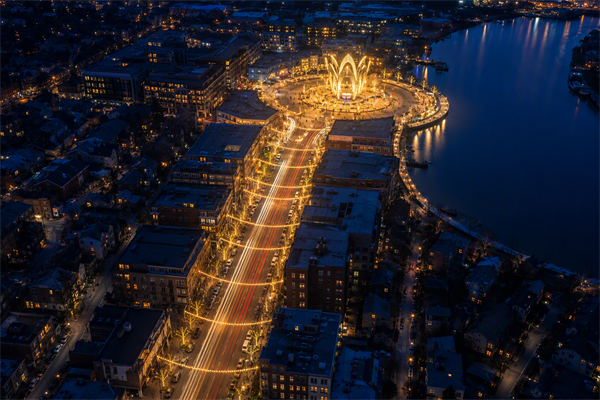
Minimalist Festive Lights: Modern Illumination Aesthetics for Urban Blocks?
Every year, procurement teams and municipal contractors face the same pressure: create a festive atmosphere across an entire urban block without the result looking cluttered, dated, or impossible to maintain. The problem is not a lack of festive lights — it is a lack of a coordinated illumination strategy that makes every product choice feel intentional.
Minimalist festive lights for urban blocks are not defined by fewer decorations or lower brightness. They are defined by deliberate visual order: controlled color temperature, planned zoning[^1], and a product mix — string lights, motif lights, and structural elements — that works together as a system rather than as scattered decorations. When buyers approach festive lighting this way, the result feels both modern and genuinely festive.
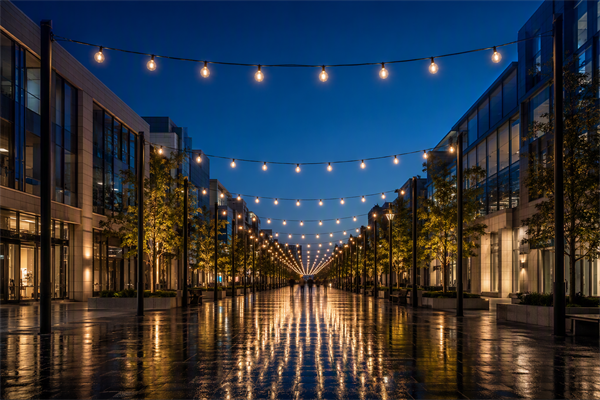
Getting that clarity on a real site — with real installation constraints, reuse expectations, and procurement timelines — requires more than choosing a product style. It requires a planning framework. The sections below break that framework into procurement-relevant decisions you can act on.
What Does "Minimalist" Actually Mean for Urban Festive Lighting?
Most buyers come to us with a clear aesthetic goal but a vague brief. They say they want something "clean" or "modern," but the site needs to feel festive enough to draw people in. The tension is real — and it does not get resolved by buying fewer christmas lights or dimming the output.
Minimalism in urban festive lighting means establishing a clear visual hierarchy across the site[^2]. It means deciding which zones carry the primary impression, which areas provide ambient fill, and where focal highlight points anchor the viewer's eye. Product volume, brightness, and density are outputs of that decision, not inputs.
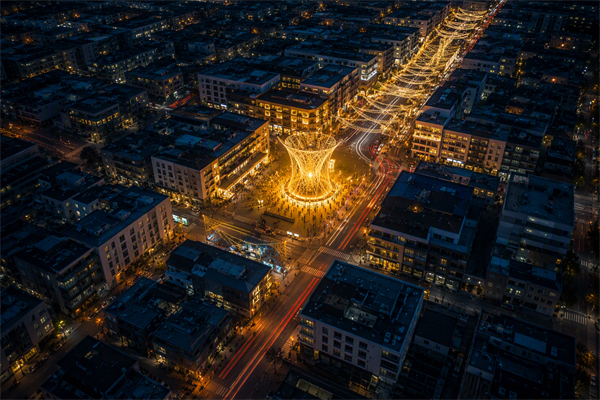
This reframe matters practically because it changes what buyers ask for in a quote. Instead of "I need 500 meters of string lights," the conversation becomes "I have a 200-meter main street, two plaza entrances, and a central focal tree — how do I make these read as one coordinated scheme?"
Why the Aesthetic Label Creates Procurement Problems
In customer inquiries and solution discussions, we often see the word "minimalist" used in ways that create downstream problems:
- Buyers reduce quantity without a plan. They cut product volume to achieve a minimal look, then find the result feels sparse or unfinished rather than refined.
- Buyers choose one product type. They select only string lights, or only motif lights, and find the scheme lacks depth and visual variation across different spatial zones.
- Buyers skip zoning. They treat the whole block as one uniform decoration zone, which produces visual monotony regardless of product quality.
Minimalism as a project decision means making these three choices explicitly before selecting any product:
- Define the visual hierarchy. Which zone is primary (entrance, central plaza, focal tree)? Which zones are secondary (connecting streets, shopfront fill)?
- Set the color temperature and palette. Warm white (2700–3000K) reads as classic festive. Cool white (4000–6000K) reads as contemporary.[^3] Mixed palettes require deliberate control or they look accidental.
- Establish reuse expectations.[^4] A scheme planned for single-season use tolerates different product choices than one expected to run for three to five years with annual reinstallation.
None of these decisions require a lighting designer. They require the buyer to answer three clear questions before the product selection conversation begins.
How Should Urban Blocks Be Planned as Connected Lighting Zones?
A common mistake we see in large-scale festival light projects is treating each zone — street, tree, façade, plaza — as a separate decoration task. Contractors source products independently for each area. The result looks like multiple unrelated events happening on the same block.
Urban blocks produce a coordinated festive impression when all zones are planned as a connected illumination system[^5]. Entrances signal arrival, main streets provide directional rhythm, trees and façades add volume and warmth, and focal points anchor the viewer's experience. Each zone has a distinct product role, but all zones share a common visual language — color temperature, line direction, and motif density.
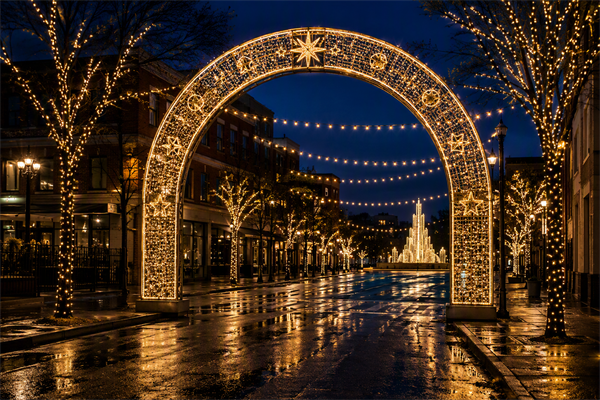
From a product-combination and implementation perspective, the spatial zone framework below is a useful starting point for most urban block briefs.
Zone-by-Zone Product Role Framework
| Zone | Primary Visual Function | Typical Product Role | Key Installation Consideration |
|---|---|---|---|
| Entrances / Gateways | Signal arrival, create first impression | Motif lights, decorative arches, structural frames | Height clearance, wind load, anchor points |
| Main Street Canopy | Directional rhythm, ambient fill | String lights (overhead span) | Span distance, catenary cable load, power spacing |
| Trees and Planters | Volume, warmth, organic texture | Christmas lights (wrap), curtain strings | IP rating, branch load, removal without damage |
| Building Façades | Brand alignment, backdrop depth | Outline lights, net lights, custom motifs | Façade material, mounting permissions, cable routing |
| Central Plaza / Focal Points | Anchor, highlight, destination feel | Oversized motifs, sculptural structures, feature trees | Ground mounting, visitor proximity, power supply |
| Connecting Side Streets | Continuity, fill | String lights (lower density), simple motifs | Reuse from main stock, simplified installation |
Thinking About Line Direction and Density Deliberately
One practical detail that separates a coordinated scheme from a cluttered one is line direction. String lights strung in consistent directions[^6] — parallel to the street axis, or in a clean overhead grid — create order. String lights layered in multiple competing directions create visual noise.
Density control works the same way. A minimalist scheme does not use fewer string lights everywhere. It uses higher density at focal zones[^7] and lower density at connecting zones, so the viewer's eye travels naturally from arrival to highlight to departure. This is a procurement-relevant observation because it affects how you split product quantities across zones — not just the total volume.
Which Products Serve Which Spatial Tasks in a Minimalist Festive Scheme?
Buyers often ask: "What is the right product for a minimalist festive look?" The honest answer is that there is no single right product — there is a right product combination. Each product category solves a different spatial problem and carries different installation, maintenance, and reuse implications.
In a minimalist urban festive scheme, LED string lights handle ambient volume and directional fill, motif lights create identifiable highlight nodes, decorative structural elements anchor focal zones, and custom-format lights solve specific site constraints. Choosing products without assigning each a spatial role produces inconsistent results regardless of individual product quality.

From a product-combination and implementation perspective, here is how each major category functions in a minimalist urban scheme.
LED String Lights: The Foundation Layer
String lights are the most flexible product in any festival light scheme. They provide ambient fill, define spatial boundaries, and create the overhead canopy effect that most buyers associate with a festive street atmosphere.
For a minimalist outcome, the key variables to control are:
- Bulb type and spacing. Larger-spaced globe bulbs (E27 format, S14 style) read as deliberate and contemporary. Closely packed mini LEDs read as traditional or high-density. Choose based on the visual rhythm you want.
- Color temperature consistency. Mixing warm white and cool white string lights in the same zone without a plan creates a patchy, inconsistent appearance. Define your temperature palette first.
- Wire color. Black wire disappears against a night sky and reads as cleaner. Green wire is standard for tree wrapping. Brown wire suits warm interior or heritage settings.
- IP rating. For outdoor urban installation, IP44 is a minimum. IP65 or above is appropriate for exposed overhead spans in high-humidity or coastal environments.[^8]
- Power spacing. Longer string light runs require attention to power injection points[^9]. Buyers sourcing for large urban blocks should confirm maximum run length and power point frequency with their supplier before finalizing quantities.
Christmas Lights for Tree and Planter Coverage
When buyers refer to christmas lights for tree decoration, they are usually describing micro-LED strings or cluster lights used to wrap branches and create organic volume. In a minimalist scheme, tree lighting is one of the most effective tools because it adds warmth and texture without requiring any structural installation.
Key considerations for procurement:
- Pre-lit vs. wrap-applied. For permanent or semi-permanent installations, pre-lit artificial trees are consistent and fast to install. For real trees or site-specific shapes, wrap-applied strings offer flexibility.
- Removal without damage. Strings with soft, flexible wire are easier to remove at season end without damaging branches or creating tangled waste.
- Plug-and-play linking. For large tree quantities, end-to-end connectable strings significantly reduce installation time and power cabling complexity.
Motif Lights: Identifiable Highlight Nodes
Motif lights — stars, snowflakes, reindeer, geometric shapes, custom logos — serve a specific function in a minimalist scheme: they create recognizable visual anchors[^10] that the viewer's eye returns to. Without them, a string-light-only scheme can feel like generic ambient lighting rather than a festive environment.
In customer inquiries and solution discussions, we often see buyers underestimate the spatial power of a well-placed motif. A single large-scale star or snowflake suspended at an entrance or intersection creates more "festive signal" than a doubling of string light volume on the same zone.
For minimalist aesthetics, the guidance is:
- Use fewer motifs with higher individual presence. One 1.5-meter snowflake reads as a design decision. Eight 0.3-meter snowflakes at random intervals reads as decoration noise.
- Align motif style with color temperature. 2D flat motifs with warm white LEDs suit traditional or heritage streetscapes. 3D wire-frame motifs with cool white LEDs suit contemporary commercial districts.
- Consider custom motifs for brand-aligned projects. Municipal clients and commercial street operators increasingly request custom shapes — city emblems, brand icons, or sponsor logos — that integrate into the festive scheme without competing with it visually.
Structural and Custom Elements: Focal Anchors
For central plazas, entrance gateways, or destination zones, structural lighting elements — arches, tunnels, sculptural trees, overhead canopies — create the strongest visual anchor in any urban scheme. These are also the highest-cost, highest-impact elements, and they carry the most significant procurement and logistics considerations.
Key evaluation criteria:
- Frame material and wind rating. Steel frames are heavier but more durable for multi-season use. Aluminum frames offer weight savings[^11] for installations requiring frequent assembly and disassembly.
- Modular design for transport. Large structures must disassemble into manageable shipping units. Confirm module dimensions against your container capacity and site access constraints.
- LED replaceability. On large structural elements, individual LED or module replaceability reduces long-term maintenance cost significantly compared to full-unit replacement.[^12]
How Do Color Temperature and Light Direction Affect the Minimalist Festive Feel?
Buyers sometimes reduce color choices to a simple warm-or-cool decision, then find the installed result feels either too dim and cozy or too clinical and cold. Neither is the problem — lack of deliberate control is the problem.
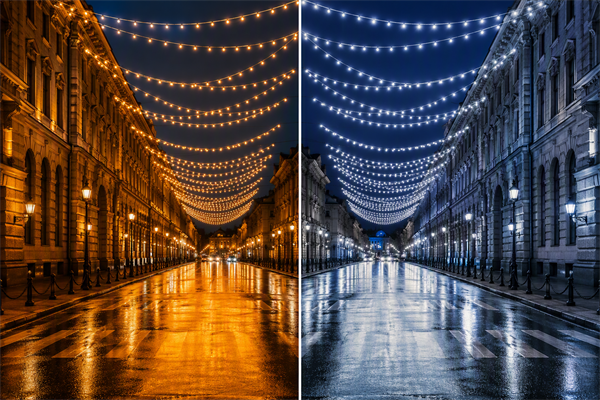
Color temperature and light direction work together to define how modern or traditional a festive lighting scheme reads. Warm white (2700–3000K) creates intimacy and classic festive warmth. Cool white (5000–6500K) creates clarity and contemporary contrast. Combining both requires assigning each temperature to a defined zone — never mixing them arbitrarily within the same zone.
Practical Color Temperature Guidelines by Zone
| Zone | Recommended Color Temperature | Reason |
|---|---|---|
| Main street canopy | 2700–3000K warm white | Creates welcoming, human-scale atmosphere for pedestrians |
| Tree and planter wrap | 2700K warm white | Enhances organic warmth of natural materials |
| Building façade outline | 4000K neutral white or brand color | Reads sharply against architectural surfaces at night |
| Entrance gateway motifs | 5000–6000K cool white or RGB | Strong contrast for arrival impact |
| Central plaza focal structure | 2700K warm white or programmable RGB | Flexibility for seasonal and event variation |
Light Direction and Visual Rhythm
Direction matters as much as temperature. Overhead string lights strung parallel to the street axis direct foot traffic and create rhythm. Perpendicular strings create a grid. Diagonal or random directions create visual tension that reads as busy rather than minimal.
For tree lighting, direction is less about geometry and more about coverage uniformity. Unevenly wrapped trees — dense at the bottom, sparse at the top — break the visual discipline of an otherwise clean scheme.
Frequently Asked Questions
Does a minimalist festive lighting scheme cost less than a traditional one?
Not necessarily. A minimalist scheme may use fewer products in secondary zones, but higher-quality or custom elements in focal zones often balance or exceed the overall cost. The value comes from reusability, lower maintenance, and a result that reads as intentional rather than decorative. Budget should follow the zoning plan, not the other way around.
What IP rating should I require for urban outdoor festival lights?
For most urban outdoor applications, IP44 is the minimum acceptable rating. For overhead spans, coastal environments, or high-humidity climates, IP65 is a more appropriate specification. Always confirm the IP rating applies to the full product — connector points are frequently the weakest link in outdoor string light systems.
How do I evaluate whether a supplier can deliver a coordinated urban scheme?
Ask the supplier to walk through a zone-by-zone product match for your specific site. A capable supplier should be able to explain how different products — string lights, motif lights, structural elements — interact spatially and how they handle installation, power, and reuse requirements. The quality of that pre-sales conversation is a reliable indicator of project support quality.
What is the minimum advance lead time for a large urban festive lighting project?
From a product-combination and implementation perspective, custom or semi-custom elements typically require 60–90 days of production lead time. Standard products in high volume may require 30–45 days. Add shipping, customs clearance, and site installation time when planning your procurement calendar. Buyers who approach suppliers in Q3 for Q4 installation have significantly more options than those who approach in October.
Can the same festive lights be reused across multiple seasons?
Yes, with the right product and storage specification. LED string lights, motif lights, and structural elements designed for commercial-grade outdoor use are typically rated for multiple installation cycles. Key factors are IP rating, connector quality, wire flexibility in cold storage conditions, and whether the product can be disassembled into storable units. Confirm reuse expectations with your supplier before finalizing the product specification.
Conclusion
Minimalist festive lights for urban blocks work when they are planned as a system — not selected as a style. The process starts with defining visual hierarchy, assigning each zone a product role, controlling color temperature and line direction deliberately, and choosing string lights, christmas lights, motif lights, and structural elements for what they each do spatially — not for how they look in a catalog image.
The result is a scheme that feels modern, coordinated, and genuinely festive without becoming maintenance-heavy or visually chaotic. If you are planning an urban block, commercial street, or large-scale festive installation and want to discuss zone-by-zone product matching for your specific site, we welcome the conversation.

[^1]: "[PDF] APPENDIX J - Lighting - Issaquah, WA", https://www.issaquahwa.gov/DocumentCenter/View/2508/App-J---Lighting. Professional lighting-design guidance identifies coordinated color temperature and spatial zoning as methods for producing coherent exterior lighting compositions; this supports the article’s planning principle rather than proving a specific festive-lighting outcome. Evidence role: expert_consensus; source type: institution. Supports: Lighting-design guidance treats color temperature control and spatial zoning as core tools for creating coherent exterior lighting schemes.. Scope note: Contextual support; most guidance addresses exterior or architectural lighting broadly, not holiday installations specifically.
[^2]: "Designing visual hierarchies for the communication of health ...", https://pmc.ncbi.nlm.nih.gov/articles/PMC11491599/. Studies of visual hierarchy and attention show that organized contrasts and focal elements guide where viewers look first and how they interpret a scene; this provides a perceptual basis for using hierarchy in festive-lighting layouts. Evidence role: mechanism; source type: paper. Supports: Research on visual hierarchy and attention explains how contrast, salience, and focal organization guide viewer perception in designed environments.. Scope note: Contextual support; perception studies may not test urban holiday lighting directly.
[^3]: "Effect of warm/cool white lights on visual perception and mood ...", https://pmc.ncbi.nlm.nih.gov/articles/PMC8481791/. Lighting-perception research links lower correlated color temperatures with warmer and more comfortable impressions and higher correlated color temperatures with cooler, more alert visual impressions; this supports the article’s warm-versus-cool distinction. Evidence role: mechanism; source type: paper. Supports: Empirical lighting studies associate lower correlated color temperatures with warmer, more comfortable impressions and higher correlated color temperatures with cooler or more alert impressions.. Scope note: Contextual support; the labels “classic festive” and “contemporary” are design interpretations built on broader perception findings.
[^4]: "Purchasing Energy-Efficient Exterior Lighting", https://www.energy.gov/cmei/femp/purchasing-energy-efficient-exterior-lighting. Public-procurement lifecycle-costing guidance treats durability, maintenance, and expected service life as relevant product-selection factors, supporting the article’s claim that reuse expectations should be set before specification. Evidence role: general_support; source type: government. Supports: Public procurement guidance commonly recommends considering lifecycle cost, durability, maintenance, and reuse rather than purchase price alone.. Scope note: Contextual support; procurement guidance may address lighting or durable goods generally rather than festive lighting specifically.
[^5]: "(PDF) Urban lighting masterplan – a step towards creating smarter cities", https://www.academia.edu/30534621/Urban_lighting_masterplan_a_step_towards_creating_smarter_cities. Urban-lighting master-plan literature emphasizes coordinated treatment of streets, façades, landmarks, and public spaces to improve nighttime legibility and coherence; this supports planning festive installations as a connected system. Evidence role: general_support; source type: institution. Supports: Urban-lighting master-plan guidance supports coordinated treatment of streets, landmarks, façades, and public spaces to create legible nighttime environments.. Scope note: Contextual support; master-plan sources usually address permanent urban lighting rather than temporary seasonal displays.
[^6]: "Visual Clutter Causes High-Magnitude Errors - PMC", https://pmc.ncbi.nlm.nih.gov/articles/PMC1382012/. Research on visual grouping and clutter shows that consistent orientation supports perceptual organization, whereas multiple competing orientations can increase visual complexity; this provides a mechanism for the article’s guidance on string-light direction. Evidence role: mechanism; source type: paper. Supports: Visual-perception research on grouping, orientation, and clutter explains why consistent line direction is perceived as more orderly than competing orientations.. Scope note: Contextual support; the evidence concerns visual perception generally, not string lights specifically.
[^7]: "Does luminance-contrast contribute to a saliency map for overt visual ...", https://pubmed.ncbi.nlm.nih.gov/12653985/. Studies of visual salience and luminance contrast indicate that visually stronger elements tend to attract attention and can structure spatial perception, supporting the use of higher lighting density at focal zones. Evidence role: mechanism; source type: paper. Supports: Research on visual salience and luminance contrast supports the idea that brighter or denser visual elements can draw attention and help structure navigation.. Scope note: Contextual support; the research supports the attention mechanism, not a fixed density formula for festive lighting.
[^8]: "IP code", https://en.wikipedia.org/wiki/IP_code. IEC 60529 defines IP44 as protection against objects larger than 1 mm and splashing water, and IP65 as dust-tight protection with resistance to water jets, providing the technical basis for distinguishing sheltered from more exposed outdoor applications. Evidence role: definition; source type: institution. Supports: The IEC ingress-protection code defines what IP44 and IP65 mean in terms of protection against solid objects, dust, and water.. Scope note: The standard defines protection levels but does not prescribe a universal minimum rating for every festive-lighting project.
[^9]: "The Ultimate LED Strip Power Injection Guide - quinled.info", https://quinled.info/the-ultimate-led-strip-power-injection-guide/. Electrical-engineering references explain that conductor resistance causes voltage drop to increase with circuit length and current, supporting the need to plan additional power-feed or injection points for long lighting runs. Evidence role: mechanism; source type: education. Supports: Electrical-engineering educational sources explain that voltage drop increases with conductor length and load, which can require additional feed points in long lighting runs.. Scope note: The principle is direct, but exact spacing depends on product voltage, wire gauge, load, and manufacturer limits.
[^10]: "Guidance of visual attention by semantic information in real-world ...", https://pmc.ncbi.nlm.nih.gov/articles/PMC3915098/. Wayfinding research shows that salient and recognizable landmarks help people orient themselves and structure spatial experience, supporting the article’s use of motif lights as visual anchors. Evidence role: mechanism; source type: paper. Supports: Wayfinding and visual-attention research supports the role of recognizable, salient landmarks in orienting viewers within an environment.. Scope note: Contextual support; the evidence concerns landmarks and visual salience generally, not decorative motifs specifically.
[^11]: "Aluminum - an overview | ScienceDirect Topics", https://www.sciencedirect.com/topics/materials-science/aluminum. Reference material-property sources report that aluminum has substantially lower density than steel, while steel is widely used for high-strength structural applications; this supports the article’s distinction between weight savings and durability considerations. Evidence role: definition; source type: encyclopedia. Supports: Reference sources document that aluminum has lower density than steel, while steel is commonly used where strength and structural durability are priorities.. Scope note: Material choice also depends on alloy, coating, design, corrosion exposure, and fabrication quality.
[^12]: "[PDF] Life Cycle Assessment of a modular LED luminaire and quantified ...", https://upcommons.upc.edu/bitstreams/7a8f3095-d7c1-4f9f-affb-7484099d6e76/download. Research on design for maintainability and lifecycle costing finds that modular, replaceable components can reduce repair effort and lifecycle maintenance burden compared with replacing complete assemblies, supporting the article’s maintenance-cost claim. Evidence role: general_support; source type: paper. Supports: Maintainability and lifecycle-cost research supports the principle that modular replaceable components can reduce repair scope, downtime, and long-term maintenance cost.. Scope note: The degree of savings depends on failure rates, labor cost, spare-part availability, and the specific lighting system design.
Table of Contents
- Minimalist Festive Lights: Modern Illumination Aesthetics for Urban Blocks?
- What Does "Minimalist" Actually Mean for Urban Festive Lighting?
- How Should Urban Blocks Be Planned as Connected Lighting Zones?
- Which Products Serve Which Spatial Tasks in a Minimalist Festive Scheme?
- How Do Color Temperature and Light Direction Affect the Minimalist Festive Feel?
-
Frequently Asked Questions
- Does a minimalist festive lighting scheme cost less than a traditional one?
- What IP rating should I require for urban outdoor festival lights?
- How do I evaluate whether a supplier can deliver a coordinated urban scheme?
- What is the minimum advance lead time for a large urban festive lighting project?
- Can the same festive lights be reused across multiple seasons?
- Conclusion