 EN
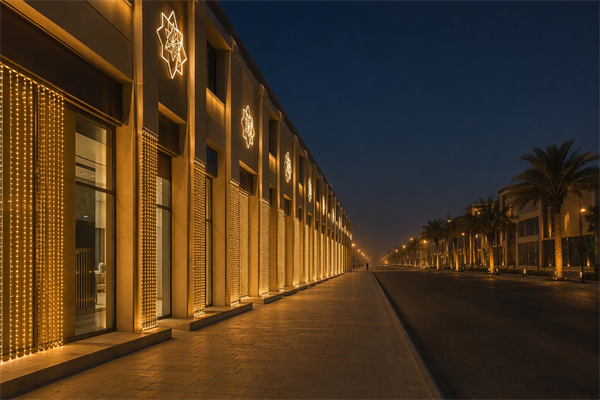
How to Choose Festival Lights for Large Commercial Projects in the Middle East
Choosing festival lights for a large commercial project in the Middle East is one of those decisions that looks straightforward until something goes wrong. Buyers often start with price. But experienced project managers know that the real risk is not overpaying — it is receiving lighting that fails in the field, arrives late, or cannot be installed safely at scale.
For large commercial projects in the Middle East, choosing festival lights means evaluating climate suitability, construction grade, batch consistency, and supplier coordination — not just unit price. The region's extreme heat, intense UV exposure, and sand and dust environment[^1] eliminate many standard decorative products from consideration before any procurement decision begins. A structured specification process reduces both environmental failure risk and delivery risk.
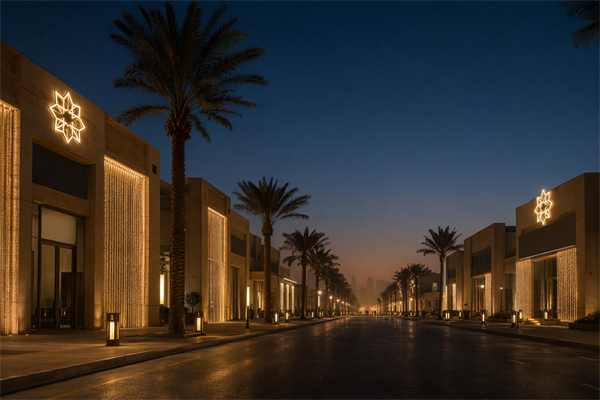
Most buyers I work with arrive at the first conversation asking the wrong question. That is not a criticism — it reflects how most retail purchasing works. But commercial projects in this region operate under different rules entirely. The sections below walk through the key evaluation layers that actually determine project success.
Why Is the Middle East Climate So Demanding for Festival Lights?
Most buyers focus on waterproofing. But waterproofing is a secondary concern in much of the Middle East. The primary challenge is heat, UV, and particulate exposure — conditions that standard decorative string lights and christmas lights are simply not designed to endure.
A well-specified outdoor festival light for the Middle East must be evaluated against ambient temperatures that regularly exceed 45°C[^2], direct sun exposure lasting 10 or more hours per day[^3], fine sand and dust that infiltrates unprotected connectors, and installation periods that often run for weeks or months rather than days.
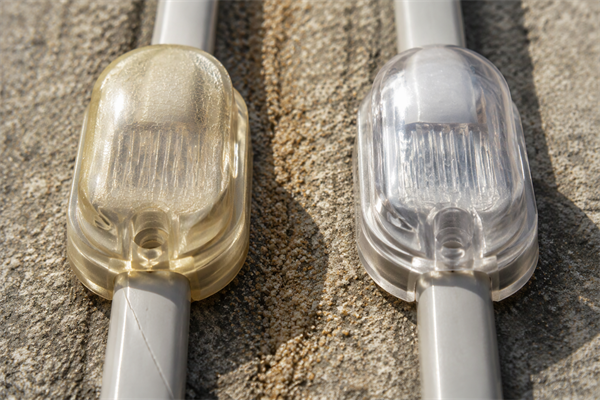
These are not edge cases. They are the baseline operating conditions for any outdoor commercial installation in the Gulf region. Ignoring them during specification is how projects end up with cracked lamp housings, yellowed diffusers, connector failures, and mid-installation replacements.
What Does IP Rating Actually Tell You — and What Does It Miss?
IP rating is the specification buyers cite most often. It is a useful starting point, but it is frequently misunderstood as a comprehensive outdoor suitability certificate.
- IP44 protects against solid objects above 1mm and water splashing from any direction. It is common on decorative string lights and motif lights sold for mild-climate use.
- IP65 adds full dust protection and low-pressure water jet resistance. It is more appropriate for outdoor festival applications.
- IP67 and IP68 add submersion resistance. These ratings are relevant for ground-level or flood-prone installations.
What IP rating does not address:[^4]
| Factor | IP Rating Coverage | What You Need Instead |
|---|---|---|
| High ambient temperature | No | Heat-rated cable insulation, temperature-rated drivers |
| UV degradation | No | UV-stabilised housing materials and cable jackets |
| Sand and fine dust ingress in connectors | Partial (IP6X for full dust) | Connector seal quality and cable entry design |
| Long-term outdoor exposure | No | Material selection, cycle testing, field review |
| Mechanical stress from wind or installation | No | Structural mounting design and cable gauge |
I have had more than one presales conversation where a client showed me a competitor's product spec, pointed to IP65, and asked why our quote was higher. The answer is always the same: IP65 tells you the housing passed a lab test under controlled conditions. It does not tell you how the cable jacket holds up after three months of direct sun in summer, or how the connector performs after sand infiltration. Those outcomes are determined by material choices and construction quality that exist entirely outside the IP rating system.
High Temperature and UV Resistance: The Overlooked Specifications
For Middle East commercial applications, cable jacket material is one of the most important specifications buyers rarely ask about.
Standard PVC jackets used in most decorative string lights and christmas lights begin to soften, crack, and become brittle under sustained high-temperature and UV exposure. This creates both a product failure risk and an installation safety concern at scale.
More suitable alternatives for extreme-climate installations include:
- Silicone cables — excellent thermal stability, flexible at high temperatures, better UV resistance than standard PVC
- Cross-linked polyethylene (XLPE) insulation — improved heat and UV performance, commonly used in outdoor power applications
- UV-stabilised PVC compounds — a middle-ground option for installations where full silicone cable is cost-prohibitive
Lamp housing materials deserve equal attention. Polycarbonate (PC) housings with UV stabilisation hold their optical clarity and structural integrity far longer than standard ABS or untreated PC under direct sunlight.[^5] Yellowing and crazing in lamp diffusers are among the most visible failure modes in outdoor festival lights that were not specified for UV exposure.
What Separates Retail Decorative Lights from Project-Grade Festival Lights?
This distinction matters more than most buyers realise when they begin procurement. Retail decorative string lights, christmas lights, and motif lights are designed for seasonal consumer use — typically short installation periods[^6], indoor or sheltered environments, and modest performance expectations.
Project-grade commercial festival lights are engineered for different demands: continuous outdoor installation, high-volume batch consistency, coordinated delivery schedules, and supplier support across the full project lifecycle.
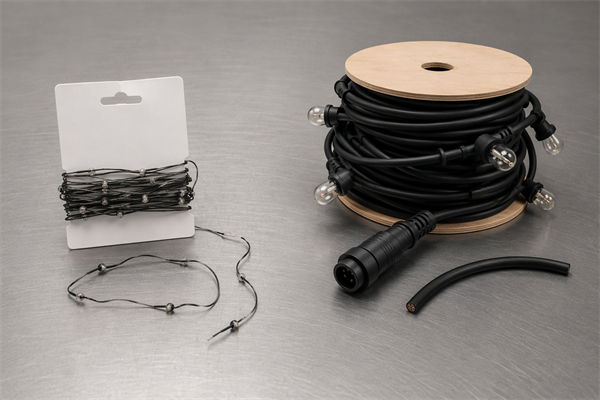
The price difference between the two categories is real. The risk difference is larger.
What Does Batch Consistency Mean for Large Projects?
When a shopping mall, municipality, or hotel installs festival lighting across a large public space, visual uniformity is a project deliverable. Colour temperature variation, brightness inconsistency, or physical size differences between batches are not just quality annoyances — they are visible failures in front of the client's end audience.
Batch consistency in project-grade festival lights covers:
- LED binning — LEDs are manufactured with inherent variation in colour and brightness.[^7] For large projects, consistent binning (matching LEDs within defined colour temperature and luminous flux ranges) is essential for uniform visual output across thousands of fittings.
- Physical dimensions — Motif light frames, string light spacing, and connector positions must be consistent across production batches so that installation proceeds without adjustment delays.
- Cable colour and length tolerance — Even minor variation in cable length creates installation problems at scale when lights are suspended between fixed anchor points.
- Packaging and labelling — Large project deliveries require clear, consistent unit identification so that installation teams can manage inventory and handle replacements without confusion.
Structural Reliability and Installation Safety
Large commercial festival lighting installations in the Middle East often involve suspension across public spaces — shopping street canopies, hotel facades, public squares, and event venues. The structural load on cables, mounting hardware, and connection points is real.[^8]
Standard retail string lights are not rated or designed for these installation scenarios. Project-grade products should be specified with:
- Appropriate cable gauge for the span and load
- Strain relief at connectors and mounting points to prevent cable pull-out under wind load or installation tension
- Secure lamp retention in housing, particularly for motif lights with multiple lamp positions
- Clear maximum span guidance from the supplier, based on the specific product and installation type
I always advise buyers to share installation drawings or at minimum a description of mounting points and spans before we confirm product specifications. A string light that works perfectly in a 3-metre indoor window display behaves very differently when it is suspended across a 20-metre outdoor span in summer wind.
How Should You Structure Your Project Inquiry to Get Accurate Recommendations?
One of the most consistent patterns in my presales experience with Middle East commercial projects is the under-specified inquiry. A buyer contacts us asking for "outdoor festival lights" with a target price, and that is all the information they provide. An accurate recommendation is simply not possible from that starting point.
The information needed to specify festival lights correctly for a large commercial project is straightforward. Assembling it before reaching out to suppliers saves significant back-and-forth time and produces a more accurate, comparable quote.
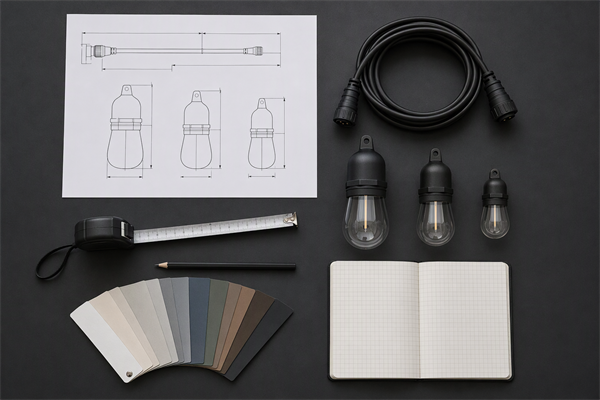
The Information Suppliers Actually Need
Project environment and installation location:
- Indoor, semi-outdoor, or fully exposed outdoor?
- Rooftop, facade, canopy, ground-mounted, or suspended overhead?
- City and country (climate variation within the Middle East is significant — coastal humidity in the Gulf differs from dry inland desert conditions)
Project dimensions and scope:
- Total linear metres of string light or cable run
- Number and type of motif lights or feature pieces
- Number of connection points, control zones, and power supply locations
Reference images or effect drawings: Photographs of the installation space and reference images showing the intended visual effect allow a supplier to identify mismatches between the buyer's expectation and what the specified product will actually deliver. This step prevents the single most common source of buyer disappointment in festival lighting projects.
Use period and exposure duration:
- A 10-day event installation has different specification requirements than a three-month seasonal display or a permanent installation with annual reuse.
Target delivery deadline: Production lead times for project-grade commercial festival lights are not the same as retail stock availability. For large custom orders — custom colours, custom motif shapes, custom branding — eight to twelve weeks from order confirmation to port of loading is a realistic expectation. Buyers who arrive with a four-week deadline for a fully custom project are not in a workable position, and a supplier who confirms that timeline without flagging it is not serving the buyer well.
What Supplier Signals Should You Evaluate Before Committing?
Supplier selection for large commercial festival lighting projects deserves more rigour than a price comparison and a product catalogue review.
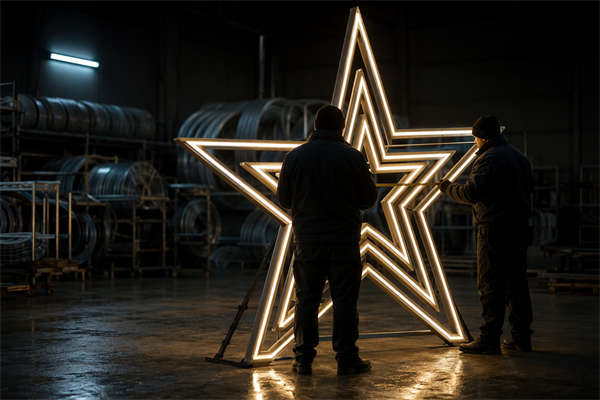
Management System Certifications as Baseline Signals
Certifications like ISO 9001 and BSCI indicate that a supplier has implemented structured quality management and social compliance systems. They are relevant signals in supplier screening — they suggest operational maturity.
However, they are management system certifications, not product performance certifications for your specific application. Treat them as baseline qualifications, not as substitutes for technical due diligence on the actual products you are buying.
Pre-Production Sample Review
For any large project order, request a pre-production sample before confirming bulk production. A physical sample allows your team or a qualified local installer to evaluate:
- Actual colour output and brightness under local lighting conditions
- Cable and housing material quality
- Connector fit and ease of installation
- Physical dimensions against your installation design
Remote product images and catalogue specifications are not sufficient for project-grade procurement decisions. A supplier who is unwilling to provide a pre-production sample for a large commercial order is presenting a meaningful risk signal.
Supplier Communication and Project Coordination Capacity
For large commercial festival lighting projects, you are not just buying a product. You are entering a coordination relationship that runs from specification through sampling, production, quality inspection, packing, export documentation, and delivery. A supplier who responds slowly to technical questions during presales will not perform better once an order is placed.
Relevant coordination questions to evaluate:
- Does the supplier have dedicated project support staff for commercial accounts?
- Can they provide production progress updates with documented inspection stages?
- What is their process if a quality issue is identified during production?
- Can they assist with packing specifications for your import logistics requirements?
Frequently Asked Questions
What IP rating should I specify for outdoor festival lights in the Middle East?
For fully exposed outdoor installations in the Middle East, IP65 is a common minimum starting point. However, IP rating alone does not address high-temperature cable performance, UV resistance, or connector seal quality under sand and dust exposure. Specify those material properties separately and ask your supplier how they are addressed in the product construction.
How long does it take to produce a large custom festival light order?
For project-grade commercial festival lights with custom specifications — such as custom motif shapes, specific colour temperatures, or branded elements — eight to twelve weeks from confirmed order to port of loading is a realistic production timeline. Allow additional time for pre-production sample review and sea freight transit. Contact your supplier early in the project planning phase.
Can standard christmas lights or retail string lights be used for large commercial outdoor projects in the Middle East?
Standard retail christmas lights and decorative string lights are not designed for the sustained heat, UV exposure, and dust conditions typical of Middle East outdoor installations. They also lack the batch consistency and structural specification needed for large commercial projects. Using retail-grade products in commercial outdoor applications increases both product failure risk and installation safety risk.
What is a motif light, and where is it used in commercial festival projects?
A motif light is a shaped decorative light fitting — typically a festive or thematic figure such as a star, snowflake, palm tree, or branded shape — constructed with LED lamps mounted on a metal or wire frame. Motif lights are commonly used as feature pieces in large commercial festival displays: shopping mall entrances, public squares, hotel facades, and event venues. For outdoor use in the Middle East, the same climate-suitability criteria apply as for any outdoor festival lighting.
Do I need to visit the factory before placing a large order?
A factory visit is not always practical, but it is a legitimate due diligence step for large-value commercial projects. If a visit is not possible, request a video walkthrough, documented production inspection reports, and third-party quality inspection options at your cost. Suppliers operating under ISO 9001 quality management systems should have documented production and inspection procedures available to share with qualified buyers.
Conclusion
Choosing festival lights for large commercial projects in the Middle East is a risk-management decision. Unit price matters, but it matters far less than climate suitability, construction grade, batch consistency, and delivery reliability. IP rating is a starting point, not a complete specification. Retail decorative string lights, christmas lights, and motif lights are not substitutes for project-grade commercial products in this environment.
The buyers who get the best outcomes are the ones who define their project requirements clearly — installation environment, dimensions, visual reference, use period, and target deadline — before they begin comparing suppliers.
If you are planning a large commercial festival lighting project in the Middle East and want a structured recommendation rather than a generic catalogue, share your project details with us. We work with importers, event management groups, municipal contractors, and large-format retail clients across the Gulf region, and we are glad to provide a specification review before any quotation discussion begins.
[^1]: "Impacts of climate and synoptic fluctuations on dust storm ...", https://pmc.ncbi.nlm.nih.gov/articles/PMC6192056/. Regional climatological and environmental data document that Gulf and Middle Eastern outdoor environments commonly combine high summer temperatures, intense solar exposure, and airborne dust; this supports the article's environmental premise, although it does not directly test festival lighting products. Evidence role: general_support; source type: government. Supports: The source should document high temperatures, strong solar radiation/UV exposure, and dust or sand events in Gulf or Middle Eastern environments.. Scope note: Contextual climate evidence supports the operating environment, not the failure rate of specific lighting products.
[^2]: "Download Data | Climate Change Knowledge Portal", https://climateknowledgeportal.worldbank.org/download-data. Official meteorological records for Gulf-region locations report summer maximum temperatures at or above 45°C, supporting the need to consider high ambient-temperature operation in outdoor lighting specifications. Evidence role: statistic; source type: government. Supports: The source should provide observed or climatological maximum temperatures for Gulf or Middle Eastern cities showing summer temperatures reaching or exceeding 45°C..
[^3]: "Sunshine duration", https://en.wikipedia.org/wiki/Sunshine_duration. Solar-resource datasets for Middle Eastern locations report high daily sunshine or irradiance levels, consistent with outdoor equipment experiencing prolonged direct solar exposure; the data characterize environmental exposure rather than lighting-material durability. Evidence role: statistic; source type: research. Supports: The source should document high sunshine duration or solar resource values in Middle Eastern/Gulf locations.. Scope note: Solar-resource data do not by themselves prove product degradation, but they substantiate the exposure conditions.
[^4]: "How IP Rating Testing Works Under IEC 60529", https://www.eurotechworld.net/resources/testing-standards/how-ip-rating-testing-works/. The IEC ingress-protection classification concerns access, solid-particle ingress, and water ingress, so it does not constitute a comprehensive assessment of UV resistance, thermal ageing, or mechanical loading. Evidence role: definition; source type: institution. Supports: The source should explain that IP ratings classify protection against solid-object/dust ingress and water ingress, not general environmental durability..
[^5]: "Polycarbonate Yellowing: Causes, Prevention & Solutions", https://salesplastics.com/does-polycarbonate-yellow/. Polymer-weathering studies show that ultraviolet exposure can cause yellowing and mechanical degradation in polycarbonate, while UV-stabilized formulations improve retention of optical and mechanical properties under outdoor exposure. Evidence role: mechanism; source type: paper. Supports: The source should document UV-induced yellowing/degradation of polycarbonate and the role of UV stabilizers in improving weathering resistance..
[^6]: "CPSC Urges Consumers to Decorate Safely for the Holidays", https://www.cpsc.gov/Newsroom/News-Releases/2003/CPSC-Urges-Consumers-to-Decorate-Safely-for-the-Holidays. Electrical-safety guidance and code commentary commonly treat decorative holiday lighting as temporary seasonal equipment, supporting the article's distinction between consumer decorative lights and products specified for extended commercial outdoor installations. Evidence role: general_support; source type: institution. Supports: The source should indicate that decorative or holiday lighting is commonly treated as temporary/seasonal lighting in electrical safety guidance or codes.. Scope note: Safety-code treatment of temporary decorative lighting supports the general distinction but may not classify every product sold at retail.
[^7]: "LED Color Characteristics", https://www.energy.gov/sites/prod/files/2016/08/f33/led-color-characteristics-factsheet.pdf. Solid-state lighting references explain that manufactured LEDs vary in chromaticity and luminous flux and are sorted into bins to control color and brightness consistency across installations. Evidence role: mechanism; source type: government. Supports: The source should explain that LEDs vary in chromaticity and luminous flux after manufacture and are sorted into bins to manage consistency..
[^8]: "Minimum Design Loads for Buildings and Other Structures", https://www.waterboards.ca.gov/waterrights/water_issues/programs/bay_delta/california_waterfix/exhibits/docs/dd_jardins/DDJ-148%20ASCE%207-10.pdf. Structural design standards for outdoor installations require consideration of dead loads, connection forces, and wind actions on exposed elements, supporting the need to assess cables, mounting hardware, and connection points in suspended lighting displays. Evidence role: mechanism; source type: institution. Supports: The source should support that outdoor suspended elements are subject to loads such as dead load, tension, and wind load that must be considered in design.. Scope note: General structural standards support the loading principle but do not provide product-specific span limits for festival lights.
Table of Contents
- How to Choose Festival Lights for Large Commercial Projects in the Middle East
- Why Is the Middle East Climate So Demanding for Festival Lights?
- What Separates Retail Decorative Lights from Project-Grade Festival Lights?
- How Should You Structure Your Project Inquiry to Get Accurate Recommendations?
- What Supplier Signals Should You Evaluate Before Committing?
-
Frequently Asked Questions
- What IP rating should I specify for outdoor festival lights in the Middle East?
- How long does it take to produce a large custom festival light order?
- Can standard christmas lights or retail string lights be used for large commercial outdoor projects in the Middle East?
- What is a motif light, and where is it used in commercial festival projects?
- Do I need to visit the factory before placing a large order?
- Conclusion