 EN

Christmas Lights Manufacturer vs. Trading Company: Which Is Better for Bulk Buyers?
Choosing the wrong supplier for a bulk Christmas lights order can derail an entire retail season or public decoration project. The wrong choice leads to delayed shipments, failed compliance checks[^1], and no clear answer when something goes wrong. Understanding the real difference between a Christmas lights manufacturer and a trading company helps bulk buyers protect their investment before placing a single purchase order.
The short answer is: neither option is automatically better. The better supplier is the one who can own the full risk chain — from product specification and sampling through production, quality control, compliance documentation, and post-sale accountability. For most bulk buyers of string lights, festival lights, and motif lights, that capability matters far more than the supplier's business structure.

That answer deserves more than a one-liner. The real work starts when you look at what each supplier type actually controls at each stage of your procurement cycle — and where the risks quietly accumulate.
Is a Christmas Lights Manufacturer Really Cheaper Than a Trading Company?
Many buyers enter the sourcing process assuming a direct factory equals the lowest price. That assumption drives a lot of rushed decisions — and a lot of expensive surprises.
A manufacturer is not automatically cheaper for bulk buyers. The real cost comparison must account for total procurement cost: sampling turnaround, defect rates, packaging compliance, rework, and delivery reliability[^2]. Unit price is only one variable in that equation.
What "cheaper" actually means at scale
When I review bulk inquiries, the conversation almost always starts with price per unit. That is understandable. But in my experience communicating directly with international buyers — importers, retail chains, and municipal decoration contractors — the unit price rarely tells the full story.
Consider the actual cost components a bulk buyer should examine:
- Sampling cost and turnaround time. A manufacturer with dedicated R&D capability can adjust a sample and return it faster. A trading company may depend on factory schedules they do not control, which can add weeks to your sampling cycle.
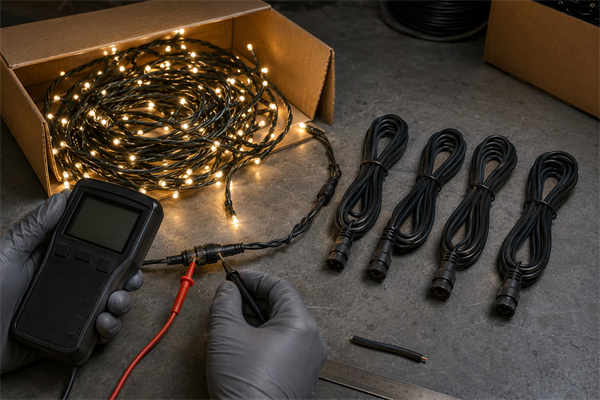
- Defect rate and QC process. A supplier with in-house quality control — incoming material inspection, in-line checks, and pre-shipment inspection[^3] — can catch problems before they reach your container. Buyers should verify what QC steps a supplier actually performs, not just claims.
- Packaging requirements. Retail buyers for large chain stores often require specific retail packaging formats, barcodes, and labeling standards. A manufacturer with export packaging experience can coordinate this directly. A trading company may add a communication layer that slows revisions.
- Rework and replacement costs. If a defective batch of string lights or festival lights arrives in-market, who absorbs the cost? A direct manufacturer with accountability in their contract has more skin in the game. A trading company's position in a dispute can be less clear.
- Communication delays. Every question routed through a trading company's intermediary adds time. For time-sensitive Christmas decoration orders, a six-day response loop can cost you a production slot.
The table below summarizes how these cost factors typically break down across both supplier types:
| Cost Factor | Christmas Lights Manufacturer | Trading Company |
|---|---|---|
| Unit Price | Often competitive at volume | May include margin markup |
| Sampling Speed | Faster with in-house R&D | Depends on factory schedule |
| QC Control | Direct in-house process | Varies; often outsourced |
| Packaging Compliance | Manageable directly | Extra communication layer |
| Customization Cost | More transparent | Harder to pin down |
| Post-sale Accountability | Direct responsibility | May dispute liability |
The conclusion I draw from this comparison is consistent: buyers should evaluate total procurement cost, not just FOB unit price.
Where Do Trading Companies Actually Add Value for Christmas Light Buyers?
It would be unfair — and inaccurate — to dismiss trading companies as useless intermediaries. In some procurement scenarios, they provide genuine value.
Trading companies can add real value when buyers need multi-category sourcing, consolidated shipments, or simplified purchasing coordination across product lines. For buyers who source festival lights alongside other product categories, a well-organized trading company can reduce the logistics and communication burden.

When a trading company makes sense
Some international buyers — particularly those managing broad product portfolios — do not have the bandwidth to manage direct relationships with five or six specialized factories. In those cases, a trading company can serve a coordination function that is worth paying for.
Scenarios where trading companies can help:
- Multi-category purchasing. If you are buying Christmas string lights, motif lights, and general retail decorations from different factories, a trading company can consolidate sourcing and reduce your vendor management workload.
- Language and documentation support. Some buyers need support navigating Chinese export documentation, customs paperwork, or supplier audits. An experienced trading company with a multilingual team can help bridge that gap.
- Smaller order quantities. Some manufacturers set high MOQs. A trading company that aggregates orders across multiple buyers can sometimes access factory capacity at lower individual minimums.
- Market access in unfamiliar categories. For buyers entering the Christmas lights category for the first time, a trading company may have pre-vetted factory relationships that reduce the discovery risk.
Where trading companies typically fall short:
However, for buyers who prioritize production-level control — especially over custom holiday lighting projects, compliance certifications, and factory-level accountability — the trading company model creates real gaps.
- Production detail visibility. A trading company may not have direct access to the factory floor. Customization requests, material changes, or packaging revisions must travel through an additional party, and translation can lose detail.
- Compliance documentation. Certifications like CE, RoHS, SAA, or ETL are issued to legal entities.[^4] Buyers should verify that the compliance documents actually cover the products they are purchasing — not just the supplier's name on the certificate. In my experience, this is where trading companies sometimes present documents that do not precisely match the product specification being ordered.
- Accountability in after-sales disputes. When a container of festival lights arrives with a defect rate above acceptable tolerance, the question of who is responsible becomes complicated if there is a trading company in the middle. Manufacturers who own the production process have a clearer obligation to respond.
What Should Bulk Buyers Prioritize When Evaluating Christmas Lights Suppliers?
"Manufacturer or trading company?" is the wrong first question. The right question is: can this supplier control the risk chain from specification to delivery?
For bulk Christmas lights procurement, buyers should evaluate suppliers across six practical criteria: production capacity, QC process, compliance documents, packaging capability, customization ability, and post-sale accountability. These criteria apply regardless of whether the supplier is a manufacturer or a trading company.

A practical evaluation framework
Based on my direct experience handling overseas inquiries, quotations, sampling coordination, and delivery discussions, here is how I recommend buyers structure their supplier evaluation:
1. Production Capacity
A reliable supplier should be able to show documented production capacity relevant to your order size and delivery window. For Christmas and festival lighting, seasonal demand peaks are predictable. Ask specifically:
- What is the monthly production capacity for string lights or motif lights at your required specification?
- How far in advance do you need to lock in a production slot for peak-season orders?
- What is the lead time from order confirmation to cargo-ready date?
2. Quality Control Process
QC claims are easy to make. Buyers should request specifics:
- Incoming material inspection: Are LED components, wire gauge, and connectors checked on arrival?
- In-line inspection: Is there a checking process during production, or only at the end?
- Pre-shipment inspection: What percentage of finished goods are tested before packing?
- Test standards: What electrical safety and performance tests are applied to string lights and festival lights?
A supplier with a documented QC process should be able to walk you through it without hesitation. Vague answers here are a red flag at any order volume.
3. Compliance Documentation
For European, Australian, Middle Eastern, or South African markets, compliance is non-negotiable. Key certificates buyers should request and verify include:
| Market | Typical Certifications |
|---|---|
| [European Union | CE, RoHS, LVD](https://en.wikipedia.org/wiki/Low_Voltage_Directive)[^5] |
| [Australia / New Zealand | SAA, RCM](https://en.wikipedia.org/wiki/Regulatory_Compliance_Mark)[^6] |
| [UAE / Saudi Arabia | ESMA, SASO](https://legacy.export.gov/article?id=United-Arab-Emirates-trade-standards)[^7] |
| [North America | ETL, UL](http://www.osha.gov/nationally-recognized-testing-laboratory-program/its)[^8] |
| General Social Compliance | BSCI, ISO 9001 |
Buyers should verify that certificates are current, cover the specific product SKU being ordered[^9], and are issued to the entity they are contracting with. A supplier who hesitates to share originals warrants further scrutiny.
4. Retail Packaging Capability
For retail chain buyers, packaging is as important as the product itself. A supplier should be able to demonstrate:
- Printed retail box or blister pack capability
- Barcode and labeling compliance with your market requirements
- Language customization for target market packaging
Packaging revisions are common during sampling. A manufacturer with in-house packaging coordination can turn these around more efficiently than a trading company routing requests through a factory.
5. Customization Capability
Many large buyers of Christmas string lights and motif lights need product customization: specific wire colors, LED counts, IP ratings, plug types, or custom holiday motif shapes. Buyers should confirm:
- Does the supplier have R&D or engineering support for custom development?
- What is the typical lead time for a custom sample?
- Who owns the tooling cost for custom motif light molds, and what is the MOQ?
In many bulk purchasing cases, customization is where the difference between a capable manufacturer and a coordinator becomes most visible.
6. Post-Sale Accountability
This is the criterion most buyers evaluate last — and the one that matters most when problems occur. Before placing an order, buyers should establish:
- What is the process for reporting and resolving quality issues after arrival?
- Who bears the cost of replacement or rework if a defect rate exceeds agreed tolerance?
- Is there a written warranty or quality assurance clause in the contract?
Frequently Asked Questions
Can a trading company provide the same compliance certifications as a manufacturer?
Trading companies can present compliance certificates, but buyers should verify that each certificate covers the exact product specification being ordered and is issued to the contracting entity. In some cases, certificates presented by trading companies reflect a factory's general approval rather than the specific product configuration. Always request the original certificate and cross-check the scope.
What is a reasonable MOQ when buying Christmas lights or festival lights in bulk?
MOQ varies by product type, customization level, and supplier capacity. Standard string lights often have lower MOQs than custom motif lights, which require tooling. A reliable supplier should be able to state their MOQ clearly and explain what drives it. Buyers should be cautious of unusually low MOQs for complex custom holiday lighting, as these may signal limited production experience.
How far in advance should bulk buyers place Christmas lights orders?
For peak-season Christmas and festival light orders, most experienced suppliers recommend placing orders at least four to six months ahead of the required delivery date[^10]. This allows time for sampling, approval, production, quality inspection, and sea freight. Buyers in markets with strict seasonal retail windows — such as Europe and Australia — should factor in customs clearance time as well.
How do I verify that a supplier is actually a manufacturer and not a trading company?
Request a factory audit, business license, and production facility photographs or video. ISO 9001 and BSCI certifications involve third-party audits that include factory verification.[^11] You can also ask for a live video call from the production floor during working hours. No verification method is foolproof, but a combination of documentation and direct communication usually reveals inconsistencies quickly.
Does IP rating matter for outdoor Christmas lights and motif lights?
Yes, significantly. For outdoor string lights, festival lights, and motif lights used in public decoration or retail display, IP44 is a common baseline, while permanent or exposed installations often require IP65 or higher.[^12] Buyers should specify the end-use environment clearly — indoor retail, covered outdoor, or fully exposed installation — and confirm the IP rating is certified, not just labeled.
Conclusion
The manufacturer versus trading company question is a useful starting point, but it is the wrong final filter for bulk Christmas lights procurement. What matters is whether a supplier can demonstrate control over the full risk chain: production capacity, quality control, compliance documentation, packaging, customization, and post-sale accountability.
In my experience working with international buyers across Europe, Australia, the Middle East, and South Africa, the buyers who experience the fewest costly surprises are those who evaluate suppliers against these practical criteria — not just supplier type or unit price. Whether you are sourcing string lights, custom motif lights, or large-scale festival lighting, the discipline of evaluating total procurement risk protects your margin, your timeline, and your end-market relationships.
If you are currently evaluating Christmas lights suppliers for an upcoming bulk order, I encourage you to request compliance documentation, ask for a detailed QC process overview, and confirm customization capabilities before committing. A supplier who can answer those questions clearly is worth a serious conversation.

[^1]: "Due diligence for responsible business conduct", https://www.oecd.org/en/topics/sub-issues/due-diligence-guidance-for-responsible-business-conduct.html. Research on supplier risk management links supplier selection and monitoring practices to delivery reliability and regulatory or quality compliance outcomes, supporting the article's framing of delays and compliance failures as procurement risks. Evidence role: general_support; source type: research. Supports: Poor supplier selection and supplier risk management can contribute to delivery disruption and compliance problems in procurement.. Scope note: This would provide general procurement-risk support rather than evidence specific to Christmas lights.
[^2]: "Analyzing Costs Using Total Cost of Ownership", https://psep.smeal.psu.edu/short-courses/supply-chain-accelerator/advanced-procurement-analyzing-costs-using-total-cost-of-ownership. Procurement literature defines total cost of ownership as a supplier-evaluation approach that incorporates purchase price together with quality, logistics, transaction, and post-purchase costs, supporting the use of total procurement cost rather than unit price alone. Evidence role: definition; source type: paper. Supports: Total cost of ownership in purchasing includes acquisition price as well as quality, logistics, transaction, and other supplier-related costs.. Scope note: The source would support the cost-evaluation framework generally, not the exact cost weights for Christmas lighting orders.
[^3]: "The Ultimate Guide to Quality Inspection in Manufacturing", https://www.6sigma.us/manufacturing/quality-inspection/. Quality-management guidance describes verification of purchased materials, monitoring during production, and final product inspection as mechanisms for controlling conformity before shipment. Evidence role: mechanism; source type: institution. Supports: Manufacturing quality systems commonly use inspection and verification at material receipt, during production, and before release or shipment.. Scope note: This supports the QC sequence as a general manufacturing practice, not as a legal requirement for all Christmas light suppliers.
[^4]: "OSHA's Nationally Recognized Testing Laboratory (NRTL) ...", http://www.osha.gov/nationally-recognized-testing-laboratory-program. Conformity-assessment rules generally require product compliance documents to identify the responsible manufacturer, importer, or certificate holder, supporting the need to verify the legal entity named on certificates. Evidence role: definition; source type: government. Supports: Conformity documents and product certifications identify responsible manufacturers, importers, certificate holders, or applicants as legal entities.. Scope note: Requirements vary by jurisdiction and certification scheme, so the source may not cover every named mark in the same document.
[^5]: "Low Voltage Directive", https://en.wikipedia.org/wiki/Low_Voltage_Directive. European Union guidance on CE marking, RoHS, and the Low Voltage Directive supports treating these regimes as relevant compliance considerations for electrical lighting products sold in the EU. Evidence role: general_support; source type: government. Supports: EU electrical and electronic products may be subject to CE marking, RoHS restrictions, and Low Voltage Directive requirements depending on product characteristics.. Scope note: Applicability depends on the product's voltage, design, components, and intended use.
[^6]: "Regulatory Compliance Mark", https://en.wikipedia.org/wiki/Regulatory_Compliance_Mark. Australian and New Zealand electrical-equipment guidance describes approval and marking frameworks, including the Regulatory Compliance Mark, supporting the article's identification of SAA-type approvals and RCM as relevant market checks. Evidence role: general_support; source type: government. Supports: Australia and New Zealand use electrical equipment safety approval frameworks and the Regulatory Compliance Mark for applicable electrical products.. Scope note: The exact approval pathway depends on the product class and local state or national rules.
[^7]: "United Arab Emirates - Trade Standards - export.gov", https://legacy.export.gov/article?id=United-Arab-Emirates-trade-standards. Official Gulf conformity-assessment sources identify national product conformity systems in the UAE and Saudi Arabia, supporting the article's treatment of ESMA and SASO as relevant compliance references for those markets. Evidence role: historical_context; source type: government. Supports: The UAE and Saudi Arabia have national product conformity authorities or schemes relevant to imported electrical products.. Scope note: UAE institutional names and responsibilities have changed over time, so current authority names should be verified for the date of import.
[^8]: "Intertek Testing Services NA, Inc.", http://www.osha.gov/nationally-recognized-testing-laboratory-program/its. The U.S. OSHA Nationally Recognized Testing Laboratory program lists organizations such as UL and Intertek, supporting the article's identification of UL and ETL as relevant North American electrical safety certifications. Evidence role: general_support; source type: government. Supports: UL and Intertek's ETL mark are associated with recognized third-party safety testing and certification for electrical products in North America.. Scope note: OSHA recognition concerns workplace product testing in the United States and does not by itself establish every retail or Canadian provincial requirement.
[^9]: "Conformity Assessment of Medical Devices - PMC - NIH", https://pmc.ncbi.nlm.nih.gov/articles/PMC12821529/. Conformity-assessment guidance treats product certificates as scope-limited documents tied to specified products, standards, and validity periods, supporting the need to verify that a certificate covers the exact SKU ordered. Evidence role: mechanism; source type: institution. Supports: Product certifications are limited by their stated scope, models, standards, and validity dates.. Scope note: The source would explain the certification principle generally; individual certificate databases must still be checked for specific products.
[^10]: "Latest Supply Chain and Freight Indicators", https://www.bts.gov/freight-indicators. Logistics and trade guidance documents show that international procurement timelines may include production, inspection, ocean transit, and customs-clearance intervals, providing contextual support for early ordering before seasonal delivery deadlines. Evidence role: general_support; source type: institution. Supports: International orders commonly require time for production, inspection, sea freight, and customs clearance, making early procurement planning necessary for seasonal goods.. Scope note: This would not directly prove a universal four-to-six-month rule for Christmas lights; lead times vary by route, factory capacity, and order complexity.
[^11]: "ISO Certification For Manufacturing: Complete Guide", https://ias-certification.com/blog/iso-certification-for-manufacturing/. Institutional guidance on ISO 9001 certification and amfori BSCI audits shows that these schemes involve external assessment of organizational or site-level practices, supporting their use as partial factory-verification evidence. Evidence role: general_support; source type: institution. Supports: ISO 9001 certification and amfori BSCI audits involve assessment of an organization's management system or production site by external auditors.. Scope note: ISO 9001 is a management-system certification and BSCI is an audit framework; neither conclusively proves product quality or ownership of a factory.
[^12]: "Ingress Protection (IP) ratings", https://www.iec.ch/ip-ratings. Ingress-protection standards define IP44 and IP65 as distinct levels of protection against particles and water, supporting the article's distinction between basic outdoor use and more exposed installations. Evidence role: definition; source type: institution. Supports: IP ratings classify protection against solid objects and water ingress, with IP44 and IP65 indicating different levels of protection relevant to outdoor exposure.. Scope note: The standard defines protection levels but does not itself prescribe which rating is required for every Christmas-light installation.
Table of Contents
- Christmas Lights Manufacturer vs. Trading Company: Which Is Better for Bulk Buyers?
- Is a Christmas Lights Manufacturer Really Cheaper Than a Trading Company?
- Where Do Trading Companies Actually Add Value for Christmas Light Buyers?
- What Should Bulk Buyers Prioritize When Evaluating Christmas Lights Suppliers?
-
Frequently Asked Questions
- Can a trading company provide the same compliance certifications as a manufacturer?
- What is a reasonable MOQ when buying Christmas lights or festival lights in bulk?
- How far in advance should bulk buyers place Christmas lights orders?
- How do I verify that a supplier is actually a manufacturer and not a trading company?
- Does IP rating matter for outdoor Christmas lights and motif lights?
- Conclusion