 EN
Christmas Lights vs. Festival Lights: Which Products Fit Different Commercial Projects?
Procurement teams often arrive with the wrong question. They ask whether they need "Christmas lights" or "festival lights" — and then discover that the product name was never the real decision. Choosing the wrong category for a commercial project means wrong lead times, wrong packaging, wrong batch consistency, and wasted budget.[^1]
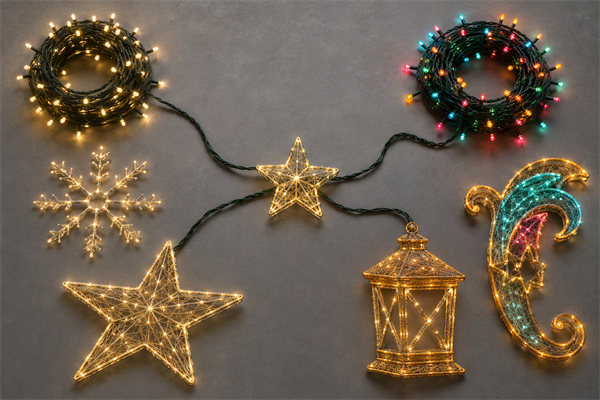
The honest answer is that "Christmas lights" and "festival lights" are not clean, opposing categories. Christmas lights serve a defined seasonal theme with recognizable visual language. Festival lights cover broader public, commercial, and multi-event decoration needs. But for commercial buyers — importers, event groups, municipal contractors, and retail chains — the right product depends on project scene, installation environment, usage period, and visual goal, not on the product name alone.
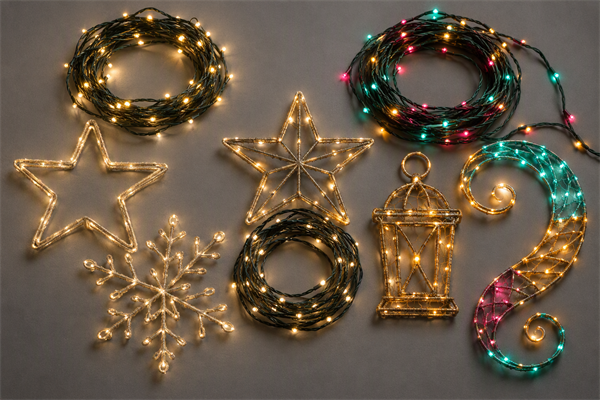
Most procurement mistakes I see come from borrowing household decoration logic and applying it to commercial projects. A mall display, a street installation, a municipal square, and an event venue each carry different requirements — and the right combination of string lights, motif lights, and shaped decorative lighting is almost never the same across two projects. The sections below walk through how to think about each variable.
Are "Christmas Lights" and "Festival Lights" Actually Different Product Categories?
Buyers who start with this question often find themselves in a frustrating loop. The product names overlap, suppliers use them interchangeably, and neither term maps cleanly onto a specification sheet.
Christmas lights refer to decorative lighting products designed around a seasonal, Christmas-specific visual theme — warm white or multicolor string lights, Santa and reindeer motif lights, snowflake and star shaped decorations. Festival lights is a broader commercial term that covers decorative lighting for any celebratory context: national holidays, street festivals, retail seasons, and large-scale public events. The product types often overlap; what separates them is the intended scene and buyer expectation.
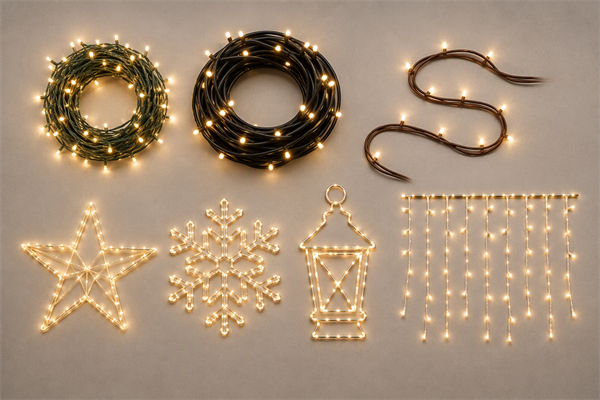
Understanding this distinction removes a common source of confusion in procurement conversations. The more useful question is not "which type?" but "what does this project actually need?" — and that question has several layers worth unpacking.
Why Product Names Mislead Commercial Buyers
When a buyer asks me for "Christmas lights," I need to ask several follow-up questions before I can recommend anything. The same is true when someone asks for "festival lights." Here is why the label alone is insufficient:
- Scene context matters. A shopping mall atrium display uses very different mounting and product specifications from a street canopy installation or a temporary event venue setup.
- Usage period changes the durability requirement. A three-week seasonal retail window display has a different product lifecycle expectation than a municipal street decoration that runs for eight to twelve weeks outdoors.
- Visual theme is not fixed by the label. Many projects I work on require a Christmas-themed aesthetic for an international retail chain — but that retail chain operates in markets where the commercial festival season starts in October and runs into the new year. "Christmas lights" as a label fits the theme, but the product spec needs to accommodate a longer display period.
- Batch consistency is a commercial requirement, not a household one. A household buyer replacing a damaged string of lights will tolerate minor color variation. A retail chain ordering for five hundred store locations cannot.
| Factor | Household Decoration | Commercial Project |
|---|---|---|
| Order volume | Small, often single units | Bulk, batch-consistent quantities |
| Display duration | Short, indoor seasonal | Can be extended, indoor or outdoor |
| Reuse expectation | Low | High — often multi-season |
| Packaging requirement | Standard retail | Project-specific, private label common |
| Delivery coordination | Flexible | Lead-time critical |
| Visual consistency | Not critical | Essential for chain or venue deployment |
What Do Different Commercial Project Types Actually Require?
This is the question most buyers should start with. Before any product recommendation is possible, the project type needs to be clear.
Commercial projects differ more from one another than they differ from "Christmas" versus "festival" as labels. The wrong product category for a project is rarely a Christmas-versus-festival mistake — it is almost always a project-type mistake.
Each commercial project type — retail decoration, street and municipal installation, event venue display, and wholesale distribution — requires a distinct combination of string lights, motif lights, and shaped decorative lighting. Project type, installation environment, usage period, and visual theme must all be defined before an accurate product recommendation or quotation is possible.[^2]
Retail Chain and Mall Displays
Retail environments are among the most specification-sensitive commercial buyers I work with. The reasons are straightforward.
A retail chain deploying seasonal decoration across dozens or hundreds of locations needs every product unit to match.[^3] Color temperature, brightness, connector type, carton dimensions, and labeling all need to be consistent across the full batch. Even a small variance in warm white color temperature — say, 2700K units mixed with 3000K units — will be visible in store[^4] and unacceptable to a visual merchandising team.
Key product considerations for retail:
- String lights in consistent color temperature, with reliable connector systems for modular display builds
- Motif lights — shaped decorative pieces such as stars, snowflakes, gift boxes, or custom branded shapes — for focal display points
- Packaging customization — private label or retailer-branded packaging is frequently required; this affects lead time and minimum order quantity
- IP rating — even indoor retail spaces near entrances may require products rated for occasional moisture exposure; buyers should verify what is appropriate for their specific installation points
In my experience handling retail inquiries, the specification that causes the most last-minute problems is packaging. Buyers finalize the product and approve samples, then raise custom packaging requirements two weeks before the shipping deadline. Custom packaging — barcodes, language variants, carton design — adds lead time. Raise it early.
Street and Municipal Installation
Municipal buyers and the contractors who serve them operate in a different risk environment from retail. Products are installed in public spaces, often at height, and must perform outdoors for extended periods.
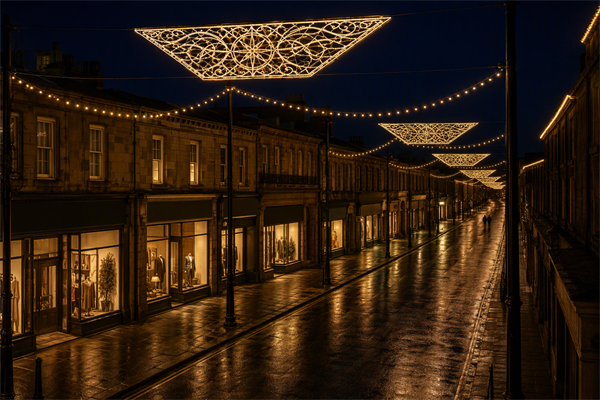
This is where the string light versus motif light versus shaped decoration combination becomes most complex. A typical street decoration scheme might include:
- Street motif lights — large-format shaped decorations (stars, snowflakes, angels, Christmas trees, lanterns) suspended over or across streets, usually with their own mounting hardware requirements
- Canopy string lights — spanning between poles or anchor points to create overhead light curtains or zig-zag light canopies
- Tree and column wrapping lights — high-density string lights or net lights applied to tree trunks, columns, or architectural elements
For outdoor municipal applications, IP65 or higher weatherproofing is a standard starting point for product consideration[^5] — but buyers must verify the specific outdoor rating requirements for their market and installation type with a qualified evaluator. I can supply products to a specification; I am not the authority on what a specific municipal installation code requires in a given country.
Reuse expectation is also critical here. Municipal street decorations are frequently a capital investment, not a seasonal expense. Buyers should ask suppliers about:
- Expected rated lifespan of LED components
- Whether replacement parts (replacement bulbs, spare connectors) are available
- How the product is packaged for storage and redeployment
Event Venue and Temporary Installation
Event management groups and venue decorators often have the most flexible visual requirements but the tightest delivery timelines. A product that needs eight weeks of lead time is useless to a buyer who confirmed the event brief five weeks ago.
For temporary event installations, the typical product mix leans toward:
- Fairy string lights and curtain lights for atmosphere and backdrop creation
- Battery-operated or low-voltage string lights where mains cabling is impractical in a temporary setup (buyers should confirm power and safety requirements with their event electrician)
- Themed motif lights in Christmas or broader festival designs depending on the event brief
- Custom shaped decorative lighting for branded or sponsor-integrated event displays
Lead time is the primary procurement risk in this category. Custom products — especially custom motif lights or branded shaped decorations — require tooling or sampling time.[^6] Standard catalog string lights and motif lights ship faster. Buyers should distinguish between standard and custom requirements early in the inquiry.
Wholesale and Distribution Buyers
Importers and wholesale distributors occupy a different position from project buyers. They are not selecting products for a single defined installation. They are curating a product range for resale — which means their selection criteria look different.
Key considerations for wholesale buyers include:
- Range breadth — a balanced mix of string lights, motif lights, and shaped decorations covering multiple price points
- Seasonal relevance — understanding which products are Christmas-specific (and therefore have a defined sell-through window) versus which festival light products carry broader year-round applicability
- MOQ and reorder terms — commercial wholesale requires clarity on minimum order quantities, reorder lead times, and whether tooled or customized products can be reordered at scale
- Certification documentation — wholesale buyers reselling into regulated markets (EU, UK, Australia, GCC) need to verify that products carry the appropriate certifications for their destination market; this is a buyer responsibility to confirm, not a claim I make on behalf of any market authority
How Should a Commercial Buyer Structure an Inquiry?
The inquiry is where most procurement inefficiency starts. Vague inquiries produce vague quotations — and then rounds of clarification that push delivery timelines.
A well-structured inquiry saves both buyer and supplier time and produces an accurate first-round quotation.
A complete commercial lighting inquiry should include: project type, installation environment (indoor/outdoor, country, venue type), usage period (dates, duration, reuse plans), visual theme or reference images, required certifications for the destination market, packaging requirements, and target quantity. These inputs directly affect product recommendation, lead time, customization feasibility, and pricing.[^7]

The Seven Inputs That Drive an Accurate Quotation
- Project type — retail, municipal, event, wholesale, or other
- Installation environment — indoor or outdoor, country of use, specific venue or location type
- Usage period — start date, display duration, whether the product will be stored and reused
- Visual theme — Christmas-specific, broader festival, branded, or other; reference images always help
- Certification requirements — CE, UKCA, SAA, GCC, or other; state the destination market; verify requirements with your compliance team
- Packaging requirements — standard, private label, retailer-specific barcode or language requirements
- Target quantity and delivery timeline — this determines whether standard or custom products are feasible within the project schedule
Buyers who provide these seven inputs in an initial inquiry receive faster, more accurate responses. Buyers who ask only "what is your price for Christmas lights?" receive a request for all seven inputs before any pricing can be offered.
Frequently Asked Questions
Can the same string lights be used for both Christmas and other festival decoration projects?
Yes, in many cases. White or warm white string lights, for example, carry no Christmas-specific visual association and are widely used across New Year, Diwali, Ramadan, and other festival decoration contexts. Color and motif choices are what create a Christmas-specific or broader festival identity. Define the visual theme before selecting products.
What is a motif light, and when does a commercial project need one?
A motif light is a shaped decorative lighting piece — a star, snowflake, reindeer, lantern, or custom form — constructed around an LED framework. Commercial projects use motif lights when they need identifiable, focal decorative elements rather than ambient or canopy lighting. Street installations, retail focal displays, and event centrepieces are common applications.
How early should a commercial buyer start the procurement process for seasonal festival lighting?
For standard catalog products, a minimum of eight to twelve weeks before the required delivery date is a reasonable starting point. For custom products — custom motif lights, private label packaging, or branded shaped decorations — allow additional time for sampling, tooling approval, and production. Buyers sourcing from China should also account for Chinese New Year production schedules if their delivery falls in the first quarter.[^8]
Do festival lights need different certifications than Christmas lights?
Certification requirements depend on the destination market and the product's electrical specifications[^9], not on whether the product is labeled "Christmas" or "festival." CE marking is relevant for the EU market; UKCA for the UK; SAA for Australia; GCC for Gulf markets.[^10] Buyers must verify the specific requirements for their destination market with their compliance team or a qualified certification body — these are not determinations a product supplier makes on behalf of a market authority.
What is the minimum order quantity for commercial festival lighting projects?
MOQ varies by product type, customization level, and supplier. Standard catalog string lights and motif lights typically carry lower MOQs than custom-designed shaped decorations or private label products. Buyers should discuss MOQ, reorder terms, and batch consistency requirements directly with their supplier as part of the initial inquiry.
Conclusion
The Christmas lights versus festival lights question is the wrong starting point for commercial procurement. The right starting point is the project itself — its scene, environment, duration, visual goal, and destination market. String lights, motif lights, and shaped decorative lighting are the building blocks. The project type determines how they are combined, specified, and sourced.
Commercial buyers who define their project requirements before asking for a quotation get better products, more accurate pricing, and fewer last-minute surprises. As a manufacturer and supplier with experience across retail, municipal, event, and wholesale projects globally, I have found that a well-briefed inquiry is the single most reliable predictor of a smooth procurement process.
If you are planning a commercial festival or Christmas lighting project and want to work through the right product combination for your specific requirements, contact our team with your project brief. We will start with the right questions.
[^1]: "Enhancing performance measurement of public procurement ...", https://pmc.ncbi.nlm.nih.gov/articles/PMC10877244/. Procurement research links incomplete or inaccurate requirement specification to supplier clarification cycles, schedule delay, cost growth, and nonconformance, providing general support for the article's claim that choosing the wrong project category can affect lead time, packaging, consistency, and budget. Evidence role: general_support; source type: paper. Supports: Research should connect unclear or inaccurate procurement specifications with delays, cost growth, supplier clarification, and nonconforming outputs.. Scope note: The support would be general procurement evidence rather than lighting-industry-specific proof.
[^2]: "Lighting Design: Techniques to Transform Interior Spaces", https://marymount.edu/blog/lighting-design-techniques-to-transform-interior-spaces/. Lighting design guidance treats application, installation environment, operating conditions, maintenance expectations, and visual objectives as inputs that determine luminaire selection and system specification, supporting the article's claim that these variables should be defined before quotation. Evidence role: general_support; source type: research. Supports: Lighting design or procurement sources should show that application, environment, use pattern, and design intent affect luminaire selection and specification.. Scope note: The source would support the specification logic generally, not the exact supplier quotation process for festival lighting.
[^3]: "The Impact of Visual Cues and Service Behavior on the ...", https://digitalcommons.usu.edu/cgi/viewcontent.cgi?article=1210&context=honors. Retail and visual-merchandising studies identify store atmosphere and consistent visual presentation as contributors to brand perception and customer experience, supporting the article's claim that multi-location seasonal decoration requires matching product appearance. Evidence role: general_support; source type: paper. Supports: Research should connect consistent retail atmospherics or visual merchandising with brand perception and customer experience across stores.. Scope note: This would support the business rationale for consistency, not a technical tolerance for any specific lighting product.
[^4]: "Solid-state lighting metrology", https://www.nist.gov/programs-projects/solid-state-lighting-metrology. Research on correlated color temperature, chromaticity tolerance, and LED color consistency shows that observers can perceive differences among warm-white light sources under common viewing conditions, supporting the article's concern that mixed 2700 K and 3000 K products may appear inconsistent. Evidence role: mechanism; source type: paper. Supports: A lighting-science source should show that humans can perceive differences in correlated color temperature or chromaticity among warm-white LED sources.. Scope note: The exact visibility threshold depends on illuminance, adaptation, fixture placement, surrounding materials, and observer conditions.
[^5]: "IP code", https://en.wikipedia.org/wiki/IP_code. IEC 60529 defines the IP code system, with IP65 indicating dust-tight protection and protection against water jets, supporting the article's use of IP65 as a relevant weather-resistance benchmark for outdoor decorative lighting. Evidence role: definition; source type: institution. Supports: A standards source should define IP65 as dust-tight protection and protection against water jets, explaining why it is relevant to outdoor weather exposure.. Scope note: The definition does not prove that IP65 is sufficient, required, or optimal for every municipal installation.
[^6]: "Development of Functional Rapid Prototyping for the ...", https://scholarworks.uni.edu/cgi/viewcontent.cgi?article=4828&context=grp. Manufacturing and product-development literature describes custom tooling, prototyping, sampling, and approval as pre-production steps that add time before full-scale manufacturing, supporting the article's claim that custom motif or branded lighting requires additional lead time. Evidence role: mechanism; source type: education. Supports: A manufacturing or product-development source should explain that custom products often require tooling, prototyping, sampling, and approval before mass production.. Scope note: The evidence would describe manufacturing processes generally rather than measuring lead time for this specific product category.
[^7]: "How To Write Purchase Specifications", https://procurement.ofa.ncsu.edu/how-to-write-purchase-specifications/. Procurement studies show that clear technical specifications, compliance requirements, quantities, packaging information, and delivery terms improve supplier evaluation and quotation accuracy, supporting the article's claim that these inquiry inputs affect recommendation, feasibility, lead time, and price. Evidence role: general_support; source type: paper. Supports: Procurement research should show that complete and precise RFQ information affects supplier pricing, lead-time estimates, feasibility assessment, and bid accuracy.. Scope note: The support would apply to procurement practice broadly and may not isolate decorative lighting as a separate category.
[^8]: "Chinese New Year and its Impact on Global Supply Chain", https://ctl.mit.edu/news/chinese-new-year-and-its-impact-global-supply-chain. Official holiday calendars and supply-chain research document that China's Spring Festival creates an extended holiday period and associated manufacturing and logistics disruptions, supporting the article's statement that buyers sourcing from China should account for Chinese New Year when planning first-quarter deliveries. Evidence role: historical_context; source type: institution. Supports: A source should document that the Lunar New Year or Spring Festival creates an extended holiday period in China and can disrupt manufacturing and logistics schedules.. Scope note: The length and severity of disruption vary by factory, region, workforce return patterns, and shipping mode.
[^9]: "General Use Products: Certification and Testing", https://www.cpsc.gov/Business--Manufacturing/Testing-Certification/General-Use-Products-Certification-and-Testing. Official product-safety guidance explains that electrical-product compliance obligations are determined by the jurisdiction of sale, product type, voltage or electrical characteristics, and applicable regulations, supporting the statement that a decorative label such as 'Christmas' or 'festival' is not the compliance basis. Evidence role: definition; source type: government. Supports: Official compliance guidance should show that product-safety marking and certification obligations depend on the market of sale and the regulated characteristics of the product..
[^10]: "CE marking", https://en.wikipedia.org/wiki/CE_marking. Official conformity-assessment guidance identifies CE marking for covered products in the European Union, UKCA marking for Great Britain, Australian electrical-equipment approval and marking systems, and Gulf conformity requirements for regulated products, supporting the article's regional certification examples. Evidence role: definition; source type: government. Supports: Official sources should identify CE marking for covered EU products, UKCA marking for Great Britain, Australian electrical approval or marking systems, and Gulf conformity requirements for regulated products.. Scope note: The exact mark, certificate, or approval route depends on product scope and local rules; SAA should be treated as an Australian certification pathway rather than as the sole Australian compliance mark.
Table of Contents
- Christmas Lights vs. Festival Lights: Which Products Fit Different Commercial Projects?
- Are "Christmas Lights" and "Festival Lights" Actually Different Product Categories?
- What Do Different Commercial Project Types Actually Require?
- How Should a Commercial Buyer Structure an Inquiry?
-
Frequently Asked Questions
- Can the same string lights be used for both Christmas and other festival decoration projects?
- What is a motif light, and when does a commercial project need one?
- How early should a commercial buyer start the procurement process for seasonal festival lighting?
- Do festival lights need different certifications than Christmas lights?
- What is the minimum order quantity for commercial festival lighting projects?
- Conclusion