 EN
How Hotels and Resorts Can Choose Outdoor Christmas Lights for Seasonal Displays
Choosing outdoor Christmas lights for a hotel or resort sounds straightforward until the first peak-season failure call arrives. A connector fails on the main entrance display. A string light section goes dark mid-display. The replacement part is on a ship somewhere. These are not hypothetical problems — they come up repeatedly in project discussions with seasonal lighting buyers, and they almost always trace back to product selection decisions made months earlier.
Selecting outdoor Christmas lights for hotels and resorts is not simply a matter of brightness or price. The most reliable approach starts with mapping display zones and visitor flow, then building a product system — string lights, motif lights, curtain lights, tree wraps, and outline lighting — matched to each zone's durability demands, installation constraints, and seasonal timeline. Buyers who plan this way significantly reduce peak-season failure risk.
Understanding that logic — zones first, product systems second, timing third — is what separates a dependable seasonal lighting range from a collection of individual SKUs that look good in a catalogue but create problems in the field. The sections below walk through each layer of that decision in detail.
Why Should Hotels Think in Display Zones Before Choosing Christmas Lights?
Most sourcing conversations I have with importers and wholesalers start with product types. That is understandable — it is what suppliers quote on. But hotel and resort buyers quickly discover that a single string light specification cannot serve an entrance canopy, a poolside palm tree, and a covered walkway at the same time.
Display zone mapping solves this. Each zone in a hotel or resort property carries different brightness expectations, visitor exposure levels, weather conditions, and installation constraints.[^1] Matching the right festival light form to each zone is how importers help their hotel clients avoid both under-performance and over-specification.
Zone-based selection requires more upfront thinking, but it dramatically reduces the risk of stocking products that perform poorly in specific hotel environments. Here is how the major zones typically differ:
Entrance and Drop-Off Areas
Hotel entrances are high-visibility, high-scrutiny zones. Guests, photographers, and social media content creators all stop here. The display needs to look intentional and premium, not functional and generic.
In project discussions, entrance areas most often call for:
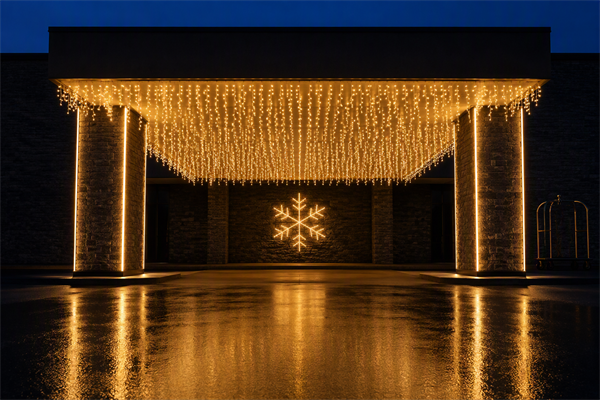
- Motif lights — shaped commercial-grade LED pieces (stars, snowflakes, angels, custom silhouettes) that anchor the visual theme
- Curtain lights or icicle lights — suspended from canopy edges or overhead structures for layered depth
- Large-scale outline lighting — tracing architectural features like columns, archways, or entrance gates
Weather resistance matters significantly at entrances because they are exposed. Buyers should ask suppliers about connector sealing, cable jacket materials, and IP ratings appropriate for their market conditions[^2]. These are factors to verify per specific project and regional safety standards — not universal guarantees.
Façade and Architectural Outlines
Façade lighting serves a different purpose. It creates the hotel's nighttime identity from a distance — the silhouette that guests photograph from across the car park or the street.
This zone rewards precision and uniformity. A façade strung with inconsistent festival lights — mismatched colour temperatures, uneven spacing, different cable gauges — reads as amateur at scale.
For importers stocking for hotel façade work, consistency across production batches matters as much as the specification itself. Colour temperature tolerance, LED chip consistency, and cable length standardisation all affect how the finished display looks. These are worth raising explicitly in supplier conversations.
Trees, Landscaping, and Pathway Areas
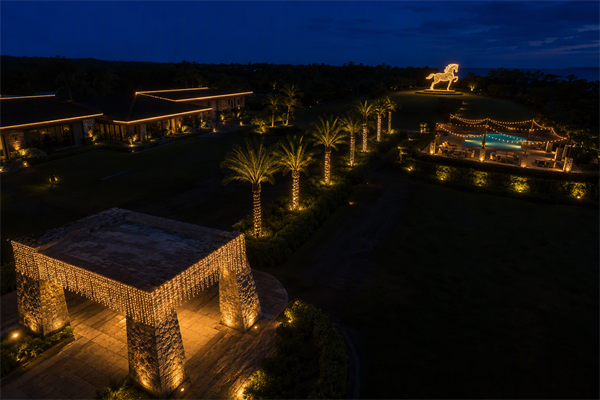
Trees and pathways represent the largest installation surface area in most hotel properties.[^3] They are also where maintenance problems concentrate, because access is harder, replacement during peak season is disruptive, and the lighting stays powered for extended hours each night.
- String lights are the dominant product form here. Wire gauge, bulb type (micro LED, C7, globe), and connector durability all affect longevity.
- Tree wrap net lights simplify installation on large specimen trees and reduce loose wire management.
- Pathway stake lights or ground-level accent pieces help define guest circulation routes after dark.
For importers, this zone is where unit cost decisions carry the most downstream risk. A marginally cheaper string light with weaker connectors across hundreds of pathway meters can generate a disproportionate number of service calls.
Poolside and Courtyard Areas
Poolside and courtyard environments introduce moisture, reflected light, and often wind exposure as compounding factors. The display also needs to feel warm and ambient rather than bright and retail-like.
Warm white string lights with weatherproof bulb sockets are a common fit. Solar-supplemented or low-voltage systems can simplify power management in zones where running mains power is difficult or expensive. However, voltage compatibility, local electrical regulations, and installation method are all decisions for qualified on-site professionals — not assumptions to build into a product specification from the sourcing side.
Photo Spots and Feature Installations
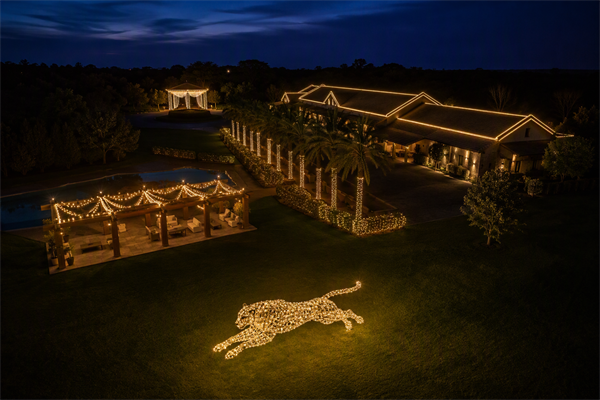
Many hotels now designate specific photo spots as social media activation points.[^4] These locations need a different product logic entirely. They reward visual novelty, strong colour saturation, and dimensional form over ambient coverage.
Custom motif lights, illuminated letters, 3D hanging display pieces, and large-format decorative LED sculptures all serve this zone. For importers and wholesalers, this is where customisation capability becomes a product differentiator. A supplier that can produce a branded or themed motif piece — a hotel's logo integrated into a star, a local landmark silhouette, a resort-specific animal motif — adds meaningful value for hotel clients seeking a distinctive display.
What Does a Hotel-Ready Outdoor Christmas Light Product System Look Like?
Single SKUs rarely solve a hotel's seasonal display. A lobby importer who stocks only standard fairy string lights will lose hotel accounts to a competitor who can supply the full visual layer — or help the buyer's client assemble one.
A hotel-ready product system means sourcing ranges that work together visually and operationally. The pieces need to share compatible colour temperatures, consistent cable and connector systems, and coordinated design language.
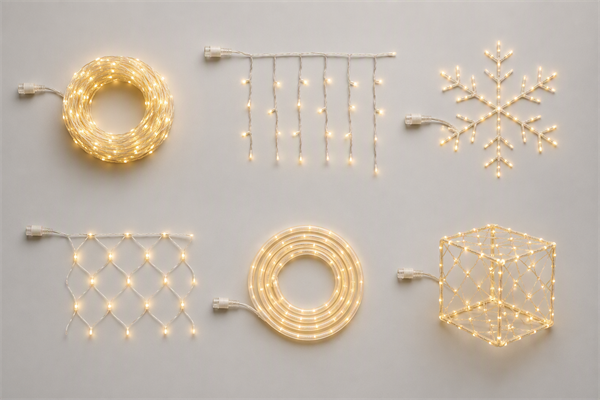
Building this kind of range takes deliberate selection logic, not just catalogue browsing. Here is how the system components typically fit together:
Core Product Categories and Their Display Functions
| Product Type | Primary Display Zone | Key Selection Criteria |
|---|---|---|
| String lights (LED, micro or bulb) | Trees, pathways, pergolas | Wire gauge, bulb type, connector durability, IP rating |
| Curtain lights / icicle lights | Façades, canopies, overhangs | Drop length consistency, power entry position, colour temperature |
| Motif lights | Entrances, photo spots, focal points | Structure rigidity, cable management, custom design availability |
| Net / wrap lights | Large trees, hedges, ground cover | Mesh pitch, LED density, ease of installation |
| Outline / rope lights | Architectural features, rooflines | Bend radius, colour consistency, waterproofing method |
| 3D feature pieces | Photo spots, lobby exteriors | Frame materials, weather resistance, power supply type |
Why Colour Temperature Consistency Matters Across a System
Warm white (2700K–3000K) is the dominant specification for premium hotel displays.[^5] But "warm white" is not a single standard[^6] — two products described identically can look visibly different on the same wall if their LED chips come from different sources or production runs.
For importers placing large seasonal orders, requesting colour temperature tolerance documentation and, where possible, batch consistency from the supplier is worth building into procurement conversations. Hotels operating multiple properties or refreshing displays season-to-season are particularly sensitive to visible inconsistency.
Operational Compatibility: Connectors and Power Systems
A frequently overlooked element of product system design is whether the products can actually be managed together on-site. Mismatched connectors between string lights and extension leads, incompatible voltage specs between zones, and different plug types across a mixed product order all create installation complexity.
For importers who supply hotel clients across multiple markets, voltage and plug configuration should be part of the product brief[^7] from the beginning — not a last-minute packaging change. Local electrical safety requirements vary by market and should be verified with qualified professionals in the destination country.
How Does Peak-Season Failure Risk Change the Way Importers Should Evaluate Christmas Lights?
The real cost of a poor outdoor Christmas lights specification is rarely visible in the unit price. It appears in the middle of December, when a hotel's display manager calls to say that 30% of the pathway lights have failed and the replacement units are six weeks away.
This scenario comes up in project discussions more often than it should. It almost always traces to the same cluster of decisions: prioritising unit cost over connector quality, skipping pre-shipment testing, or ordering too close to the installation window.
The Highest-Risk Failure Points in Outdoor Festival Lights
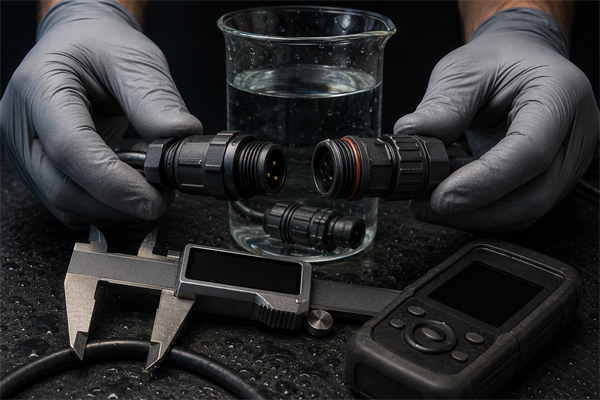
Understanding where festival lights fail helps importers ask better questions at the sourcing stage:
- Connectors and junction points[^8] — The most common failure site, especially in string lights exposed to rain, temperature cycling, or repeated coiling and uncoiling during installation
- Cable jacket degradation — UV exposure and temperature extremes break down PVC jackets[^9] faster on lower-specification materials; relevant for lights installed on rooftops, south-facing facades, or in high-sun climates
- LED solder joints[^10] — Vibration from wind, foot traffic near ground installations, or repeated handling during installation affects solder joint longevity in lower-grade productions
- Power supply and driver quality — For larger motif lights and 3D feature pieces, the power supply is often the first component to fail; it is also the most disruptive to replace mid-season
Buyers who are evaluating suppliers should ask specifically about these points rather than accepting general quality assurances. Certifications such as CE, SAA, or SABS are documents to verify per market — they indicate conformity testing has occurred[^11], but they do not replace a conversation about specific construction choices.
Sampling and Pre-Shipment Inspection
For importers placing significant seasonal orders, sampling before production commitment and pre-shipment inspection before shipment are both standard risk management steps. The additional lead time these require is one more reason why project timelines need to start earlier than most buyers initially plan.
Why Does Delivery Timing Belong in the Product Quality Conversation?
Timing is not a logistics footnote. For seasonal displays, it is a core component of whether the product actually works.
Hotels typically have a fixed installation window — a narrow number of weeks before Christmas when contractors are available, when the property is not yet at peak occupancy, and when the display must be complete and operational. Missing that window by even two weeks can mean the display opens late, is rushed, or is incomplete.
The Seasonal Supply Chain Timeline
In project supply discussions, a workable backwards timeline from a typical early-December hotel installation window looks roughly like this:
- Installation window: first week of December
- In-country clearing and delivery: allow 2–3 weeks before installation
- Ocean freight transit: 3–5 weeks from origin port, depending on routing
- Pre-shipment inspection: 1 week
- Production: 4–8 weeks depending on product complexity and customisation
- Sample approval: 2–3 weeks
- Order placement: therefore, roughly 14–20 weeks before installation
That puts a clean order placement date in July or early August for a December installation. Many first-time importers in this category place orders in October and spend December managing a crisis.

Customisation Extends Lead Times Further
Custom motif lights — branded pieces, bespoke shapes, or client-specific colour schemes — add 2–4 weeks to production timelines at minimum. For importers whose hotel clients want distinctive or branded display elements, this makes early commercial alignment between the importer and the supplier essential.
Replenishment planning also belongs in this conversation. A hotel that needs to replace failed sections mid-season, or expand the display for a New Year's event, cannot wait six weeks for a container. Importers who pre-position a buffer stock of high-failure-risk components — connectors, replacement bulbs, short extension sections — provide meaningfully better service to hotel clients than those who do not.
Frequently Asked Questions
What IP rating should outdoor Christmas lights have for hotel use?
IP44 is a common baseline for most outdoor decorative lighting in sheltered or semi-exposed positions. Fully exposed installations — rooftops, façades, or poolside areas — often call for IP65 or higher. Exact requirements depend on the specific installation environment and local electrical standards, which qualified professionals in the destination market should confirm.
Can the same string light specification work across different hotel zones?
Rarely at the premium end. Entrance displays, pathway lighting, and poolside areas have different brightness, weather exposure, and aesthetic requirements. Importers who recommend a single string light specification for all zones often find that hotel clients report it as under-performing in some areas and over-engineered in others.
How early should an importer place a Christmas lights order for hotel clients?
In most project supply discussions, 14–20 weeks before the installation window is a practical minimum for standard products. Custom or branded motif lights require additional lead time. For a first-week-of-December installation, that means order placement in July or August at the latest.
What makes motif lights worth the higher unit cost for hotel displays?
Motif lights solve a specific display problem that string lights cannot: they create a focal point with a defined visual identity. At hotel entrances and photo spots, a well-made motif piece signals intent and premium quality in a way that ambient string lighting alone does not. The unit cost is higher, but the display impact per piece is also disproportionately high.
Should importers stock spare components alongside main seasonal lighting products?
Yes — particularly for connectors, replacement bulbs or LED sections, and power supply units for larger motif lights. These are the highest-failure-rate components in a hotel display. Pre-positioning replaceable parts reduces mid-season emergency orders and protects the importer's service reputation with hotel clients.

Conclusion
Selecting outdoor Christmas lights for hotels and resorts is ultimately a product system and risk management decision, not a catalogue exercise. The most effective approach starts with display zones, builds a coherent system of string lights, festival lights, motif lights, curtain lights, and feature pieces matched to each zone's demands, and then plans the supply timeline backwards from the installation window.
For importers and wholesalers, the competitive advantage is not the lowest unit cost — it is the ability to recommend a dependable, visually consistent range that performs through peak season without emergency calls. If you are planning a hotel or resort seasonal lighting range and want to discuss product systems, customisation options, or supply timelines, I would welcome the conversation.
[^1]: "APPENDIX A. ROADWAY LIGHTING DETAILS | FHWA", https://highways.dot.gov/safety/other/visibility/roadway-visibility-research-needs-assessment/appendix-roadway-lighting. Professional exterior-lighting guidance treats outdoor lighting as an area- and task-specific design problem, with illuminance, glare control, exposure, and user movement considered separately for different zones; this supports the article's use of zone mapping, although it does not specifically prescribe hotel Christmas-light product categories. Evidence role: expert_consensus; source type: institution. Supports: A lighting-design standard or professional guide should support that exterior lighting requirements vary by application area, user activity, and environmental exposure.. Scope note: The support is contextual design consensus rather than direct evidence about seasonal hotel decorations.
[^2]: "IP code", https://en.wikipedia.org/wiki/IP_code. IEC 60529 defines ingress-protection codes as classifications for protection against solid-object and water entry into electrical enclosures, supporting the need to evaluate IP ratings and sealing for outdoor lighting; the standard defines protection classes but does not determine the correct rating for every local installation. Evidence role: definition; source type: institution. Supports: A standards source should define IP ratings and explain that they classify protection against solid-object and water ingress for electrical enclosures.. Scope note: The source supports the meaning and relevance of IP ratings, while project-specific suitability still depends on local conditions and codes.
[^3]: "Special Pedestrian Districts and Site Design for ...", https://hidot.hawaii.gov/highways/files/2013/07/Pedest-Tbox-Toolbox_9-Special-Ped-Districts-and-Site-Des-for-Peds.pdf. Hospitality landscape-planning literature commonly treats planting, pedestrian circulation, and outdoor amenity areas as major components of resort and hotel site design, which contextualizes why trees and pathways can dominate seasonal-lighting coverage; it does not quantify their share in all hotel properties. Evidence role: general_support; source type: education. Supports: A hospitality landscape-design or site-planning source should show that hotels and resorts commonly include extensive planted areas and pedestrian circulation paths that form major exterior design elements.. Scope note: The support is contextual and may not prove that these are the largest surfaces at every property.
[^4]: "Revisiting a destination image model in the social media ...", https://dr.lib.iastate.edu/bitstreams/d080188c-28a7-4806-af14-fc3edf3e1b50/download. Hospitality and tourism research on user-generated social-media content describes visually distinctive hotel and destination spaces as tools for encouraging guest photography and online sharing, supporting the article's reference to photo spots as social-media activation points; the evidence is about marketing behavior rather than Christmas lighting specifically. Evidence role: general_support; source type: paper. Supports: A hospitality or tourism paper should support that hotels and destinations use visually distinctive spaces to encourage guest photography and social-media sharing.. Scope note: The support is indirect because it concerns social-media-oriented hospitality spaces generally.
[^5]: "Color temperature", https://en.wikipedia.org/wiki/Color_temperature. Lighting references commonly classify correlated color temperatures around 2700K–3000K as warm white and associate them with warmer, more relaxed interior or hospitality atmospheres, supporting the article's CCT range; such sources do not prove that this range is dominant across all premium hotel Christmas displays. Evidence role: definition; source type: institution. Supports: A lighting source should support that 2700K–3000K is generally classified as warm white and is often used where warm ambience is desired.. Scope note: The evidence supports the technical classification and hospitality ambience association, not a quantified market share.
[^6]: "Solid-state lighting metrology", https://www.nist.gov/programs-projects/solid-state-lighting-metrology. Technical lighting guidance explains that LED color appearance is specified by correlated color temperature and chromaticity tolerances, so products with the same nominal label, such as warm white, may still differ visibly; this supports the article's warning about color consistency, although perceived differences also depend on viewing conditions and adjacent surfaces. Evidence role: mechanism; source type: government. Supports: A government or technical lighting source should explain that LED products with similar nominal CCT labels can vary in chromaticity because of binning and tolerance ranges.. Scope note: The source supports the mechanism of variation rather than documenting a specific hotel-display failure.
[^7]: "Mains electricity by country", https://en.wikipedia.org/wiki/Mains_electricity_by_country. International references on mains electricity document that voltage, frequency, and plug/socket configurations vary by country, supporting the need to define these parameters early in an imported lighting product brief; such references identify compatibility issues but do not address every certification requirement for decorative lighting. Evidence role: general_support; source type: encyclopedia. Supports: A neutral reference should document that countries use different mains voltages, frequencies, and plug/socket systems.. Scope note: The support is general electrical-infrastructure context, not product-specific compliance advice.
[^8]: "The influence of thermal cycling test parameters on ...", https://ui.adsabs.harvard.edu/abs/2022MiRe..13814633K/abstract. Reliability studies of electrical connectors identify moisture, corrosion, fretting, contact resistance changes, and thermal or mechanical cycling as common mechanisms of connector degradation, supporting the article's focus on connectors and junctions as vulnerable points; the literature may not rank them as the single most common failure site in decorative lighting. Evidence role: mechanism; source type: paper. Supports: A reliability paper should support that electrical connectors are vulnerable to moisture ingress, corrosion, contact resistance changes, and mechanical stress.. Scope note: The support is mechanistic and may not provide failure-rate data for Christmas-light installations specifically.
[^9]: "Study of the natural ageing of PVC insulation for electrical ...", https://www.academia.edu/31931428/Study_of_the_natural_ageing_of_PVC_insulation_for_electrical_cables. Polymer-aging research shows that PVC insulation and jacketing can undergo photodegradation and thermal aging, including embrittlement and loss of mechanical properties, supporting the article's concern about UV and temperature exposure; degradation rates depend on formulation, stabilizers, exposure intensity, and service conditions. Evidence role: mechanism; source type: paper. Supports: A materials or electrical-insulation paper should support that PVC insulation or jacketing degrades under UV radiation and thermal aging.. Scope note: The source supports the material mechanism, not a universal service-life estimate for all light strings.
[^10]: "Failure Behavior and Mechanism of Solder Joint Under ... - PMC", https://pmc.ncbi.nlm.nih.gov/articles/PMC12898236/. Electronics-reliability studies identify thermal cycling, vibration, and mechanical handling as causes of solder-joint fatigue or cracking in electronic assemblies, supporting the article's identification of LED solder joints as a potential failure point; the evidence is general to electronic assemblies and may not isolate decorative-light strings. Evidence role: mechanism; source type: paper. Supports: An electronics-reliability paper should support that solder joints are susceptible to fatigue or cracking from vibration, handling stress, and thermal cycling.. Scope note: The support is mechanism-based rather than a field failure study of hotel lighting displays.
[^11]: "CE marking", https://en.wikipedia.org/wiki/CE_marking. Official conformity-assessment guidance explains that marks such as CE marking or third-party safety certifications signify compliance with specified regulatory or certification requirements, but the assessment route differs by scheme; this supports treating such documents as compliance evidence while qualifying the article's wording because CE marking is often based on manufacturer declaration rather than independent testing. Evidence role: definition; source type: government. Supports: Official conformity-assessment sources should explain what CE marking and product certification marks signify, while distinguishing self-declaration from third-party certification.. Scope note: The source should be used to clarify that not all marks prove identical third-party testing.
Table of Contents
- How Hotels and Resorts Can Choose Outdoor Christmas Lights for Seasonal Displays
- Why Should Hotels Think in Display Zones Before Choosing Christmas Lights?
- What Does a Hotel-Ready Outdoor Christmas Light Product System Look Like?
- How Does Peak-Season Failure Risk Change the Way Importers Should Evaluate Christmas Lights?
- Why Does Delivery Timing Belong in the Product Quality Conversation?
-
Frequently Asked Questions
- What IP rating should outdoor Christmas lights have for hotel use?
- Can the same string light specification work across different hotel zones?
- How early should an importer place a Christmas lights order for hotel clients?
- What makes motif lights worth the higher unit cost for hotel displays?
- Should importers stock spare components alongside main seasonal lighting products?
- Conclusion