 EN
EN

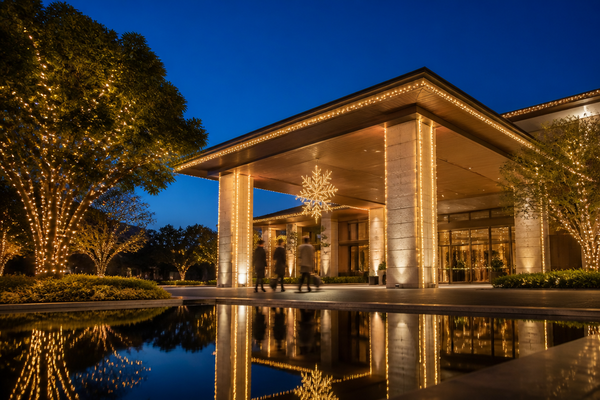
Hotel and Resort Festive Lighting: How Do You Balance Luxury and Practicality?
Hotel and Resort Festive Lighting can look impressive in a proposal but become risky when buyers focus only on style or price. A poor choice can create installation problems, maintenance pressure, and inconsistent guest experiences during peak season. I believe the better solution is to evaluate beauty, safety, durability, and supply reliability together.
Hotel and resort festive lighting should balance luxury and practicality by using coordinated themes, suitable brightness, durable outdoor-rated structures, safe electrical design, easy maintenance, and reliable supplier support. Importers and distributors should judge products by total cost of ownership, not only by catalog appearance or unit price.
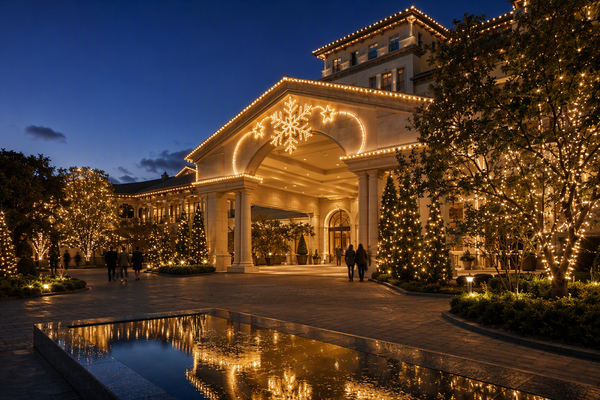
Luxury lighting is not just a brighter christmas light display or a larger decorative motif. In my manufacturing experience, the strongest festive concepts are usually the ones that combine visual discipline with practical engineering choices. The sections below explain how I would evaluate products before recommending them to hotel and resort buyers.
How Should Hotel and Resort Festive Lighting Create Luxury Without Overdesign?
Luxury can disappear when a lighting plan becomes too bright, too crowded, or too difficult to understand[^1]. Hotel guests expect atmosphere, not visual noise. The challenge is to create a premium festive mood while keeping the space elegant, comfortable, and aligned with the property’s brand.
Hotel and Resort Festive Lighting creates luxury through coordinated themes, correct scale, layered brightness, suitable color temperature, and scene-specific placement[^2]. A refined design usually uses fewer random products and more consistent visual language across entrances, facades, gardens, pathways, restaurants, poolside areas, and photo spots.
Luxury Starts With Visual Control
I often remind buyers that luxury is not the same as excess. A hotel lobby, garden entrance, or resort pathway can look premium with carefully selected LED string lights, motif lights, and decorative structures. However, the same space can look cheap if every product uses a different color, flash speed, cable color, or light density.
For hotel and resort projects, visual control usually starts with these questions:
- What is the main theme: classic Christmas, winter luxury, tropical holiday, Arabic-inspired décor, or modern minimalism?
- What color temperature fits the space: warm white, cool white, champagne gold, RGB, or mixed tones?
- What areas need attention: entrance, trees, facade, corridor, poolside, dining area, or event lawn?
- What should guests photograph?
- What should stay in the background?
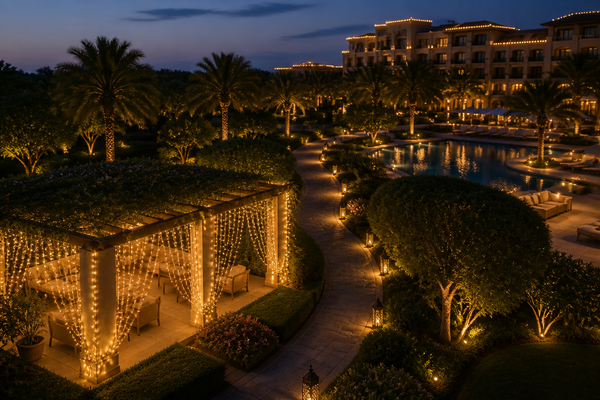
A premium result often comes from layering, not from adding more products. For example, an importer might propose warm white string light curtains for a garden pergola, low-brightness pathway motifs near walking areas, and one larger custom holiday design at the main entrance. Each element has a job.
Scene-Specific Placement Matters
Different hotel zones need different lighting logic. A bright facade installation may work well from a distance, but the same brightness near a restaurant terrace may feel harsh[^3]. A decorative motif light near a poolside area may need more careful structure and positioning than a product placed in a dry indoor lobby.
| Hotel or Resort Area | Visual Goal | Practical Buying Concern |
|---|---|---|
| Main entrance | Strong first impression | Scale, stability, weather resistance |
| Lobby or indoor atrium | Elegant welcome | Fire-safe materials, cable management |
| Garden pathways | Soft guidance | Low glare, waterproofing, trip-risk control |
| Facades | Brand visibility | Mounting method, wind exposure, access |
| Poolside areas | Relaxed atmosphere | Moisture resistance, safe placement |
| Event lawns | Photo opportunities | Modular structure, repeat installation |
This is where manufacturing experience becomes useful. A beautiful drawing must become a manufacturable product. If a custom motif is too large for shipping, too fragile for repeated use, or too hard to mount, the importer may face after-sales issues later.
Color Temperature and Brightness Should Match the Brand
A luxury city hotel may prefer warm white or champagne tones because they feel soft and refined. A family resort may choose richer colors and playful shapes. A beachfront property may prefer softer outlines and lower glare.
I would avoid assuming one solution fits every hotel. Buyers should request samples, mock-up photos, or small trial sets when possible. A string light that looks perfect in a dark warehouse may appear too dim on a bright facade or too strong beside reflective glass.
A practical luxury display should look premium in photos, feel comfortable in person, and remain manageable for the installation team.
For importers and distributors, this means the product range should include both decorative variety and specification discipline. Matching cable colors, consistent LED tone, stable controllers, and repeatable production batches can matter as much as the visible design itself.
What Makes Hotel and Resort Festive Lighting Practical for Importers and Distributors?
A festive lighting product can look attractive in a catalog but still create problems for the importer. Late installation, missing spare parts, unclear packaging, or inconsistent repeat orders can damage the distributor’s relationship with hotel clients. Practicality protects both the buyer and the final project.
Hotel and Resort Festive Lighting is practical when it supports easy installation, accessible maintenance, controlled power planning, repeatable packaging, spare-part replacement, energy-aware operation, and consistent reordering. The most practical choice is often the product with the best total cost of ownership, not the lowest initial price[^4].
Total Cost of Ownership Is the Real Price
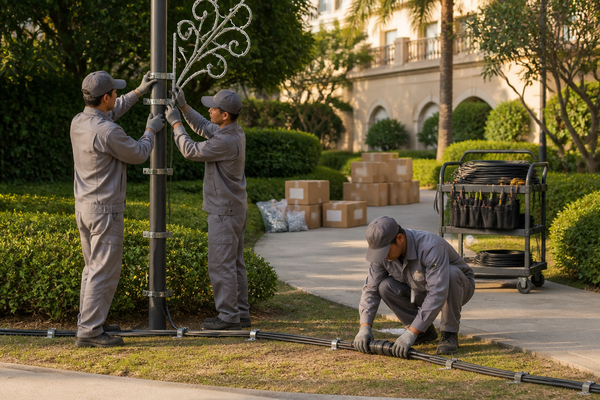
In B2B festive lighting supply, the unit price is only one part of the cost. I have seen buyers spend a lot of time negotiating a small price difference while overlooking packaging volume, installation accessories, replacement policies, or cable length requirements. These details can change the real project cost.
Importers and wholesalers should review the full cost picture:
-
Product cost
This includes the decorative item, cable, controller, transformer, connectors, and accessories. -
Installation cost
A complex structure may require more labor, lifting equipment, or custom brackets. -
Shipping and storage cost
Oversized motifs and poorly designed cartons can increase freight and warehouse pressure. -
Maintenance cost
Public-space lighting needs accessible replacement parts and clear repair logic. -
Repeat-order cost
If the product cannot be reproduced consistently next season, the hotel may need a redesign. -
After-sales cost
Missing labels, unclear manuals, or weak packaging can cause claims and delays.
Practical Product Features to Check
A practical hotel lighting product should be easy to understand before purchase. Importers should ask for clear information, not just attractive photos.
| Evaluation Item | Why It Matters for Hotels and Resorts |
|---|---|
| Modular design | Easier shipping, installation, repair, and storage |
| Clear cable layout | Reduces confusion during setup |
| Replaceable parts | Supports maintenance during peak season |
| Consistent LED color | Keeps the display visually uniform |
| Suitable packaging | Protects goods during international transport |
| Batch documentation | Helps distributors manage repeat orders |
| Installation guidance | Reduces avoidable mistakes on site |
A basic string light order may seem simple, but hotel use can make it more demanding. For example, a tree-wrapping project may need specific cable color, LED spacing, waterproof connectors, and packing by area. If everything arrives mixed in generic cartons, the installer may waste time sorting products on site.
Energy Use Should Be Evaluated Carefully
LED festive lighting is generally more energy-efficient than older lighting technologies[^5], but actual energy use depends on product type, quantity, operating hours, voltage system, controller mode, and local electricity costs[^6]. I would avoid making universal savings claims without project data.
For hotel and resort buyers, energy planning should include:
- Estimated total wattage by area
- Daily operating hours
- Transformer or power supply location
- Cable run length
- Local voltage and plug requirements
- Dimming or timer options
- Backup and maintenance access
A distributor does not need to act as the hotel’s electrical engineer. However, the distributor should provide accurate product information so the hotel’s qualified installation or engineering team can make safe decisions.
Packaging and Reuse Matter More Than Many Buyers Expect
Hotels often reuse festive decorations for more than one season. Poor packaging can damage products during storage, especially motif lights, acrylic designs, and frame-based structures. I prefer packaging plans that show how the product will be removed, installed, repacked, and stored.
Good packaging may include:
- Area-based carton labels
- Inner protection for LED sections
- Moisture-resistant packing for sea freight
- Spare parts in clearly marked bags
- Assembly diagrams inside cartons
- Carton numbers linked to the packing list
These details do not always look exciting in a product photo. However, they often decide whether a festive lighting program feels easy or painful for the hotel client.
Which Safety and Quality Factors Matter Most in Public-Area Festive Lighting?
Public-area lighting carries more responsibility than private home decoration[^7]. A hotel or resort display may be touched by guests, exposed to rain, installed near pathways, or operated for long hours. If quality is weak, the risk is not only product failure. The risk can become reputational and operational.
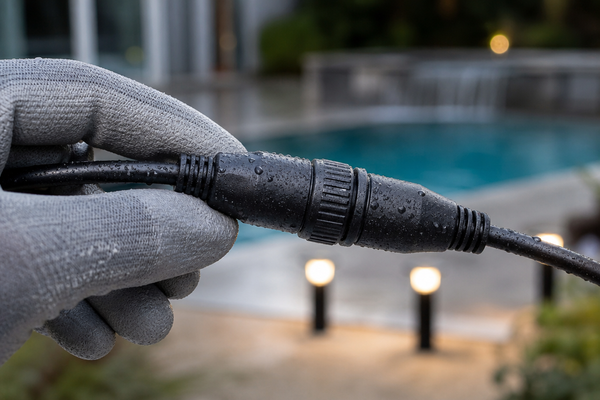
The most important safety and quality factors include suitable materials, waterproof structure, stable electrical components, weather resistance, safe installation design, verified documentation, and destination-market compliance. Buyers should verify all certification claims against local regulations and project requirements before approving any festivel light product.
Public Spaces Require Conservative Product Selection
A decorative product for a small retail window is different from a product used in a hotel garden, resort entrance, or outdoor event zone. Public-space use usually requires more conservative selection because many people pass through the area. Weather, cleaning routines, children, luggage carts, and event traffic can all affect the installation.
I am not a hotel engineer, so I do not make final site-safety decisions for a property. However, from a manufacturing and B2B supply perspective, I believe importers should check whether the product structure matches the intended environment.
Important questions include:
- Will the product be used indoors or outdoors?
- Will guests be able to touch it?
- Will it face rain, wind, sun, humidity, or salt air?
- Will it be installed near water features or poolside areas[^8]?
- Will it need to operate every night for several weeks?
- Will the hotel’s maintenance team need to replace sections quickly?
Materials and Structure Affect Durability
For motif lights and custom holiday designs, the frame, coating, cable, LED, connector, and decorative covering all contribute to durability. If one part is weak, the whole display can fail early.
| Component | Buyer Should Check | Hotel Scenario |
|---|---|---|
| Metal frame | Thickness, coating, weld quality | Outdoor entrance motifs |
| LED light source | Color consistency, layout, rated specs | Photo zones and facades |
| Cable | Insulation, flexibility, color | Tree wrapping, garden use |
| Connector | Fit, sealing, replacement access | Outdoor modular displays |
| Decorative material | UV resistance, flame-related documents where required | Indoor and outdoor décor |
| Power supply | Labeling, compatibility, protection | Long operating hours |
Waterproofing deserves special attention. Buyers often ask for an IP rating, but they should also ask how the product is constructed. A rating on paper is useful only when the design, production process, and installation method support the intended use[^9]. Destination-market requirements may also differ, so importers should ask qualified professionals to confirm what is required.
Certification Claims Should Be Verified
Our business has ISO9001 and BSCI certification, and these documents can help buyers understand our quality management and social compliance framework. However, I would never suggest that these certificates automatically prove every product is suitable for every hotel project.
For technical and public-area festive lighting, buyers should verify:
- Product test reports
- Electrical labels
- Market-specific compliance documents
- Material declarations where needed
- Production inspection records
- Destination voltage and plug requirements
- Project-specific installation requirements
Some markets may require CE, UKCA, RoHS, REACH, SAA, UL, ETL, or other documentation depending on product type and destination[^10]. The correct requirement is project- and market-dependent. Importers should confirm with local authorities, testing bodies, or qualified compliance consultants before committing to a hotel tender.
Inspection Should Happen Before Shipment
Quality control should not wait until the goods reach the hotel[^11]. A distributor serving premium clients should build inspection steps into the order timeline.
Common inspection points include:
-
Pre-production sample confirmation
Buyers should approve LED color, size, cable color, materials, and structure. -
Incoming material checks
The factory should monitor key materials before mass production. -
In-process inspection
Workers and QC staff should check assembly quality, wiring, coating, and dimensions. -
Function testing
Products should be powered on and checked for light performance. -
Packaging inspection
Labels, carton strength, spare parts, and packing lists should be verified. -
Final random inspection
Buyers may use their own team or third-party inspectors before shipment.
For hotel and resort festive lighting, a small defect can become a large problem when the installation deadline is fixed. This is why quality control must connect directly to delivery planning.
How Should Buyers Evaluate Suppliers for Hotel and Resort Festive Lighting?
A supplier is not just a source of products. For hotel and resort festive lighting, the supplier affects design feasibility, production consistency, delivery timing, documentation, and after-sales response. A weak supplier can make even a beautiful concept difficult to execute during peak season.
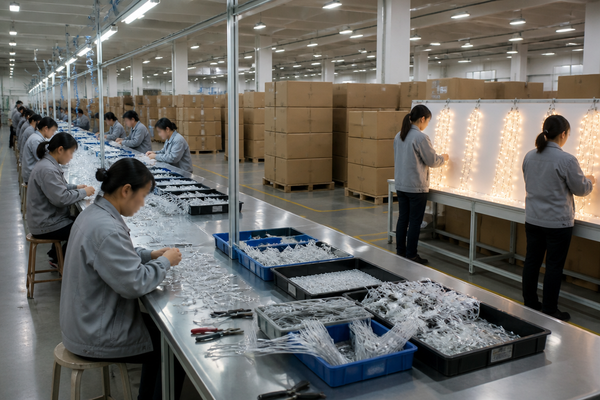
Buyers should evaluate suppliers by manufacturing capability, quality control process, export experience, sample accuracy, lead-time reliability, packaging design, replenishment ability, and communication speed. For Hotel and Resort Festive Lighting, supplier reliability is part of the product value, especially for importers serving demanding hotel clients.
Manufacturing Capability Supports Custom Design
Hotel and resort buyers often want a unique visual identity. They may request custom colors, logo elements, large entrance motifs, themed arches, or coordinated christmas light installations across several zones. These requests are reasonable, but they must be manufacturable.
As an integrated manufacturer and trading supplier based in Zhongshan, China’s well-known lighting industry center[^12], my team works with LED string lights, decorative motif lights, and custom holiday designs. This experience helps us evaluate whether a concept can be produced consistently, packed safely, and shipped efficiently.
When buyers evaluate a supplier, they should ask:
- Can the supplier produce both standard and custom designs?
- Can the supplier provide drawings or mock-ups before production?
- Can the supplier control LED color consistency across batches?
- Can the supplier explain the frame, cable, connector, and packaging structure?
- Can the supplier support repeat orders next season?
- Can the supplier offer spare parts and replacement sections?
Lead Time Must Match Peak-Season Reality
Festive lighting is seasonal. Hotels and resorts often need products installed before Christmas, New Year, Ramadan events, national celebrations, or regional tourism peaks. If production or shipping runs late, the commercial value of the order drops quickly.
Importers should work backward from the installation date:
| Timeline Step | Buyer Action |
|---|---|
| Concept stage | Confirm theme, target areas, and budget range |
| Sampling stage | Approve color, structure, and key specifications |
| Production stage | Reserve capacity and confirm inspection plan |
| Shipping stage | Choose freight method and check documents |
| Installation stage | Ensure labels, drawings, and spare parts are ready |
| After-season stage | Record issues for replenishment and improvement |
For large or custom orders, buyers should avoid waiting until the last moment. Factories can become busy before peak festive seasons. Raw material availability, shipping schedules, and inspection windows can also affect delivery.
Batch Consistency Protects Distributor Reputation
A hotel client may reorder the same motif light, string light, or facade decoration next year. If the new batch has a different LED tone, frame size, cable color, or controller effect, the distributor may face complaints.
This is why batch records matter. A reliable supplier should be able to keep product specifications organized. Useful records may include:
- Approved sample photos
- LED color temperature range
- Material specifications
- Cable and connector details
- Frame dimensions
- Packing method
- Label format
- Previous order references
For distributors, these records are not just factory paperwork. They are tools for protecting long-term client relationships.
Communication Is a Real Supply Chain Asset
International festive lighting supply involves many details. A small misunderstanding about voltage, plug type, carton marking, or installation accessories can cause real problems. A supplier should respond clearly and quickly, especially before production begins.
I prefer communication that is practical and documented. For example:
- Confirm product specifications in writing.
- Use annotated photos for custom details.
- Share packing lists before shipment.
- Mark spare parts clearly.
- Keep inspection reports easy to review.
- Discuss risks early instead of hiding them.
A supplier does not need to promise everything. In fact, I trust suppliers more when they explain limitations clearly. For hotel and resort festive lighting, honest feasibility review is better than an unrealistic “yes” during quotation.
Frequently Asked Questions
What is the best type of festive lighting for hotels and resorts?
The best type depends on the area, theme, climate, and installation method. Many projects combine LED string lights, motif lights, curtain lights, and custom decorative structures. Buyers should evaluate visual effect, safety, waterproofing, maintenance access, and supplier reliability before choosing.
Should hotel festive lighting use warm white or colorful LEDs?
Warm white often creates a more elegant and luxury atmosphere, while colorful LEDs can suit family resorts, theme events, or high-energy holiday zones. The right choice depends on the hotel brand, guest profile, location, and design concept. Buyers should confirm samples before mass production.
How can importers reduce risk when buying custom festive lights?
Importers can reduce risk by confirming drawings, approving samples, checking materials, verifying compliance documents, planning inspections, and requesting clear packaging. They should also confirm lead times early because custom festive lighting can be difficult to rush during peak season.
Are certifications enough to prove a lighting product is suitable for hotel use?
No. Certifications and audit documents are useful trust signals, but buyers should verify product-specific test reports and destination-market requirements. Hotel projects may also need qualified electrical or safety evaluation based on local regulations, installation location, and public-area use.
Why does supplier reliability matter for hotel and resort festive lighting?
Supplier reliability affects production consistency, delivery timing, spare parts, packaging, and repeat orders. Hotel clients often work with fixed installation dates and high guest expectations. A reliable supplier helps importers protect both project quality and customer relationships.
Conclusion
Hotel and Resort Festive Lighting should deliver a premium guest experience without creating avoidable problems for importers, distributors, or hotel operators. The best buying decisions consider theme coordination, product structure, safety documents, installation practicality, packaging, maintenance, and supplier reliability. I recommend treating every project as both a visual display and a supply-chain commitment. If you need LED string lights, decorative motif lights, or custom festive designs for hotel and resort clients, contact us to discuss a practical, manufacturable solution.

[^1]: "Influence of color on glare perception revealed when seeing the sun ...", https://pmc.ncbi.nlm.nih.gov/articles/PMC12521605/. Professional lighting-design guidance identifies glare control, luminance balance, and visual comfort as central elements of lighting quality, supporting the article’s claim that excessive brightness or visual clutter can weaken the perceived quality of a display; the evidence is general design guidance rather than a hotel-festive-lighting experiment. Evidence role: expert_consensus; source type: institution. Supports: Lighting quality depends on visual comfort, glare control, luminance balance, and appropriate visual hierarchy rather than brightness alone.. Scope note: Contextual support from lighting-design standards or guidance, not direct proof of guest reactions to a specific hotel display.
[^2]: "Hotel Lighting Strategies Using Layered Architectural Illumination", https://boca.lighting/lighting-design-for-luxury-hotels-key-principles-and-layering-strategies/. Hospitality and architectural lighting literature describes layered illumination, color temperature, spatial hierarchy, and zone-specific lighting as standard tools for shaping ambience and user experience, supporting the article’s design rationale; it does not specifically evaluate seasonal hotel decorations. Evidence role: general_support; source type: education. Supports: Hospitality and architectural lighting design commonly uses layered lighting, appropriate color temperature, scale, and zoning to shape atmosphere and user experience.. Scope note: Supports the design principles generally, not the exact festive-lighting product mix proposed in the article.
[^3]: "Glare", https://www.energy.gov/cmei/ssl/glare. Research and lighting guidance on discomfort glare explain that perceived harshness depends on luminance, contrast, viewing angle, and observer position, supporting the article’s distinction between distant facade lighting and closer terrace lighting; the support is based on general glare mechanisms rather than a festive-lighting field trial. Evidence role: mechanism; source type: research. Supports: Perceived glare and visual discomfort are affected by luminance, contrast, viewing distance, and the observer’s position.. Scope note: Mechanistic support only; it does not quantify an acceptable brightness threshold for this specific hotel scenario.
[^4]: "Life Cycle Cost (LCC)", https://www.waru.edu/acquipedia-article/life-cycle-cost-lcc. Government procurement guidance defines life-cycle or total ownership cost as including acquisition, operation, maintenance, and related support costs, supporting the article’s claim that unit price alone is an incomplete basis for purchasing decisions. Evidence role: definition; source type: government. Supports: Total cost of ownership or life-cycle costing includes acquisition costs plus operating, maintenance, logistics, and end-of-life costs..
[^5]: "How Do Holiday Lights Work? - Department of Energy", https://www.energy.gov/articles/how-do-holiday-lights-work. Energy-efficiency guidance from government energy agencies reports that LED lighting uses substantially less electricity than incandescent lighting, supporting the article’s statement that LED festive lighting is generally more energy-efficient than older technologies. Evidence role: general_support; source type: government. Supports: LED lighting, including holiday lighting, typically uses substantially less electricity than incandescent lighting for comparable decorative use..
[^6]: "How much electricity is used for lighting in the United States? - EIA", https://www.eia.gov/tools/faqs/faq.php?id=99&t=3. Energy-use calculation guidance explains that electricity consumption and cost are derived from connected load, operating hours, control strategy, and local tariffs, supporting the article’s caution that actual festive-lighting energy use is project-specific. Evidence role: mechanism; source type: government. Supports: Lighting electricity use and cost are calculated from power demand, operating hours, controls, and applicable energy prices..
[^7]: "Temporary wiring and temporary lighting in heavy construction. - OSHA", https://www.osha.gov/laws-regs/standardinterpretations/1979-12-20-0. Electrical safety codes and public-event guidance treat temporary and publicly accessible electrical installations as requiring controls for environmental exposure, physical access, and shock or fire hazards, supporting the article’s more conservative approach to hotel public-area lighting. Evidence role: expert_consensus; source type: institution. Supports: Electrical installations used in public or temporary event settings require attention to access, environment, installation method, and protection against electrical hazards.. Scope note: The source would support the safety principle generally and may not address hotel festive lighting as a separate product category.
[^8]: "Don't Swim with Shocks: Electrical Safety In and Around Pools, Spas ...", https://www.cpsc.gov/safety-education/safety-guides/pools-and-spas/dont-swim-shocks-electrical-safety-and-around-pools. Electrical codes for swimming pools and wet locations impose specific requirements on equipment placement, protection, and installation, supporting the article’s warning that lighting near water features or poolside areas requires additional safety review. Evidence role: expert_consensus; source type: institution. Supports: Electrical equipment and lighting near pools or wet locations are subject to stricter safety provisions because water increases shock risk..
[^9]: "IP code - Wikipedia", https://en.wikipedia.org/wiki/IP_code. IEC 60529 defines IP codes as standardized classifications of enclosure protection against solid objects and water under specified test conditions, supporting the article’s point that the rating must be considered together with construction and installation conditions. Evidence role: definition; source type: institution. Supports: IP ratings classify enclosure protection under defined test conditions and do not independently validate all installation environments or field modifications.. Scope note: The standard defines the rating system; it does not certify the suitability of any particular festive-lighting product after installation.
[^10]: "RoHS Directive - Environment - European Commission", https://environment.ec.europa.eu/topics/waste-and-recycling/rohs-directive_en. Official conformity-assessment guidance for the EU, United Kingdom, and other markets shows that electrical products may be subject to different marking, safety, and chemical-compliance obligations depending on jurisdiction and product category, supporting the article’s market-dependent compliance statement. Evidence role: general_support; source type: government. Supports: Electrical and lighting products are subject to market-specific conformity, safety, and chemical-compliance requirements that vary by jurisdiction and product type..
[^11]: "ISO 9001 - Clause 8.6 Release of Products and Services ...", https://www.iso-templates.com/blog/iso-9001-clause-8.6-release-of-products-and-services-explained/. Quality-management standards such as ISO 9001 require organizations to control production, verify conformity, and release products only after specified acceptance criteria are met, supporting the article’s recommendation for pre-shipment and in-process quality checks. Evidence role: expert_consensus; source type: institution. Supports: Quality-management systems commonly require verification, inspection, and controlled release before products are delivered to customers..
[^12]: "Guzhen, Guangdong", https://en.wikipedia.org/wiki/Guzhen,_Guangdong. Regional government and industry-development sources identify Zhongshan, especially Guzhen, as a major lighting manufacturing and trade cluster in China, supporting the article’s geographic context; this does not verify the capabilities of the specific supplier. Evidence role: historical_context; source type: government. Supports: Zhongshan, particularly Guzhen, is widely identified in government or regional sources as an important lighting manufacturing and trade cluster in China.. Scope note: Supports the regional industry claim only, not the supplier’s individual production capacity.
Table of Contents
- Hotel and Resort Festive Lighting: How Do You Balance Luxury and Practicality?
- How Should Hotel and Resort Festive Lighting Create Luxury Without Overdesign?
- What Makes Hotel and Resort Festive Lighting Practical for Importers and Distributors?
- Which Safety and Quality Factors Matter Most in Public-Area Festive Lighting?
- How Should Buyers Evaluate Suppliers for Hotel and Resort Festive Lighting?
-
Frequently Asked Questions
- What is the best type of festive lighting for hotels and resorts?
- Should hotel festive lighting use warm white or colorful LEDs?
- How can importers reduce risk when buying custom festive lights?
- Are certifications enough to prove a lighting product is suitable for hotel use?
- Why does supplier reliability matter for hotel and resort festive lighting?
- Conclusion