 EN
EN

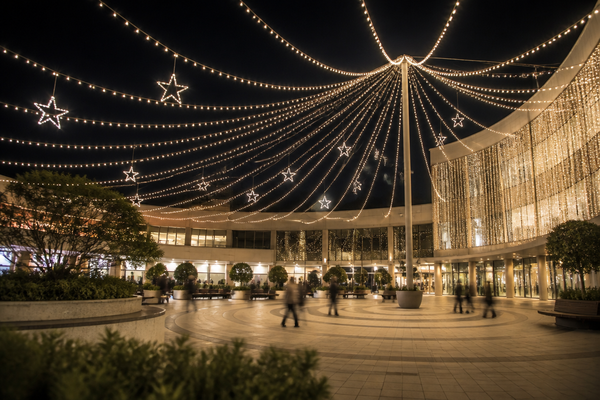
Multi-Season Lighting: Designing Installations That Work Beyond Christmas?
Multi-season lighting often fails when buyers start with a Christmas product list and hope the same items will work later. That creates awkward displays, extra storage, and slow-moving inventory. I prefer to treat lighting as a reusable seasonal asset, planned around the full commercial calendar before any product is selected.[^1]
Multi-season lighting means designing decorative lighting installations, product ranges, or retail programs that can serve several seasonal moments beyond Christmas. Buyers should plan from the annual event calendar, choose adaptable visual language, and calculate total ownership cost, including setup, dismantling, storage, replacement parts, and resale flexibility.

A color-changing christmas light is not automatically a year-round solution. In many customer discussions I have seen, the real challenge is not color alone. The deeper question is whether the shape, structure, control method, packaging, and maintenance plan can support multiple selling or installation cycles.
How Should Multi-Season Lighting Start With an Annual Event Calendar?
Many buyers lose value because they begin with products instead of dates. They choose a festive product, then later ask how to reuse it for New Year, Ramadan, summer retail, or national holidays. That order creates compromise. I start with the calendar because it shows the real reuse target.
Multi-season lighting should start with a clear annual event calendar. Buyers should list every occasion the lighting must support, define the visual tone for each event, and then select reusable elements that fit several moments. This approach reduces one-time inventory and helps importers, dealers, and project buyers plan smarter assortments.[^2]

Why the calendar comes before the product list
When I speak with importers or professional dealers, I often notice that the first request sounds product-based: “Do you have a new christmas light design?” or “Can this string light change color?” Those are useful questions, but they are not the first questions I would ask.
I would usually ask:
- Which months need commercial lighting activity?
- Which events drive real sales or project demand?
- Which events share similar colors, shapes, or atmosphere?
- Which installations must stay in place for several months?
- Which items must be repacked, stored, and sold again?
This order changes the buying logic. A product that looks perfect for December may be weak for February, May, or August. A more neutral item may look slightly less “Christmas-only,” but it may create more total value across the year.
A practical calendar framework
For importers and dealers, I would divide the calendar into seasonal selling windows rather than only holiday names.
| Calendar Window | Possible Use Case | Lighting Requirement | Reuse Potential |
|---|---|---|---|
| November–January | Christmas, New Year, winter shopping | Warm, festive, high visibility | High if motifs are neutral |
| February–April | Ramadan, Easter, spring retail | Softer tones, cultural fit, elegant shapes | Medium to high with careful design |
| May–August | Summer events, malls, resorts, outdoor dining | Durable appearance, bright atmosphere | High for string light and canopy effects |
| September–October | National holidays, city events, harvest themes | Flag colors, civic symbols, warm tones | Medium with modular parts |
This table is not a universal rule. Each market has its own public holidays, climate, retail calendar, and cultural expectations. Still, the principle is stable. Multi-season lighting needs a calendar-based brief before it needs a catalog selection.
The buyer’s hidden risk: idle inventory
Single-season products can look cheaper at the quotation stage. However, importers and wholesalers know that unsold inventory is not free. Stock that cannot be reused across campaigns ties up warehouse space and working capital.[^3]
A buyer should ask:
- Can this item be sold as both Christmas and general decorative lighting?
- Can the packaging avoid overly narrow seasonal wording?
- Can the same shape work for retail streets, malls, hotels, or municipal displays?
- Can spare parts support future orders?
- Can the design be refreshed with accessories instead of fully replaced?
In search briefs, I sometimes see buyers use broad terms like string light, christmas light, and even the misspelled term festivel light when they are still exploring options. Those searches show a real market behavior. Buyers may begin with a familiar seasonal keyword, but their business need is often wider than one holiday.
I see multi-season lighting as a planning discipline, not a product category alone.
When buyers define the event calendar first, they can build a lighting range that supports several selling stories. That approach helps dealers explain reuse value to end customers. It also helps commercial decoration buyers avoid displays that feel out of place after Christmas.
Why Does Multi-Season Lighting Depend on Design Language?
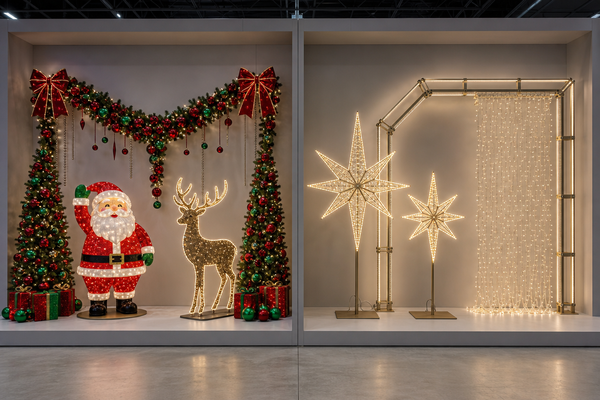
A lighting product may offer many colors, but it can still look locked into Christmas. Stars, snowflakes, gift boxes, Santa figures, and red-green patterns carry strong seasonal meaning.[^4] If buyers ignore design language, they may own products that technically function but visually fail outside December.
Multi-season lighting depends on design language because shape, motif, color balance, scale, and animation decide whether an installation feels natural in several seasons. Neutral silhouettes, modular elements, switchable effects, and restrained color schemes usually offer better reuse than strongly themed Christmas-only designs.
Color is only one layer
Many people assume that reuse means “the lights can change color.” Color control can help, but it cannot solve every design problem.[^5]
For example, a red and green gift-box frame may still read as Christmas even if the LED color changes to blue or gold. A snowflake motif may look strange in a summer shopping street. A reindeer silhouette may not match Ramadan, national celebrations, or a hotel entrance program.
So I prefer to evaluate design language through five layers:
- Shape
- Motif
- Color scheme
- Animation effect
- Installation context
Each layer affects whether the same lighting can move from one event to another.
Reusable design language examples
| Design Element | More Christmas-Specific | More Multi-Season Friendly |
|---|---|---|
| Motif | Santa, reindeer, snowman | Stars, arches, waves, geometric patterns |
| Color | Fixed red and green | Warm white, gold, RGB, tunable combinations |
| Shape | Christmas tree frame only | Modular cone, arch, tunnel, curtain |
| Effect | Fast flashing holiday pattern | Soft chasing, twinkle, dimming, static scenes |
| Packaging | “Christmas decoration only” | “Seasonal decorative lighting” |
This does not mean buyers should avoid Christmas designs. Christmas remains a major sales driver for many importers and wholesalers. The point is that not every item in a seasonal range should be Christmas-locked. A balanced assortment can include strong Christmas hero items and more flexible elements.
How I think about neutral motifs
Neutral does not mean boring. A well-designed arch, star canopy, light curtain, or geometric frame can create strong visual impact without tying itself to one holiday. A warm white string light, for instance, can support winter retail, garden dining, weddings, hotel terraces, and summer markets.
For professional dealers, this matters because end customers often ask for value justification. A dealer can explain that a modular light tunnel can serve:
- A Christmas shopping entrance
- A New Year photo zone
- A city festival walkway
- A mall anniversary campaign
- A hotel outdoor dining feature
The buyer then sees more than a decoration. The buyer sees an asset.
The problem with forced reuse
I have seen this concern appear in many solution-planning conversations. A commercial buyer wants to reuse a display, but the design looks too strongly tied to the previous event. The result can feel cheap, even if the product itself is not cheap.
Forced reuse often happens when:
- The motif is too specific.
- The color palette is fixed.
- The controller has limited scene options.
- The structure cannot accept accessories.
- The packaging makes resale difficult.
In multi-season lighting, the goal is not to hide the original purpose. The goal is to design enough flexibility from the beginning.
A simple design test for buyers
Before confirming a product, I would ask the team to imagine the item in three different moments:
- December retail display
- A non-Christmas civic or cultural event
- A summer commercial setting
If the product feels natural in at least two of the three, it may have reuse potential. If it only works in the first setting, the buyer should treat it as a single-season item and price it accordingly.
This test is simple, but it prevents a common mistake. It keeps the conversation focused on visual adaptability, not only on electrical function or color options.
How Should Buyers Calculate the Total Cost of Multi-Season Lighting?
A low unit price can hide expensive ownership.[^6] Buyers may save money during procurement, then lose it through repeated installation, dismantling, storage, repair, repacking, or unsold stock. That is why I believe multi-season planning needs a total cost view, not only a product quotation.
Buyers should calculate multi-season lighting cost by adding product price, freight, installation labor, dismantling labor, storage, spare parts, maintenance, repackaging, and inventory risk.[^7] A higher-quality reusable item may cost more upfront but can become more practical when it supports several campaigns or resale windows.

The quotation is only the first number
In B2B decorative lighting, the unit price matters. I respect that buyers work with budgets, retail price points, and tender constraints. However, the quotation is only one part of the decision.
A total cost view should include:
- Initial product cost
- International freight and local delivery
- Installation labor
- Dismantling labor
- Storage volume
- Replacement parts
- Controller compatibility
- Repackaging for resale
- Inventory markdown risk
- Disposal or recycling costs where applicable
A cheaper item may be suitable for short-term retail promotion. It may not be suitable for a dealer who wants repeat use across several customer campaigns.
Example cost logic without invented ROI
I avoid making universal ROI claims because each market has different labor rates, freight costs, sales channels, and storage fees. Still, the decision logic is clear.
| Cost Factor | Single-Season Product | Multi-Season Lighting Approach |
|---|---|---|
| Unit price | Often lower | Often moderate or higher |
| Installation frequency | May repeat for each event | May stay longer or adapt in place |
| Storage pressure | Higher if unsold | Lower if reused or resold |
| Spare parts | May be limited | Should be planned |
| Visual flexibility | Low to medium | Medium to high |
| Inventory risk | Higher after season ends | Lower if positioned for several events |
This table does not prove that one option is always better. It shows where buyers should look before they decide.
Installation and dismantling deserve attention
For municipal contractors and event companies, installation labor can be a major cost.[^8] Even for importers and dealers, installation details affect customer satisfaction and repeat sales.
Buyers should ask:
- Can the product be installed quickly by qualified personnel?
- Can sections be replaced without removing the whole display?
- Can the structure be folded, stacked, or packed efficiently?
- Can the same fixing method work in multiple locations?
- Does the product require special tools or rare accessories?
Technical decisions should be verified by qualified professionals for the specific site. Wind exposure, mounting surfaces, electrical supply, local regulations, and public access conditions all matter. As a manufacturer, I can support product planning and documentation, but I would not replace the role of a local engineer, electrician, or compliance specialist.
Storage can decide profit
Storage is easy to underestimate.[^9] Large motifs, frames, arches, and tree structures occupy space. If the product cannot be nested or disassembled well, the buyer may pay for that volume long after the event ends.
For dealers, storage also affects sales flexibility. A compact, modular design can be easier to keep for future campaigns. A bulky, one-theme product may force discounting after the season.
I would evaluate storage with practical questions:
- What is the packed size after use?
- Can the product return to its original carton?
- Are connectors protected during storage?
- Are labels clear for future sorting?
- Can spare parts be stored with the main set?
- Can the product be checked before the next season?
Good multi-season lighting is not only attractive when installed. It is also manageable when removed.
Unsold inventory risk is a real purchasing cost
Importers and wholesalers often carry inventory risk. A product that misses the Christmas selling window may sit for months.[^10] If the design is strongly Christmas-only, the next selling chance may be nearly one year away. If the product can be repositioned for festivals, weddings, hospitality, retail, or public events, the buyer has more options.
This is where product naming and packaging matter. A carton that says only “Christmas snowflake street decoration” has a narrower resale story than one that supports broader seasonal use. Of course, packaging should remain accurate. Buyers should not mislead end customers. But a flexible product deserves flexible commercial positioning.
In my view, total cost is where multi-season lighting becomes a serious procurement topic. It moves the conversation from “What is the cheapest item?” to “Which item creates value for more months?”
What Supplier Checks Make Multi-Season Lighting Easier to Reuse?
Even a good design can fail if supplier support is weak. Buyers may need spare parts, consistent color batches, compatible controllers, clear documentation, and repeat production. Without these basics, reusable lighting becomes difficult to maintain after the first season.[^11]
Supplier checks for multi-season lighting should include production consistency, documentation, spare parts planning, packaging method, controller compatibility, quality management records, and sample approval. Buyers should verify certificates, test reports, and compliance documents before purchase, especially for public or commercial installations.[^12]

Reuse depends on repeatability
When buyers plan for several seasons, they need more than a nice sample. They need confidence that future batches, spare parts, and accessories can match the original order.
I would check these points during supplier evaluation:
- Can the supplier maintain consistent LED color temperature or RGB behavior?
- Can the supplier provide replacement sections or components?
- Can the same controller family support future expansion?
- Can the packaging survive storage and repacking?
- Can the supplier document wiring, connection, and assembly clearly?
- Can the supplier explain realistic lead times for repeat orders?
These checks are practical. They help buyers avoid a common problem: the first installation looks good, but the second season becomes difficult because parts do not match or documentation is unclear.
Documentation buyers should request
For technical B2B products, documents do not replace inspection or local compliance review. Still, they help buyers compare suppliers and reduce uncertainty.
| Document or Record | Why Buyers Request It | Important Note |
|---|---|---|
| Product specification sheet | Confirms dimensions, power, materials, packing | Buyers should verify against samples |
| Assembly instruction | Supports installers and dealers | Site conditions still need local review |
| Spare parts list | Helps maintenance planning | Availability should be confirmed |
| Quality inspection record | Shows production checks | It is not a guarantee by itself |
| Certification documents | Supports compliance evaluation | Buyers should verify validity and scope |
| Factory audit documents | Supports supplier selection | Documents should match the actual factory |
Our company has ISO9001 and BSCI documentation, and I would always encourage buyers to verify such documents directly. A certification can be useful in supplier evaluation, but the buyer should check the scope, validity period, issuing body, and relevance to the ordered product.
Samples should test reuse, not only appearance
A sample review often focuses on brightness, shape, and finish. Those points matter. However, for multi-season lighting, I would also test how the item behaves after handling.
A buyer can review:
- Assembly and disassembly
- Connector protection
- Packing and repacking
- Controller scene changes
- Accessory compatibility
- Labeling and part identification
- Visual fit across several event themes
This sample process gives buyers better evidence before bulk production. It also helps importers and dealers prepare sales materials. They can show end customers how one item can support multiple campaigns.
Technical claims need verification
Decorative lighting often includes technical terms such as waterproof rating, voltage, LED lifespan, UV resistance, flame retardancy, or safety compliance. These details are important, but buyers should not accept them as marketing phrases only.
I would suggest that buyers:
- Request technical sheets.
- Request applicable test reports.
- Confirm the product version tested.
- Check whether the report applies to the final configuration.
- Ask local professionals about installation rules.
- Review destination-market requirements before shipment.
This is especially important for public areas, commercial streets, outdoor malls, hotels, and municipal projects. The supplier can support manufacturing quality control and product information. The local buyer, contractor, or appointed professional should confirm application-specific suitability.
Supplier communication is part of quality control
Good reuse planning requires clear communication. A supplier should understand the buyer’s event calendar, not only the quantity and target price. When I support planning discussions, I try to ask about the intended use period, expected display changes, packing needs, and future repeat orders. Those questions often reveal better product choices.
For example:
- An importer planning a wider seasonal range may need neutral carton wording and modular designs.
- A professional dealer may need spare LED strings and simple assembly instructions.
- An event company may need fast setup and transport-friendly structures.
- A commercial decoration buyer may need a display that changes atmosphere without changing the full installation.
These are different buying situations. They should not receive the same product recommendation.
The best supplier check is simple: Can this supplier help me maintain the product after the first season? If the answer is unclear, the buyer should treat the reuse claim with caution.
Frequently Asked Questions
Is multi-season lighting just RGB Christmas lighting?
No. RGB control can help, but multi-season lighting is broader. It includes event calendar planning, neutral design language, modular structures, suitable packaging, spare parts, and total cost review. A christmas light that changes color may still look Christmas-only if the motif is too specific.
What products usually work well for multi-season displays?
Products with neutral shapes often work best. Examples include string light sets, light curtains, arches, tunnels, star canopies, geometric frames, and modular motifs. Buyers should still review specifications, installation conditions, packaging, and compliance documents before confirming any order.
How can importers reduce unsold seasonal inventory?
Importers can reduce risk by balancing Christmas-specific hero items with reusable seasonal designs. They can also use flexible packaging, plan spare parts, choose neutral motifs, and build sales stories for several events, such as New Year, Ramadan, summer dining, retail campaigns, and local festivals.
Should buyers always choose the most reusable design?
No. Some events need strong seasonal identity, and a dedicated Christmas display can be the right choice. Buyers should decide based on the sales channel, event calendar, budget, storage plan, and expected reuse. Multi-season lighting is a strategy, not a rule for every product.
What documents should buyers verify before purchasing?
Buyers should verify product specifications, test reports, certification documents, quality inspection records, assembly instructions, and spare parts lists. They should also confirm that documents apply to the exact product version ordered. For project installations, qualified local professionals should review site-specific requirements.
Conclusion
Multi-season lighting works best when buyers treat it as a long-term asset decision, not as a simple extension of Christmas purchasing. I would start with the annual event calendar, then review design language, total ownership cost, storage, spare parts, and supplier support. This approach helps importers, wholesalers, dealers, and commercial buyers reduce one-time inventory pressure and build more flexible seasonal programs. If you are planning a reusable decorative lighting range, I can help you turn your event calendar into a practical product brief for supplier discussion.

[^1]: "The Ultimate Guide to Retail Assortment Planning", https://www.toolio.com/post/the-ultimate-guide-to-retail-assortment-planning. Retail merchandising literature describes seasonal calendars as a planning tool for aligning assortments, inventory, and promotional activity with expected demand periods; this supports the calendar-first logic, although it does not address decorative lighting specifically. Evidence role: general_support; source type: education. Supports: A source should support the idea that retail and merchandising decisions are commonly planned around seasonal calendars and demand periods.. Scope note: Contextual support from retail planning rather than direct evidence about lighting procurement.
[^2]: "Development of an Assortment-Planning Model for", https://vtechworks.lib.vt.edu/bitstreams/020a17b3-782d-483e-98c5-ced810db5efd/download. Research on retail assortment and seasonal inventory management shows that aligning assortments with demand patterns can reduce inventory mismatch and end-of-season exposure; this supports the proposed planning mechanism, though not specifically for decorative lighting. Evidence role: mechanism; source type: paper. Supports: A source should explain how assortment planning and demand-period planning affect inventory levels and inventory risk.. Scope note: The support is based on general retail inventory theory, not a lighting-industry study.
[^3]: "[PDF] A comparison of inventory carrying cost in literature and in practice", https://dr.lib.iastate.edu/bitstreams/8d2b0874-381d-4752-b619-a8d340042d5d/download. Operations and supply-chain sources define inventory carrying cost as including capital costs and storage-related costs, supporting the claim that slow-moving stock ties up both warehouse space and working capital. Evidence role: mechanism; source type: research. Supports: A source should support that inventory creates carrying costs, including storage costs and capital tied up in stock..
[^4]: "Santa Claus - Wikipedia", https://en.wikipedia.org/wiki/Santa_Claus. Reference sources on Christmas symbolism identify Santa Claus, gift-giving, winter imagery, and red-green color schemes as established features of Christmas visual culture, supporting the article’s point that such motifs can limit cross-season reuse. Evidence role: historical_context; source type: encyclopedia. Supports: A source should document that Santa Claus, gift-giving, snow imagery, and red-green color schemes are established Christmas or winter holiday symbols.. Scope note: The source would support symbolic associations, not buyer response in every market.
[^5]: "The Influence of Object-Color Knowledge on Emerging ... - PMC", https://pmc.ncbi.nlm.nih.gov/articles/PMC7455208/. Studies in visual perception and design semiotics show that object recognition and visual meaning depend on form, context, and other cues in addition to color; this supports the claim that RGB color changes alone cannot make a strongly themed motif season-neutral. Evidence role: mechanism; source type: paper. Supports: A source should support that visual interpretation depends on multiple features, including shape and context, not color alone.. Scope note: The evidence is general visual-perception support rather than a test of decorative lighting products.
[^6]: "Life Cycle Cost (LCC)", https://www.waru.edu/acquipedia-article/life-cycle-cost-lcc. Public procurement guidance on life-cycle costing explains that acquisition price is only one component of total cost and that operation, maintenance, storage, and end-of-life costs may also be relevant, supporting the article’s total-cost framing. Evidence role: definition; source type: government. Supports: A source should define total cost of ownership or life-cycle costing as including costs beyond initial purchase price..
[^7]: "Life Cycle Cost (LCC)", https://www.waru.edu/acquipedia-article/life-cycle-cost-lcc. Institutional guidance on total cost of ownership and life-cycle costing supports evaluating procurement decisions by adding acquisition, logistics, installation, maintenance, and end-of-life cost elements rather than relying on unit price alone. Evidence role: general_support; source type: institution. Supports: A source should support the inclusion of lifecycle and operational cost categories beyond unit price in procurement decisions.. Scope note: The cited framework would support the cost categories generally, while inventory risk and repackaging may require adaptation to seasonal lighting.
[^8]: "Holiday Lighting & Décor for the City of Falls Church", https://fallschurchva.gov/DocumentCenter/View/16324. Municipal contract records for seasonal lighting installation and removal can document that labor, equipment, and site work are explicit and material cost items in public decoration projects, supporting the article’s warning that installation labor should be budgeted separately. Evidence role: case_reference; source type: government. Supports: A source should provide public contract or municipal budget evidence showing that installation and removal labor form a notable part of decorative lighting project costs.. Scope note: A municipal contract would provide case-based support and may not represent all private or international projects.
[^9]: "A comparison of inventory carrying cost in literature and in ...", https://dr.lib.iastate.edu/bitstreams/8d2b0874-381d-4752-b619-a8d340042d5d/download. Inventory-management sources identify warehousing and storage expenses as components of inventory carrying cost, supporting the article’s point that post-season storage can materially affect the economics of reusable decorations. Evidence role: mechanism; source type: research. Supports: A source should explain that storage space and warehousing expenses are components of inventory carrying cost..
[^10]: "An analysis of attribute-based markdown policy for fashion retailers", https://www.sciencedirect.com/science/article/abs/pii/S014829632200220X. Research on seasonal inventory and retail markdowns shows that products with concentrated demand periods face elevated leftover-stock risk after the selling season, supporting the claim that Christmas-specific products may become slow-moving if they miss the peak window. Evidence role: mechanism; source type: paper. Supports: A source should support that seasonal demand creates inventory risk when products remain unsold after the peak season.. Scope note: The evidence would support seasonal inventory dynamics generally, not the exact duration for decorative lighting in every market.
[^11]: "Parts, Materials and Processes (PM&P) Management", https://www.waru.edu/acquipedia-article/parts-materials-and-processes-pmp-management. Maintainability and asset-management standards emphasize documentation, spare-parts planning, and component consistency as factors that enable repair and continued operation, supporting the article’s claim that reusable lighting depends on supplier support after the first season. Evidence role: mechanism; source type: institution. Supports: A source should support that maintainability depends on documentation, spare parts availability, component consistency, and repair planning.. Scope note: The support is drawn from general maintenance principles rather than a decorative-lighting-specific standard.
[^12]: "General Use Products: Certification and Testing | CPSC.gov", https://www.cpsc.gov/Business--Manufacturing/Testing-Certification/General-Use-Products-Certification-and-Testing. Product-safety regulatory guidance for electrical equipment requires manufacturers and importers to maintain appropriate technical documentation and conformity evidence, supporting the article’s advice that buyers verify certificates and test reports before commercial or public installation. Evidence role: expert_consensus; source type: government. Supports: A source should support that electrical products require appropriate compliance documentation and that documentation should match the product and intended market.. Scope note: Specific requirements vary by jurisdiction and product configuration.
Table of Contents
- Multi-Season Lighting: Designing Installations That Work Beyond Christmas?
- How Should Multi-Season Lighting Start With an Annual Event Calendar?
- Why Does Multi-Season Lighting Depend on Design Language?
- How Should Buyers Calculate the Total Cost of Multi-Season Lighting?
- What Supplier Checks Make Multi-Season Lighting Easier to Reuse?
- Frequently Asked Questions
- Conclusion