 EN
EN


Christmas & New Year: How Should I Optimize the European Festive Lighting Supply Chain?
Late orders look safe at first. Then best-selling SKUs disappear, factory capacity closes, and every delayed christmas light order becomes a selling risk.
I optimize festive lighting supply chains by reserving capacity, materials, SKU priorities, QC points, packaging details, and delivery schedules before the Christmas and New Year demand window becomes crowded.
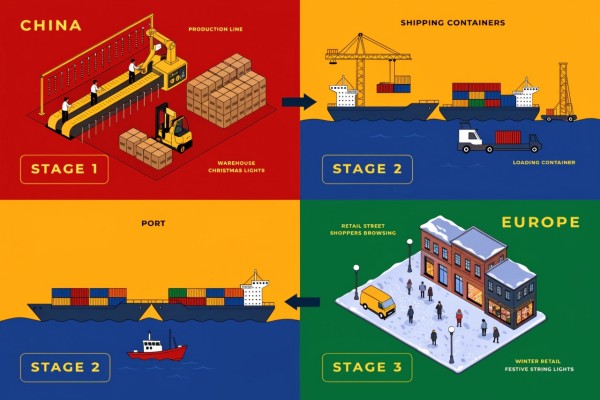
I work from the factory side in China, so I see the pressure before the buyer sees it on the shelf. I see material queues, production line plans, packaging checks, and export delivery limits. I also see how one small delay can move through the whole order. If I treat a string light, a large motif light, and a custom festivel light design as the same product, I create risk before production even starts. The real question is simple. Are my Christmas best-selling SKUs already backed by reserved production capacity, or am I waiting for market confirmation and hoping capacity will still be available?
Why Should I Not Wait Until European Demand Is Visible?
Waiting feels careful. I understand that. But when I wait too long, I do not reduce risk. I move the risk into production.
I should not wait until demand is visible because peak-season capacity, key materials, and popular festive lighting SKUs may already be booked before I confirm replenishment.[^1]

When I support European importers and wholesalers, I often see one pattern. Buyers want to confirm market interest before they place larger orders. That sounds logical for normal products. It is much harder for Christmas and New Year lighting. The selling season is short. The production season is earlier than many people expect.[^2] If I wait until retailers or dealers show clear demand, the factory may already be running other orders.
I do not treat "available stock" as a real supply chain plan. It is a backup. It may help for a small urgent need, but it cannot protect a full seasonal assortment.[^3] The stronger approach is to identify best-selling SKUs early and reserve production time.
| Planning Choice | What I May Gain | What I May Risk |
|---|---|---|
| Wait for visible demand | Lower early commitment | No capacity for hot SKUs |
| Reserve capacity early | Better delivery control | Earlier SKU decisions needed |
| Buy only spot stock | Fast for small gaps | Limited styles, mixed quality, weak packaging fit |
| Plan core SKUs first | Stable supply base | Less freedom for last-minute changes |
I also separate confirmed core items from possible trend items. Core items may include warm white LED string light models, classic curtain lights, icicle lights, and popular outdoor christmas light sets. Trend items can be reviewed later. I do not want a late trend decision to block the production of the products that must arrive on time.
How Should I Separate Timelines for String Lights, Motif Lights, and Custom Festive Designs?
Many delays start from one wrong idea. I treat all festive lighting as one category, then I learn that each product has a different lead time.
I should separate procurement timelines because standard string lights, decorative motif lights, and customized festive designs need different sampling, material, tooling, assembly, QC, and packaging steps.[^4]
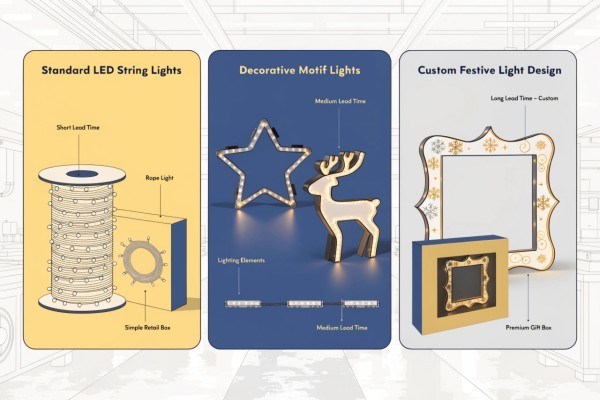
I see standard LED string lights as the most repeatable category. If the specification is stable, the main work is material preparation, production line scheduling, electrical testing, packaging, and carton marking. The risk still exists, but the process is clear. A string light order with known wire color, LED color, plug type, controller type, and packaging can move faster than a newly designed motif.
Decorative motif lights need more physical structure. They may include frames, rope light, LED modules, connectors, fixing points, and sometimes outdoor protection details. These items need more attention to size, weight, display angle, packing protection, and installation use. A beautiful motif light can still create trouble if the carton is weak or the fixing method is unclear.
Customized festive lighting needs the longest planning window.[^5] I need artwork, size confirmation, sample review, material matching, production trial, QC standards, and packaging approval.
| Product Type | Main Time Driver | My Planning Focus |
|---|---|---|
| Standard LED string light | Material and line schedule | Lock specification early |
| Decorative motif light | Frame, structure, packing | Confirm drawing and protection |
| Customized festivel light design | Sampling and approval | Start before the peak queue |
| Retail-ready christmas light pack | Label, barcode, manual, carton | Confirm compliance details early |
I do not push all items into one delivery promise. I build the schedule from product reality. This keeps my promise closer to what the factory can truly deliver.
Why Can the Lowest Unit Price Become Expensive?
A low price looks clean on a quote sheet. But I have learned that the real cost appears when the shipment is late, wrong, or reworked.
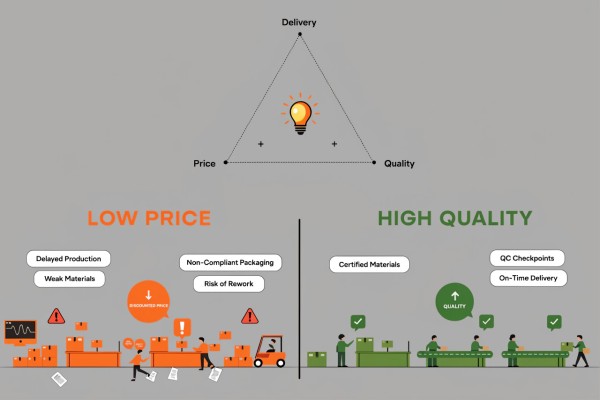
I do not ignore price. European importers and wholesalers must protect margins. Retail chains and project buyers also compare cost closely. But I do not see unit price as the full cost of a christmas light order. I see it as one part of a larger risk picture.
A cheaper offer may use slower material sourcing. It may depend on unconfirmed capacity. It may leave packaging details open until too late. It may also create quality pressure if the supplier cuts testing time or uses weak components.[^7] I am not saying a higher price always means better supply. I am saying a very low price needs careful questions.
| Quote Item | Low-Price Risk I Check | Why It Matters |
|---|---|---|
| LED and wire materials | Unclear grade or late sourcing | It affects safety and consistency |
| Plug and controller | Wrong market version | It can block sale or create complaints |
| Retail packaging | Missing label or weak carton | It can cause rework and delay |
| Production slot | Not truly reserved | It can move the order behind others |
| QC process | Too few checkpoints | It can let defects reach the buyer |
As a China-based manufacturer and trading company, I have to balance price and reliability. I prefer to explain cost drivers early. If a buyer needs a lower price, I discuss what can be adjusted safely. I do not like cutting the parts that protect delivery, compliance, and customer trust.
What Should I Lock With My Supplier Before Peak Season?
Peak season is not the right time to discover missing details. I need to lock the order before small questions become large delays.
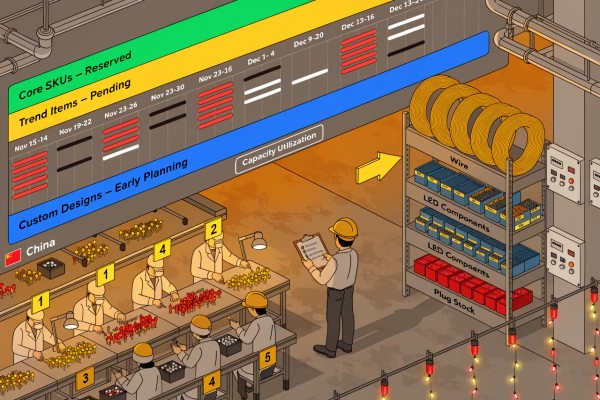
I like to start with SKU priority. Not every item has the same role. Some SKUs are core volume products. Some items are margin builders. Some products complete the display range. Some custom motif lights support a project or a city decoration plan. If I do not rank them, the supplier may not know what must move first when production time becomes tight.
Then I lock specifications. For a string light, I confirm LED color, wire color, length, spacing, plug type, IP rating needs, controller function, packaging format, and certification or market documents needed. For motif lights, I confirm size, frame material, light source, structure, hanging or mounting method, and packing protection. For custom products, I confirm drawing, sample, color, logo, and installation notes.
| What I Lock | My Reason |
|---|---|
| SKU priority list | I protect the best-selling items first |
| Production capacity | I reduce the risk of being pushed back |
| Main materials | I avoid material shortage during peak time |
| Approved sample | I reduce rework and unclear expectations |
| Packaging artwork | I avoid late label and barcode changes |
| QC checkpoints | I catch problems before shipment |
| Delivery plan | I align production with export needs |
I also treat ISO9001 and BSCI as useful credibility signals.[^9] They show that a supplier has management and social compliance systems. But I do not treat them as magic shields. I still need clear specifications, real QC work, and practical communication. Certificates support trust. They do not replace planning.
How Do I Build QC and Packaging Into the Supply Chain Instead of Adding Them at the End?
Quality checks done only at the end feel efficient. But if I find a problem after packing, I already lost time.
I build QC and packaging into the supply chain by checking materials, samples, production process, finished goods, labels, cartons, and export packing before shipment.
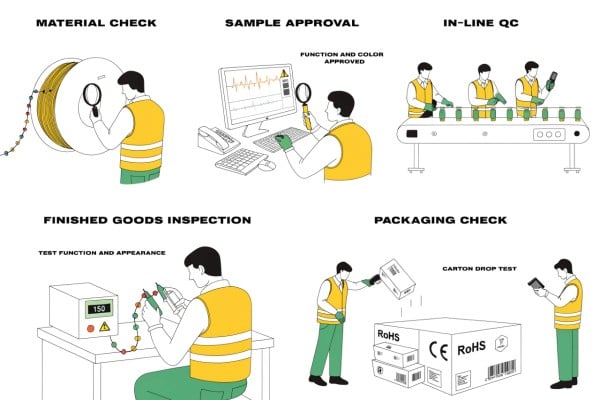
I see QC as a chain, not as one final inspection. For festive lighting, this matters because the product must work, look good, fit the market, and survive transport. A christmas light item may pass a basic lighting test but still fail the buyer's needs if the label is wrong, the barcode is missing, the carton is weak, or the instruction sheet does not match the product.
I prefer to define checkpoints before production starts. The first checkpoint is material confirmation. The second is sample or pre-production approval. The third is in-line checking during production. The fourth is finished product inspection. The fifth is packaging and carton check before loading.[^10] This process does not remove every risk, but it gives me more chances to catch problems early.
| QC Stage | What I Check | What I Want to Prevent |
|---|---|---|
| Material check | Wire, LEDs, plugs, controllers | Wrong parts or unstable supply |
| Sample approval | Function, color, size, look | Misunderstood specification |
| In-line QC | Assembly, connection, lighting | Batch defects |
| Finished goods QC | Function, appearance, quantity | Customer complaints |
| Packaging check | Label, barcode, manual, carton | Rework and retail problems |
| Loading check | Carton condition and marks | Delivery confusion |
For European wholesale and retail channels, packaging is not just a box. It is part of the product.[^11] A strong festive lighting supply chain includes packaging artwork, language needs, barcode position, carton marks, and pallet or loading requirements. I want these details closed early, not discussed when goods are already packed.
How Should I Plan Delivery Without Pretending I Can Predict Every Logistics Problem?
I cannot control every port, vessel, or road delay. But I can control how early I prepare the order and how clearly I plan shipment.
I should plan delivery by agreeing on realistic production finish dates, inspection time, packing time, document preparation, and export handover before the seasonal shipping rush.
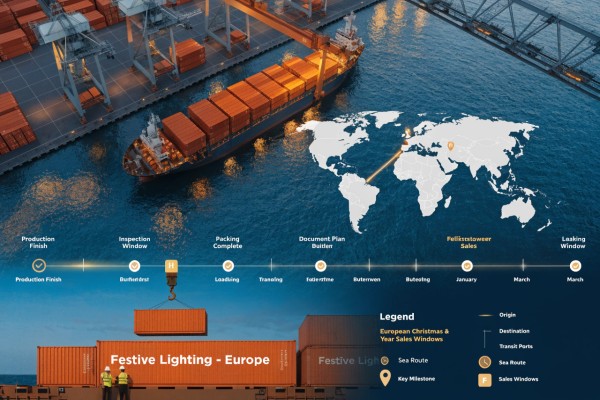
I do not claim that I can predict all sea freight changes or every port situation.[^12] That is not honest. My work is more practical. I make sure the goods are ready in a planned way, so the buyer has more options before the selling window closes. Late production leaves no room. Early and organized production gives the buyer space to react.
I also separate factory completion from real readiness. Finished production is not the same as ready-to-ship. The goods still need final inspection, packaging confirmation, carton marking, booking support, export documents, and loading arrangement. If I ignore these steps, I create false confidence.
| Delivery Step | My Practical Check |
|---|---|
| Production finish date | I confirm it against real line capacity |
| Inspection window | I leave time for checking and possible correction |
| Packing completion | I confirm retail pack and export carton details |
| Document preparation | I check invoice, packing list, and needed files |
| Loading plan | I match cartons with booking and warehouse readiness |
| Buffer time | I avoid planning shipment at the last possible moment |
For European Christmas and New Year lighting buyers, timing is not just about arrival. It is about the sales calendar. Importers need time to receive, inspect, distribute, and sell. Wholesalers need time to serve dealers. Retailers need time to display. Municipal and event buyers need time to install. I plan backward from that real use date, not from the date that production "might" finish.
Conclusion
I optimize festive lighting supply chains by planning early, locking capacity, separating product timelines, protecting QC, and asking one question before peak season: is capacity already reserved?

[^1]: "Integrated Planning of Supply and Inventory Under Seasonal ...", https://pubsonline.informs.org/doi/10.1287/trsc.2025.0026. Research on seasonal-product supply chains links short selling windows, uncertain demand, and finite production capacity to stockout and late-fulfillment risk, supporting early capacity reservation; the evidence is contextual rather than specific to Christmas-light factories in China. Evidence role: general_support; source type: paper. Supports: Seasonal products with concentrated demand require earlier capacity and material planning because late orders face capacity constraints and stockout risk.. Scope note: Contextual support for seasonal manufacturing risk, not direct proof that specific festive-lighting SKUs are booked in advance.
[^2]: "[PDF] Dynamic Inventory Allocation for Seasonal Merchandise at Dillard's", https://www2.isye.gatech.edu/~atoriello3/Dillards.pdf. Seasonal-inventory research describes products with short selling periods and advance production or procurement decisions, which supports the need to plan Christmas-light production before retail demand is fully visible; the source provides a general seasonal-inventory framework rather than a lighting-specific calendar. Evidence role: general_support; source type: paper. Supports: Seasonal products are sold in compressed time windows and require upstream inventory or production decisions before demand is fully observed.. Scope note: The evidence explains seasonal inventory timing generally and may not specify Christmas lighting.
[^3]: "[PDF] Development of an Assortment-Planning Model for - VTechWorks", https://vtechworks.lib.vt.edu/bitstreams/020a17b3-782d-483e-98c5-ced810db5efd/download. Studies of retail assortment and seasonal inventory planning show that assortment availability depends on advance purchasing and replenishment decisions, while late replenishment is limited by lead times and stockout risk; this supports the article's operational point but does not measure spot-stock availability for festive lighting. Evidence role: mechanism; source type: paper. Supports: Seasonal assortment planning depends on coordinated inventory decisions, and late emergency replenishment is constrained by lead times, assortment availability, and stockout risk.. Scope note: Contextual support from retail inventory theory, not direct evidence about a particular supplier's available stock.
[^4]: "Navigating new product development: Uncovering factors and ...", https://pmc.ncbi.nlm.nih.gov/articles/PMC10788447/. Manufacturing research on product complexity and customization finds that additional design, tooling, coordination, and quality-control requirements can lengthen lead times and increase process variation, supporting differentiated timelines for lighting product types; the evidence is general and not limited to holiday lighting. Evidence role: mechanism; source type: paper. Supports: Product complexity and customization increase the number of process steps, coordination needs, and lead-time risks in manufacturing.. Scope note: General manufacturing evidence, not a direct comparison of string lights, motif lights, and custom festive designs.
[^5]: "The relationship between mass customization and sustainable ...", https://pmc.ncbi.nlm.nih.gov/articles/PMC10950661/. Literature on mass customization and engineer-to-order production identifies design clarification, sampling or prototyping, approval loops, and production coordination as lead-time drivers, supporting the claim that custom festive lighting needs a longer planning window; the source does not provide a Christmas-light-specific lead-time benchmark. Evidence role: mechanism; source type: paper. Supports: Customized or engineer-to-order products typically require additional design, approval, and coordination stages that increase planning lead time.. Scope note: Contextual support from customization and engineer-to-order manufacturing research.
[^6]: "[PDF] EFFECTIVE METHODOLOGIES FOR SUPPLIER SELECTION AND ...", https://etda.libraries.psu.edu/files/final_submissions/419. Procurement and quality-management research on total cost of ownership and cost of quality shows that purchase price is only one cost component and that defects, rework, delays, and failures can raise total cost, supporting the warning against choosing solely by lowest unit price; the evidence is general rather than specific to festive-light orders. Evidence role: expert_consensus; source type: paper. Supports: Procurement decisions should consider total cost of ownership, including quality, delivery reliability, rework, and failure costs rather than unit price alone.. Scope note: General procurement and quality-cost evidence, not direct financial data from Christmas-light shipments.
[^7]: "Risk factors in the assessment of suppliers - PMC - NIH", https://pmc.ncbi.nlm.nih.gov/articles/PMC9342744/. Supply-chain quality research discusses how supplier incentives, cost pressure, and weak monitoring can increase quality risk by reducing process control or encouraging lower-cost inputs, supporting the article's concern about testing time and components; the source gives a mechanism rather than evidence about a named supplier. Evidence role: mechanism; source type: paper. Supports: Cost pressure and supplier incentives can affect quality practices, including inspection effort and component choices.. Scope note: Mechanistic support; it does not prove that any particular low-priced quote involved reduced testing or weak components.
[^8]: "Material requirements planning with a novel lot sizing method and a ...", https://pmc.ncbi.nlm.nih.gov/articles/PMC12307884/. Operations-management references treat capacity planning, materials planning, production scheduling, quality-control planning, and delivery coordination as interdependent controls for meeting output and timing requirements, supporting the need to lock these details before peak production; the support is general rather than lighting-specific. Evidence role: expert_consensus; source type: education. Supports: Operations-management sources identify capacity planning, material planning, production scheduling, quality control, and delivery coordination as core controls for reliable manufacturing execution.. Scope note: General operations-management support, not a festive-lighting industry standard.
[^9]: "ISO 9001:2015 - Quality management systems — Requirements", https://www.iso.org/standard/62085.html. ISO describes ISO 9001 as a quality management system standard, while amfori describes BSCI as a system for improving social performance in global supply chains, supporting their use as management and social-compliance signals; these certifications or memberships do not by themselves prove product quality or delivery performance. Evidence role: definition; source type: institution. Supports: ISO 9001 is a quality management system standard, and BSCI is a social-compliance monitoring framework.. Scope note: Directly supports the meaning of the schemes, but not the performance of any individual supplier.
[^10]: "[DOC] EQA_Exh5.docx - DOE Office of Science", https://science.osti.gov/-/media/SCMS/Management-Systems/QUAL/EQA/EQA_Exh5.docx. Quality-management guidance such as ISO 9001 emphasizes controlled production, verification of inputs and outputs, and documented checks at appropriate stages, supporting the use of material, pre-production, in-line, final, and packaging inspections; the standard provides a management framework rather than prescribing this exact five-step sequence. Evidence role: expert_consensus; source type: institution. Supports: Quality-management frameworks emphasize controlled production processes, verification activities, and inspection at appropriate stages.. Scope note: Supports staged process control generally, not this exact checklist as a universal requirement.
[^11]: "[PDF] Evaluation of the functions of packaging and their relations to ...", https://scholarworks.umt.edu/cgi/viewcontent.cgi?article=3278&context=etd. Packaging research identifies protection, handling, information communication, and marketing presentation as core packaging functions, supporting the claim that retail packaging is part of the product rather than merely a container; the evidence is broad consumer-goods research and not specific to Christmas lights. Evidence role: general_support; source type: paper. Supports: Packaging serves protective, logistical, informational, and marketing functions, making it part of the delivered product experience.. Scope note: Contextual support from packaging literature, not festive-lighting-specific compliance guidance.
[^12]: "[PDF] Review of maritime transport 2024", https://unctad.org/system/files/official-document/rmt2024_en.pdf. International maritime-transport reporting documents port congestion, disruption risk, and schedule reliability problems in container shipping, supporting the statement that a supplier cannot predict or control every sea-freight or port situation; the evidence is sector-level rather than route-specific for any one Christmas-light shipment. Evidence role: general_support; source type: institution. Supports: Maritime transport can be affected by port congestion, schedule reliability issues, and disruptions outside a shipper's direct control.. Scope note: Sector-level logistics evidence, not proof of delay on a specific lane or shipment.
Table of Contents
- Christmas & New Year: How Should I Optimize the European Festive Lighting Supply Chain?
- Why Should I Not Wait Until European Demand Is Visible?
- How Should I Separate Timelines for String Lights, Motif Lights, and Custom Festive Designs?
- Why Can the Lowest Unit Price Become Expensive?
- What Should I Lock With My Supplier Before Peak Season?
- How Do I Build QC and Packaging Into the Supply Chain Instead of Adding Them at the End?
- How Should I Plan Delivery Without Pretending I Can Predict Every Logistics Problem?
- Conclusion