 EN
EN

B2B Marketing Strategy: How to Sell Festive Lighting to Shopping Malls?
A B2B marketing strategy for selling festive lighting to shopping malls cannot rely on beautiful product photos and low unit prices alone. Mall buyers face fixed holiday deadlines, safety concerns, installation limits, and budget pressure. If your proposal does not reduce those risks, the buyer may hesitate. The solution is to sell a complete, mall-ready seasonal lighting concept.
A strong B2B marketing strategy for shopping mall festive lighting should package products into clear commercial scenarios, such as entrances, atriums, walkways, windows, and photo spots. It should include visual concepts, budget tiers, safety documents, samples, packaging details, installation guidance, and delivery schedules so mall buyers can compare value and reduce project risk.
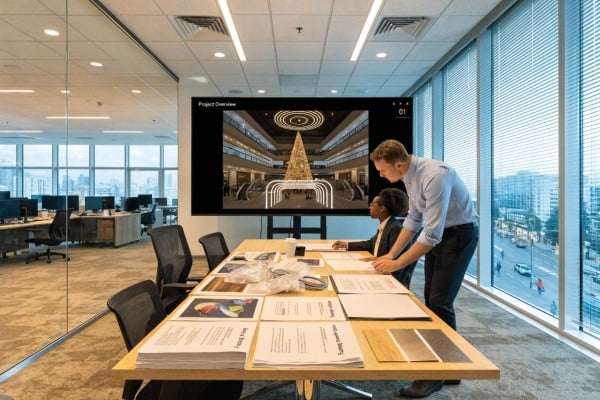
I often see channel customers lose momentum when they show only catalog pages or single-item quotations. Shopping malls are not simply buying LED lights. They are buying a seasonal experience that must look attractive, install safely, arrive on time, and support commercial atmosphere.
Why Does a B2B Marketing Strategy for Mall Festive Lighting Start With Buyer Risk?
Many festive lighting sellers begin with product advantages. They talk about brightness, price, frame size, or factory capacity. Those points matter, but they do not answer the buyer's first concern. A shopping mall project carries visible risk. If anything arrives late, looks weak, or fails safety checks, the problem becomes public.
A B2B marketing strategy for mall festive lighting should start with risk control because mall buyers need confidence before they approve a seasonal decoration plan. They need to know the lights will match the concept, fit the site, meet safety expectations, arrive before the holiday, and stay within budget.
Mall Buyers Are Buying Certainty, Not Only Decoration
In mall-related festive lighting inquiries, we often see buyers ask for more than a price list. They usually care about:
- Visual effect: Will the final display look rich enough for the mall space?
- Safety: Are the materials, voltage, cables, and connectors suitable?
- Installation: Can the contractor install the decoration within a short window?
- Durability: Can the lights handle repeated use, indoor humidity, or outdoor weather?
- Deadline: Can production and shipping finish before the peak holiday period?
- Budget: Can the supplier offer options without forcing a full redesign?
These questions are practical. They are not theoretical marketing topics. A mall does not want to explain to tenants why the Christmas tree arrived late. An event company does not want to send workers back because the frame connection is unclear. A distributor does not want to lose a client because the proposal looked like a random product list.
That is why I believe a supplier-side B2B marketing strategy must translate factory capability into buyer-facing proof.
Risk-Control Materials That Build Trust
A stronger proposal should include practical documents and visuals. These materials make your offer easier to approve.
| Buyer Concern | Weak Proposal | Strong Proposal |
|---|---|---|
| Visual effect | Product photos only | Renderings, scene references, size comparison |
| Budget | One quotation | Basic, upgraded, customized packages |
| Safety | "Good quality" statement | Certifications, material notes, voltage options |
| Installation | No guidance | Assembly drawings, hanging points, frame details |
| Delivery | General lead time | Production schedule and shipping plan |
| Quality | Factory promise | Sample approval, inspection photos, QC checklist |
When we support importers, distributors, contractors, and project suppliers, we usually help them prepare this type of proof. Our role is not only to produce LED string lights or festive motifs. Our role is also to help partners answer the questions their mall clients will ask.
A Practical Example
Let us say a buyer asks for "Christmas decoration for a medium-size mall atrium." A weak reply may include:
- A 6-meter tree photo
- A few snowflake lights
- Unit prices
- A shipping estimate
That may look fast, but it creates more questions.
A stronger reply would include:
- A 6-meter or 8-meter tree option
- Matching hanging snowflakes for the atrium
- Warm white LED string lights for railings
- A photo spot with a reindeer or gift box motif
- Basic, upgraded, and customized budget tiers
- Power requirements and packaging volume
- Production time and shipment planning
- Compliance files available for review
This approach changes the conversation. The buyer no longer compares only "price per piece." The buyer compares project confidence.
In festive lighting projects, the safest marketing message is not "we are cheap." The safer message is "we can help you deliver the display correctly and on time."
How Should Your B2B Marketing Strategy Turn Lights Into Mall-Ready Scenarios?
Product catalogs can help buyers browse, but they rarely close mall decoration projects by themselves. A mall buyer may not know how one LED motif, one curtain light, and one 3D sculpture can work together. If the seller does not create the scene, the buyer must imagine it alone.
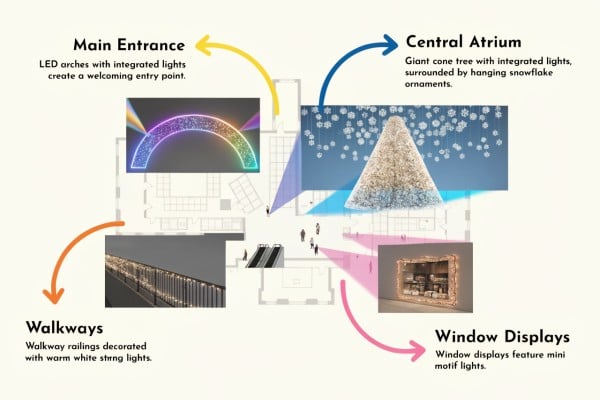
Your B2B marketing strategy should turn festive lighting products into mall-ready scenarios by grouping items around real commercial spaces. The most useful scenarios include entrances, atriums, walkways, shop windows, ceiling areas, outdoor façades, and photo spots. Each scene should show the visual role, product list, size range, and budget level.
Why Scenarios Sell Better Than Single Products
Shopping malls are spatial businesses. Their festive decoration needs to match traffic flow, ceiling height, entrance width, brand level, local holiday habits, and installation time. A product-only quotation ignores these conditions.
In my experience, channel customers often receive broad requests like:
- "Can you send Christmas decoration ideas for a mall?"
- "Do you have Ramadan lighting suitable for a commercial entrance?"
- "We need a proposal for a shopping center atrium."
- "Can you recommend outdoor LED motifs for a retail street?"
- "What can we do for a low-budget holiday campaign?"
These questions are not asking for one SKU. They are asking for a solution framework.
Common Mall Festive Lighting Scenarios
A mall-ready proposal can be built around zones. This structure helps the buyer understand where the budget goes.
| Mall Area | Decoration Goal | Suitable Festive Lighting Products |
|---|---|---|
| Main entrance | Create first impression | LED arch, curtain lights, motif lights, garlands |
| Atrium | Build visual center | Giant tree, 3D sculpture, hanging lights, gift boxes |
| Walkways | Extend holiday atmosphere | String lights, snowflake motifs, ceiling drops |
| Shop windows | Support retail display | Mini motifs, warm white strings, neon-style lights |
| Outdoor façade | Attract street attention | Large motifs, net lights, waterproof string lights |
| Photo spot | Encourage visitor interaction | 3D reindeer, Santa chair, moon/star motif, themed frame |
When you present by area, the mall buyer can see the full experience. The contractor can also estimate installation needs more easily.
How I Like to Build a Scene-Based Proposal
I usually suggest starting with three questions before selecting products:
-
What holiday or theme is the mall targeting?
Christmas, New Year, Ramadan, Eid, national holidays, winter season, and summer festivals all need different design language. -
Which zone matters most?
Some malls need a strong entrance. Others need an atrium centerpiece. Retail streets may need outdoor weather-resistant motifs. -
What level of customization is realistic?
A fully customized display may look unique, but it needs more time for drawings, samples, production, and confirmation.
After that, you can build a scene list. For example:
Example: Christmas Mall Atrium Package
- Centerpiece: 7-meter cone tree with warm white LED string lights
- Surrounding décor: 3D gift box motifs and small reindeer frames
- Ceiling: Hanging snowflakes at mixed sizes
- Railings: LED string lights with garland decoration
- Photo spot: "Merry Christmas" illuminated frame
This is much easier to sell than "tree, snowflake, reindeer, string light." The products become a complete commercial display.
Example: Ramadan or Eid Mall Entrance Package
- Entrance arch: Crescent and star LED motif
- Side decoration: Warm white curtain lights
- Walkway: Lantern-shaped motif lights
- Photo area: Moon bench or Arabic pattern frame
- Optional upgrade: Programmable color-changing lighting effect
This scenario respects the theme and gives buyers a clear mental image.
The Key Marketing Shift
A good festive lighting supplier should not force the buyer to connect every detail. The supplier should help the channel partner present a ready-to-understand concept.
That is the difference between:
- "Here is our catalog."
- "Here are three mall entrance concepts based on your budget and deadline."
The second sentence is much stronger.
What Proposal Materials Should a B2B Marketing Strategy Include for Shopping Mall Buyers?
Many distributors and contractors work hard to find the right products, but their proposal still looks thin. The buyer may like the idea, yet they may pause because there is not enough proof. A festive lighting project becomes easier to approve when the proposal includes documents that answer safety, quality, effect, and delivery questions.
A B2B marketing strategy for festive lighting should include proposal materials such as renderings, reference photos, product specifications, sample options, certifications, inspection standards, packaging details, installation guidance, and delivery schedules. These materials help channel customers present factory capability as a lower-risk mall decoration solution.
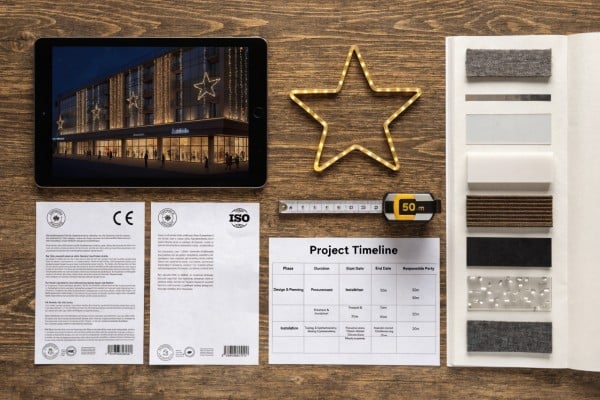
The Proposal Should Reduce Buyer Anxiety
A mall buyer may not say, "I feel anxious about this supplier." Instead, they may ask many small questions:
- "Can you show how it looks at night?"
- "What is the size of the frame?"
- "Can the voltage match our market?"
- "Do you have CE or other documents?"
- "How is it packed?"
- "How long does production take?"
- "Can we get a sample before bulk order?"
- "What happens if the installation team needs guidance?"
These questions are normal. A strong proposal prepares answers before the buyer has to ask.
Essential Materials for a Mall Festive Lighting Proposal
Here is a practical checklist I recommend for channel partners.
| Material | Why It Matters | Best Use |
|---|---|---|
| Concept images | Help buyer imagine the final display | Early proposal stage |
| Product specifications | Confirm size, LED type, color, voltage | Technical review |
| Scene product list | Connect items to mall areas | Budget discussion |
| Budget tiers | Prevent lowest-price comparison | Negotiation stage |
| Certificates and test reports | Support safety review | Procurement review |
| Sample photos or videos | Prove real effect | Buyer confirmation |
| Packaging details | Help logistics planning | Before order approval |
| Installation notes | Reduce contractor confusion | Before delivery |
| Production schedule | Control deadline risk | Project planning |
| QC photos | Build confidence before shipment | Final inspection |
Why Visual Proof Is So Important
Festive lighting is highly visual. A buyer may not understand the value difference between two LED motifs from a spreadsheet. But they can understand it when they see:
- A day-view product photo
- A night-view lighting effect
- A size reference with people or storefronts
- A mockup placed into a mall entrance image
- A short video showing brightness and flashing mode
In our pre-sales work, we often support customers with effect photos, product videos, and layout suggestions. These assets help them sell the proposal internally or to their own mall clients.
Compliance and Quality Documents Matter
Commercial decoration is not the same as home decoration. A mall display is public-facing. Safety matters. Different markets may request different documents, so I avoid saying one document fits every country. However, buyers commonly ask about:
- CE-related documents for European markets
- RoHS information for material compliance
- Low-voltage product details
- Fire-retardant material information where applicable
- IP rating for outdoor products
- Factory audit or social compliance documents
- ISO9001 quality management reference
- BSCI audit reference when requested by retail customers
As a China-based manufacturer and trading company, we have found that these documents help partners move from "supplier claim" to "reviewable evidence." They do not replace the buyer's own compliance process. However, they make the conversation more professional.
Packaging and Logistics Should Not Be an Afterthought
Large festive lighting products can be difficult to ship. A 3D reindeer, metal frame arch, or giant cone tree may require special packing. If the proposal ignores packaging volume, the final landed cost may surprise the buyer.
A better proposal should include:
- Carton size or crate size
- Gross weight and net weight
- Packing method
- Disassembly structure
- Container loading estimate
- Spare parts suggestion
- Labeling and retail packaging options if needed
For retail chains, packaging design and barcode labeling may matter. For contractors, strong export packing and easy reassembly may matter more. Your B2B marketing strategy should match the material to the buyer type.
How Can Tiered Packages Help You Avoid Lowest-Price Negotiations?
Price pressure is common in festive lighting. When a buyer sees only one quotation, the conversation often becomes simple: "Can you make it cheaper?" This is difficult for importers, distributors, and contractors because they still need margin, quality, and delivery reliability.
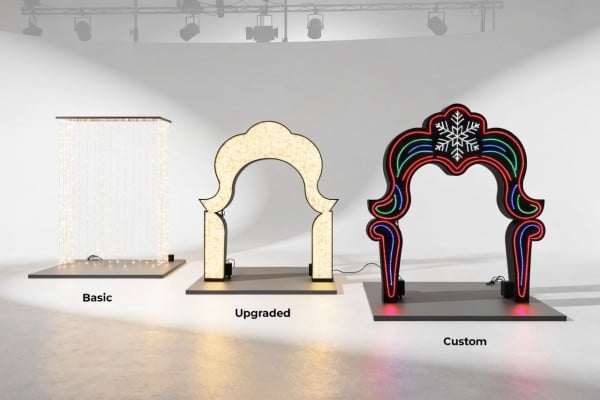
Tiered packages help you avoid lowest-price negotiations by giving shopping mall buyers structured choices. A basic package controls cost, an upgraded package improves visual effect, and a customized package supports a unique theme. This lets buyers compare value by budget instead of forcing every discussion toward the cheapest product.
Why One Price Creates a Weak Position
A single quotation makes the buyer think in one direction. If the number feels high, they ask for a discount. If the number feels low, they worry about quality. Either way, the seller has little room to explain value.
A tiered offer changes the frame. It shows that the supplier understands different budget levels.
A Simple Three-Tier Structure
| Package Level | Best For | Typical Features |
|---|---|---|
| Basic | Smaller malls or tight budgets | Standard motifs, simple string lights, limited customization |
| Upgraded | Mid-range commercial displays | Better density, more scene coverage, stronger centerpiece |
| Customized | Premium projects or brand campaigns | Unique shapes, custom colors, logo elements, special themes |
This structure is easy for mall buyers to compare. It also helps channel partners protect their margins because they are not selling only unit price.
Example: Mall Entrance Festive Lighting Packages
| Option | Products Included | Buyer Benefit |
|---|---|---|
| Basic Entrance | LED curtain lights + two side motifs | Creates a festive entrance with controlled cost |
| Upgraded Entrance | LED arch + curtain lights + hanging stars | Gives stronger photo effect and better visual depth |
| Customized Entrance | Custom arch + branded colors + themed motifs | Builds a unique seasonal identity for the mall |
The buyer can now decide based on project goals. If the mall only needs atmosphere, the basic option may work. If the mall wants a strong promotional display, the upgraded or customized option becomes easier to justify.
Budget Tiers Should Not Mean Quality Tiers
This point is important. A basic package should not mean unsafe materials or weak quality. It should mean simpler design, fewer custom parts, or lower decoration density.
I normally separate cost control into several areas:
- Design complexity: Standard shapes cost less than custom sculptures.
- Lighting density: More LEDs create stronger effect but raise cost.
- Material choice: Different frames and covers affect durability and price.
- Size: Larger structures need more material and shipping space.
- Control system: Static lighting costs less than programmable effects.
- Packaging: Heavy-duty wooden crate packing costs more than standard carton packing.
- Delivery method: Air freight saves time but increases cost sharply.
This explanation helps buyers understand where money goes. It also makes the seller look more transparent.
How Tiered Packages Support Different Channel Customers
Different B2B customers need different selling tools.
Importers may need packages that fit seasonal stock planning. They want products that can sell to multiple local clients.
Distributors may need clear product lines with repeatable designs. They often prefer catalog-based packages with some customization.
Event companies may need stronger visual concepts and fast installation structures. They care about impact and deadline.
Municipal or commercial contractors may need documents, technical drawings, and weather resistance details.
Retail chains may need packaging, labeling, compliance documents, and consistent product quality.
A practical B2B marketing strategy should not treat all buyers as the same. The same festive lighting product may need five different proposal angles depending on the channel.
A Personal Note From Supplier-Side Work
When customers ask us for "your best price," I usually try to understand the project scene first. I want to know whether the buyer needs a simple walkway atmosphere or a high-impact central display. The lowest price may win a small order, but a clear package can win a better project.
That is why I prefer to send options. Options make the conversation more balanced. They also help the buyer feel in control.
How Do Production, Compliance, and Delivery Support Strengthen the Sale?
A beautiful concept can still fail if the factory cannot produce, document, pack, and ship it on time. Shopping mall festive lighting has a hard deadline. Christmas, New Year, Ramadan, Eid, and national festivals do not move because production is delayed.
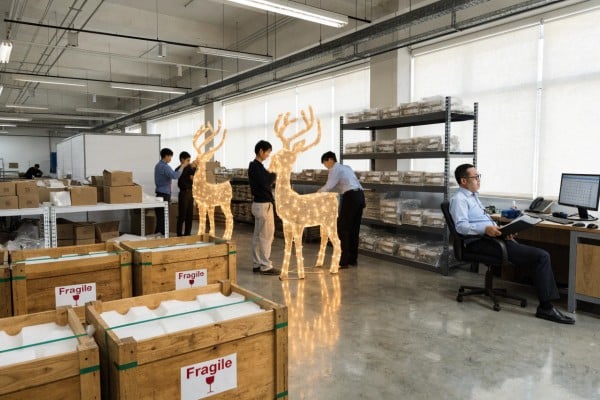
Production, compliance, and delivery support strengthen the sale because they prove that the festive lighting proposal can become a real installed project. Buyers need samples, confirmed specifications, quality checks, safety documents, packaging plans, and delivery schedules before they trust a supplier with a time-sensitive mall decoration order.
The Real Value of a Manufacturer Is Execution
Many suppliers can show attractive photos. Fewer suppliers can support the whole process from concept to shipment. In our work as a China-based festive lighting manufacturer and trading company, we see execution support as one of the strongest parts of our value.
That support may include:
- Custom design discussion
- Sample production
- Material and LED confirmation
- Voltage and plug matching
- Color temperature selection
- Frame structure review
- Bulk production planning
- Quality inspection
- Packaging design
- Export documentation
- Container loading planning
- Delivery schedule follow-up
These steps are not glamorous, but they protect the project.
Sample Approval Helps Control Expectations
For customized festive lighting, a sample can prevent expensive misunderstandings. A buyer may approve a drawing, but the real product can still raise questions about color, brightness, size, or finish.
A sample process can confirm:
- LED color temperature, such as warm white, cool white, or RGB
- Flashing or static lighting effect
- Frame color and coating
- Acrylic, PVC, tinsel, or fabric decoration material
- Cable length and connector style
- Packaging method
- Assembly structure
For large custom items, a full-size sample may not always be practical. In that case, a material sample, section sample, lighting effect video, or scaled prototype may help.
Production Planning Should Match the Holiday Calendar
Festive lighting orders are seasonal. This creates pressure. If the buyer confirms too late, production and shipping choices become limited.
A realistic timeline may include:
| Stage | Typical Focus | Risk If Ignored |
|---|---|---|
| Concept confirmation | Theme, size, budget | Repeated redesign |
| Sample approval | Effect, material, structure | Buyer dissatisfaction |
| Bulk production | Quantity and QC | Late shipment |
| Inspection | Function and appearance | On-site defects |
| Packing | Protection and loading | Damage in transit |
| Shipping | Vessel or air schedule | Missed holiday deadline |
| Installation | Assembly and power planning | Delayed opening |
The exact timing depends on product complexity and order size. Standard LED string lights are different from customized 3D motif sculptures. A serious B2B marketing strategy should explain this instead of promising unrealistic speed.
Compliance Support Helps Channel Partners Look Professional
We should be careful here. A supplier should not claim that one certificate automatically satisfies every mall or every country. Requirements vary by market, buyer, and product type. However, organized compliance documents make the project easier to review.
Useful documents may include:
- Product specification sheet
- Test reports where available
- CE-related documents for suitable products
- RoHS declaration or supporting information
- IP rating details for outdoor use
- Transformer or controller information
- Material safety notes
- Factory certificates such as ISO9001
- Social compliance reference such as BSCI when relevant
When channel customers receive these documents early, they can answer buyer questions faster. This speed can matter during seasonal procurement.
Installation Guidance Reduces Site Problems
Mall installation often happens at night or during short closing windows. Contractors may not have time to guess how a frame connects or where the power input should be placed.
Good installation support may include:
- Numbered frame parts
- Assembly drawings
- Hanging point suggestions
- Power input location
- Cable connection diagram
- Spare LED or spare connector recommendation
- Packing list by carton
- On-site troubleshooting notes
These details are easy to overlook during sales. However, they can determine whether the buyer sees you as a product seller or a project partner.
Delivery Certainty Is a Sales Argument
Delivery planning is not just operations. It is part of marketing. When a buyer sees a clear production and shipment plan, they feel less risk.
A delivery plan should explain:
- When drawings or samples must be approved
- When materials will be purchased
- When production will start
- When QC inspection will happen
- When goods will be packed
- When shipment can be arranged
- Which transport method is realistic
This information helps importers and contractors communicate with mall buyers. It also prevents last-minute panic.
In seasonal lighting, trust often comes from boring details. A good supplier makes those details visible.
How Can Sales Materials Help Channel Partners Win Mall Projects?
Many factories focus only on production, but channel partners need sales tools. Importers, distributors, event companies, and contractors must present ideas to their own customers. If they do not have professional materials, they may struggle even when the product quality is good.
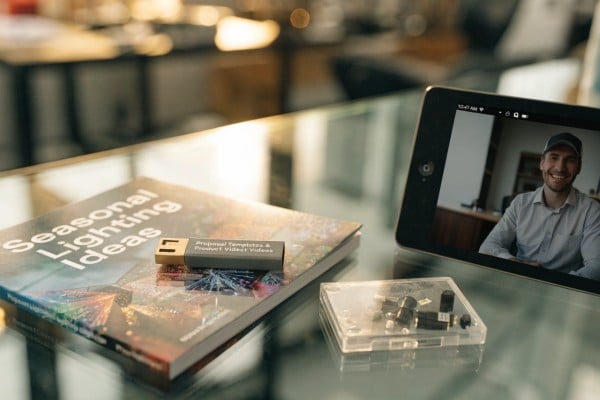
Sales materials help channel partners win mall projects by converting factory products into buyer-friendly presentations. Useful tools include themed catalogs, proposal templates, product videos, installation images, comparison tables, sample kits, budget packages, and compliance folders. These materials make the partner's sales process faster and more convincing.
Why Channel Partners Need More Than a Factory Catalog
A factory catalog is useful, but it usually organizes products by category: LED string lights, motif lights, curtain lights, 3D decorations, trees, and accessories. A mall buyer thinks differently. They think by scene, season, deadline, and budget.
That is why channel customers often need sales materials that answer questions like:
- "What can I propose for a mall entrance?"
- "What does a mid-budget atrium decoration include?"
- "Can I show a Christmas photo spot concept?"
- "Do you have products suitable for outdoor installation?"
- "Can I explain the difference between basic and premium options?"
If the supplier prepares these tools, the partner can respond faster.
Useful Sales Materials for Festive Lighting Projects
Here are materials I would prepare for serious B2B partners.
| Sales Material | Purpose | Best Format |
|---|---|---|
| Theme catalog | Show holiday ideas by season | |
| Scene proposal | Present entrance, atrium, walkway options | Slide deck |
| Product video | Show lighting effect | MP4 or link |
| Budget package sheet | Compare basic, upgraded, custom options | PDF or Excel |
| Compliance folder | Support technical review | PDF folder |
| Installation reference | Reduce contractor questions | PDF or images |
| Sample kit | Help buyer compare colors and materials | Physical samples |
| Case-style reference images | Inspire buyer confidence | Image folder |
How to Build a Better Festive Lighting Presentation
A strong presentation does not need to be complicated. It should be clear. I usually suggest this order:
-
Theme page
Show the holiday concept and mood. -
Mall zone plan
Break the decoration into entrance, atrium, walkway, and photo spot. -
Key visual products
Show the main products with size and effect photos. -
Package options
Offer basic, upgraded, and customized plans. -
Technical details
Include voltage, material, IP rating, and installation notes. -
Compliance and factory support
Add relevant certificates, QC process, and production capability. -
Timeline
Show order confirmation, sample, production, shipment, and delivery milestones. -
Next steps
Ask for site dimensions, budget range, target holiday, and required documents.
This structure helps the buyer move from interest to decision.
Do Not Overpromise With Sales Materials
Sales materials should be attractive, but they should stay realistic. I do not recommend showing a huge luxury display if the buyer has a small budget. I also do not recommend using images that cannot be produced within the timeline.
Good marketing creates desire. Good B2B marketing also protects trust.
For festive lighting, every image should be connected to production reality:
- Can the factory make this size?
- Can the material match the environment?
- Can the packing protect the product?
- Can the shipping schedule meet the holiday?
- Can the installation team assemble it?
If the answer is unclear, the sales material should be adjusted.
Why This Helps Your Partner Sell Repeatedly
When channel partners have better materials, they can approach more mall-related buyers. They can also reuse the same framework for different projects. For example, a Christmas entrance proposal can be adapted into a New Year display. A Ramadan crescent theme can be adjusted for different mall sizes.
This creates long-term value. The supplier becomes more than a source of products. The supplier becomes a partner in proposal development, customization, and delivery planning.
That is the kind of B2B marketing strategy that fits festive lighting projects.
Frequently Asked Questions
What is the best way to sell festive lighting to shopping malls?
The best way is to sell a complete seasonal experience, not only individual lights. I recommend preparing scene-based proposals for entrances, atriums, walkways, windows, and photo spots. The proposal should include visuals, budget tiers, safety documents, installation notes, and delivery planning.
Why do mall buyers ask for so many documents before ordering festive lighting?
Mall festive lighting is public-facing and deadline-sensitive, so buyers want to reduce risk. They may review product specifications, compliance documents, samples, packaging details, and installation guidance. These materials help them check safety, quality, logistics, and project feasibility before approval.
How can distributors avoid competing only on low price?
Distributors can avoid lowest-price competition by offering basic, upgraded, and customized packages. This helps mall buyers compare value at different budget levels. It also shifts the discussion from unit price to visual effect, installation convenience, compliance support, and delivery certainty.
What products are commonly used in shopping mall festive lighting projects?
Common products include LED string lights, curtain lights, motif lights, 3D sculptures, cone trees, hanging snowflakes, light arches, garlands, gift boxes, reindeer frames, crescent motifs, star lights, and customized photo spots. The right mix depends on holiday theme, mall layout, budget, and installation conditions.
How early should buyers start planning mall festive lighting orders?
Buyers should start as early as possible, especially for customized products. Planning needs time for concept design, samples, confirmation, production, inspection, packing, and shipping. Standard items may move faster, but custom mall displays need a longer schedule to protect the holiday deadline.
Conclusion
A strong B2B marketing strategy for selling festive lighting to shopping malls is not about pushing the lowest price. It is about helping buyers and channel partners reduce risk. The best proposals turn products into mall-ready scenes, offer clear budget tiers, include visual proof, prepare compliance documents, and show realistic delivery planning. As a festive lighting manufacturer and trading company in Zhongshan, we support partners with customization, production, documentation, packaging, and proposal materials. If you are preparing a mall decoration project, contact us to build a practical festive lighting solution together.
Table of Contents
- B2B Marketing Strategy: How to Sell Festive Lighting to Shopping Malls?
- Why Does a B2B Marketing Strategy for Mall Festive Lighting Start With Buyer Risk?
- How Should Your B2B Marketing Strategy Turn Lights Into Mall-Ready Scenarios?
- What Proposal Materials Should a B2B Marketing Strategy Include for Shopping Mall Buyers?
- How Can Tiered Packages Help You Avoid Lowest-Price Negotiations?
- How Do Production, Compliance, and Delivery Support Strengthen the Sale?
- How Can Sales Materials Help Channel Partners Win Mall Projects?
-
Frequently Asked Questions
- What is the best way to sell festive lighting to shopping malls?
- Why do mall buyers ask for so many documents before ordering festive lighting?
- How can distributors avoid competing only on low price?
- What products are commonly used in shopping mall festive lighting projects?
- How early should buyers start planning mall festive lighting orders?
- Conclusion