 EN
EN

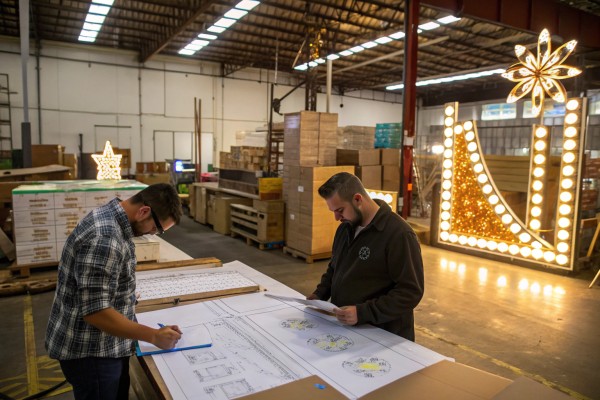
2026 Global Supply Chain Outlook for Holiday Lighting Wholesale?
Holiday lighting wholesale in 2026 will feel risky if buyers focus only on whether the unit price rises or falls. A low quotation can become expensive when specifications, certifications, samples, packaging, or production windows are unclear. I see the safer path as early technical confirmation, not early price chasing.
For 2026 holiday lighting wholesale, buyers should plan around total procurement risk instead of simple price movement. The best results come from confirming product type, target-market compliance, plug and voltage details, customization needs, sample approval, packaging, MOQ, and production schedule before peak-season capacity becomes tight.
The buyers I speak with often ask, “Will prices be better next season?” That question matters, but it is not the first question I would ask. The better question is: Can this product be made, tested, packed, shipped, and delivered correctly before the selling or installation deadline?
Why Should Holiday Lighting Wholesale Buyers Look Beyond Unit Price in 2026?
Holiday lighting wholesale buyers often feel pressure to secure the lowest quotation early. That pressure is understandable. However, a cheap price can hide later problems. If the product fails market requirements, needs rework, or misses the shipping window, the real cost becomes much higher.
For 2026, wholesale buyers should compare total procurement risk, not only unit price[^1]. A strong quotation should match the exact product specification, certification target, plug type, voltage, packaging method, customization scope, MOQ, inspection standard, and delivery schedule. Price only helps when these details are already clear.
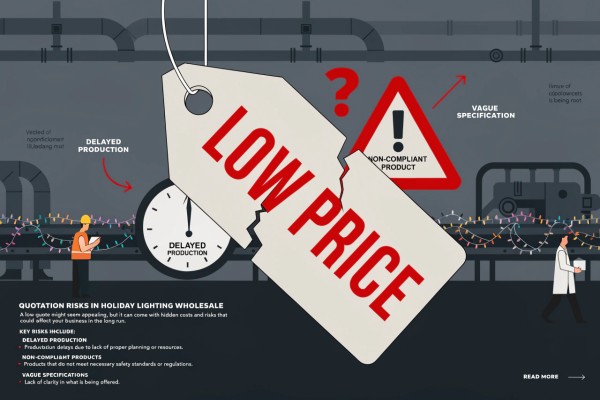
Unit price is only one part of the real cost
In my daily communication with overseas customers, I often see buyers start with a simple request: “Please quote your best price for LED string light.” That is a normal first step. But after two or three emails, the real buying decision becomes more complex.
A string light for a European retailer is not the same as a decorative light for a Middle East outdoor project. A christmas light for supermarket shelves is not the same as a customized motif light for a city street. Even when the product photo looks similar, the requirements can be very different.
The final procurement cost can be affected by:
- Certification gaps
- Wrong plug or voltage
- Outdoor waterproof grade requirements
- Packaging redesign
- Barcode and label mistakes
- Sample rework
- Late design confirmation
- Production line capacity during peak season
- Container loading and shipment timing
- After-sales risk from quality complaints
I do not present myself as a macroeconomic forecaster. I cannot tell a buyer with certainty whether shipping rates, exchange rates, tariffs, copper prices, plastic prices, or market demand will move in one direction in 2026. Those external variables need current verification. However, I can say from order communication experience that avoidable internal mistakes often cost buyers more than small unit-price differences.
A simple risk comparison
| Buying focus | Short-term benefit | Hidden risk | Better 2026 approach |
|---|---|---|---|
| Lowest unit price only | Quick comparison | Wrong specification or weak compliance | Compare price after confirming details |
| Early inquiry only | More supplier options | No sample or packaging lock-in | Build a confirmation calendar |
| Fast customization | Faster quotation | Rework and production delay | Approve drawings and samples early |
| General product description | Easy RFQ | Supplier may quote different standard | Use a detailed specification sheet |
| Late inspection | Saves time at first | Problems found too late | Set inspection standard before production |
What I check before treating a quote as serious
When I review an inquiry, I do not look only at wattage, size, or LED quantity. I also try to understand the buyer’s sales channel and target market. A large retailer may need packaging tests, carton marks, barcode format, and strict delivery slots. A municipal contractor may care more about structure strength, outdoor performance, and installation timing.
For a more reliable holiday lighting wholesale plan, I suggest buyers prepare these points before comparing prices:
- Product category: string light, christmas light, motif light, curtain light, icicle light, or customized pattern light.
- Target country or region: Europe, Australia, UAE, Saudi Arabia, South Africa, or another market.
- Electrical requirements: plug type, voltage, transformer, cable standard, and outdoor use.
- Compliance target: CE, RoHS, UKCA, SAA, or other market-specific needs.
- Visual details: LED color, wire color, size, flash function, controller, and brightness.
- Packaging: retail box, color label, hanging card, master carton, pallet requirement.
- Timeline: sample approval date, production date, inspection date, shipment date, delivery deadline.
A lower price is useful only when the product behind that price is the correct product.
This is especially important for holiday lighting wholesale because the season is unforgiving[^2]. If goods arrive too late for Christmas retail shelves or a city decoration project, the buyer cannot simply sell the same demand next month.
Is Ordering Early Enough for Holiday Lighting Wholesale Success?
Holiday lighting wholesale buyers often hear that they should “order early.” That advice is true, but it is incomplete. Early ordering does not reduce risk if the product specification remains vague. A buyer can place an early order and still lose time through unclear samples, packaging changes, or certification questions.
Ordering early only works when key decisions are confirmed early. Buyers need to lock product type, target market requirements, sample approval, customization details, packaging artwork, MOQ, inspection criteria, and production schedule. Without these confirmations, an early order can still become a late shipment.
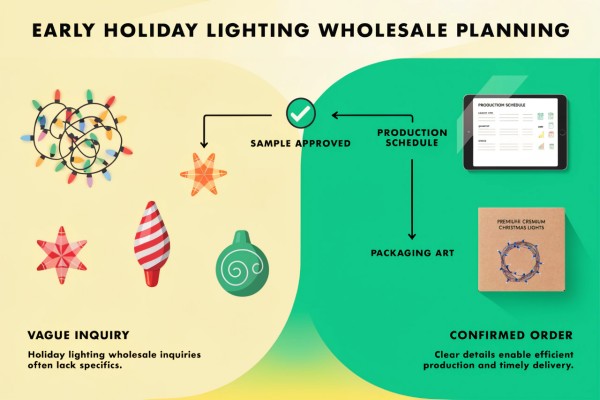
“Early” should mean confirmed, not just discussed
In my experience, many buyers begin communication months before production, but they still confirm the important details very late. The inquiry starts early. The order does not become production-ready early.
This difference matters.
For example, a buyer may send a request for a christmas light assortment in February. The price is discussed in March. But the buyer may not confirm:
- The exact LED color temperature
- The retail packaging artwork
- The plug standard
- The carton quantity
- The certificate requirement
- The final assortment list
- The purchase order quantity
If those details are not confirmed until June or July, the factory may still face a tight schedule. The buyer may think the project started early, but the production team sees it as a late-confirmed order.
A practical 2026 planning timeline
The best timeline depends on product type and order complexity. Still, I usually encourage buyers to work backward from the required arrival date.
| Stage | Standard products | Customized products | Why it matters |
|---|---|---|---|
| Product selection | 1–2 weeks | 2–4 weeks | Buyers compare models and functions |
| Quotation confirmation | 1 week | 1–2 weeks | Details affect real price |
| Sample making | 1–3 weeks | 3–6 weeks | Custom shape or structure needs testing |
| Sample approval | 1–2 weeks | 2–4 weeks | Buyer feedback may require changes |
| Packaging confirmation | 1–2 weeks | 2–3 weeks | Retail packaging can delay production |
| Mass production | 3–6 weeks | 5–10 weeks | Peak season capacity is limited |
| Inspection and shipment | 1–3 weeks | 1–3 weeks | Inspection booking and loading need time |
These ranges are not fixed promises. They are planning references. Actual timing depends on order quantity, product complexity, material availability, supplier capacity, and testing requirements.
Early ordering checklist
Before a buyer says, “We want to order early,” I suggest using a checklist like this:
-
Have we confirmed the product category?
A standard string light needs a different timeline from a 3D street-crossing motif light. -
Have we confirmed the market?
Europe, Australia, and the Middle East often require different electrical and compliance checks. -
Have we approved the sample?
A sample is not useful if it is only “almost correct.” -
Have we approved packaging?
Packaging often becomes a hidden bottleneck for retail buyers. -
Have we confirmed MOQ and assortment?
Many buyers combine multiple SKUs. One slow SKU can delay the whole shipment. -
Have we booked a production window?
Factories cannot reserve unlimited capacity without confirmed order details. -
Have we agreed on inspection standards?
Inspection should not be a surprise at the end of production.
Why this matters more in seasonal lighting
Holiday lighting wholesale has a strong seasonal deadline. A delay in general consumer goods may still be manageable. A delay in festivel light, christmas light, or public holiday decoration can destroy the selling opportunity.
Retailers need shelf time. Importers need warehouse time. Project contractors need installation time. Municipal buyers need public launch dates. If a lighting arch, tree motif, or street decoration arrives after the festival date, the buyer may face not only lost sales but also contract pressure.
That is why I prefer to discuss confirmation quality before discussing “early order” as a slogan. Early communication is good. Early finalization is better.
How Do Product Types Change Holiday Lighting Wholesale Lead Times?
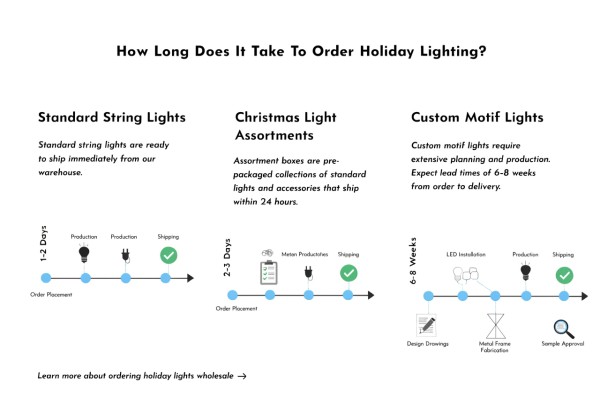
Holiday lighting wholesale lead times change sharply by product type. Buyers sometimes group all decorative lighting together, but factories do not plan them the same way. Standard LED string lights, decorative motif lights, customized pattern lights, and project-based lighting solutions each have different design, sampling, material, and production logic.
Standard string lights usually move faster because specifications are mature. Motif lights and customized holiday patterns need more time for design, frame structure, sample approval, LED layout, electrical checks, and packing decisions. Project-based lighting solutions also require installation and site-planning coordination.
Standard LED string lights
LED string light products are usually the easiest category to plan, especially when the buyer chooses existing models. The main variables include:
- Length
- LED quantity
- LED spacing
- Wire color
- Cable material
- Plug type
- Controller function
- Indoor or outdoor use
- Packaging type
A simple warm white string light for retail may have a relatively short sample and production cycle. However, that does not mean buyers can skip technical confirmation. A small difference in cable, plug, or transformer can affect cost and compliance.
For wholesale buyers, the key is to avoid vague descriptions like “standard Christmas string lights.” A better specification would be:
10m LED string light, 100 LEDs, warm white, green wire, outdoor use, EU plug, 220–240V, retail color box, CE/RoHS target, 24 pcs per carton.
That level of detail makes quotations more comparable.
Christmas light retail assortments
Christmas light assortments for large retailers can become more complex than they appear. The product itself may be standard, but the retail requirements may add time.
Retail buyers often need:
- Branded packaging
- Multilingual instructions
- Barcode labels
- Carton marks
- Drop-test or packaging checks[^3]
- Product photos
- Shelf display requirements
- Delivery slot coordination
- Mixed SKU container loading
A buyer may order 10 different christmas light SKUs in one program. If nine SKUs are ready and one SKU has a packaging issue, the whole shipment plan can be affected.
Decorative motif lights
Motif light products have a different supply chain logic. A motif light may include a metal frame, LED rope light, string light, acrylic parts, fixing accessories, waterproof connectors, and customized dimensions. The production process involves more than assembling LEDs.
Common motif light checks include:
| Check item | Why buyers should confirm it early |
|---|---|
| 2D or 3D design | Affects structure, cost, packing volume, and installation |
| Frame material | Impacts strength, weight, and outdoor durability |
| LED type | Changes brightness, color effect, and power consumption |
| Size and mounting method | Must match site or display requirements |
| Waterproof level | Outdoor public decoration needs proper protection[^4] |
| Packing method | Large motifs need safe packing and container planning |
I have seen buyers ask for a large decorative motif with a short lead time because they compare it to a standard string light. That comparison is risky. A customized motif may need design drawings, sample sections, frame confirmation, and several rounds of adjustment.
Customized pattern lights and project-based solutions
Customized holiday lighting products need the most careful planning. These may include city street decorations, shopping mall displays, giant tree ornaments, Ramadan lighting motifs, national day patterns, or large outdoor festival installations.
The buyer may need to confirm:
- Theme and artwork
- Dimensions
- Color scheme
- LED effect
- Installation method
- Power distribution
- Outdoor environment
- Packing and transport
- Spare parts
- Project deadline
For project-based work, the question is not only “Can you produce this?” The better question is “Can we confirm every technical decision early enough for safe production and delivery?”
This is where holiday lighting wholesale becomes closer to project procurement. The quotation should reflect design work, material planning, production scheduling, packing volume, and delivery risk. If buyers only compare unit price, they may miss the most important part of the decision.
What Market-Specific Checks Should Holiday Lighting Wholesale Buyers Make?
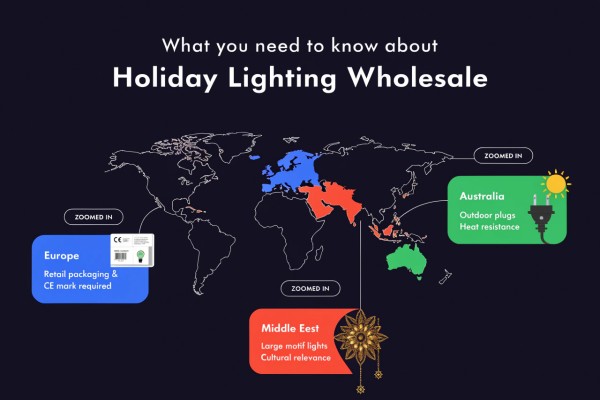
Holiday lighting wholesale planning should change by target market. A product suitable for one country may not be ready for another country.[^5] Europe, Australia, and the Middle East show this clearly. Each market creates different checks around compliance, plugs, voltage, outdoor use, packaging, delivery expectations, and customization timelines.
Buyers should build a market-specific checklist before confirming 2026 orders. Europe often requires strong attention to certification and retail delivery standards. Australia needs plug, voltage, and outdoor-use adaptation.[^6] The Middle East often involves large decorative projects, customized motif lights, and longer design-confirmation timelines.
Europe: compliance and retail execution
For Europe, buyers often ask about CE, RoHS, packaging languages, and retailer requirements. I always treat Europe as a detail-sensitive market because many customers sell through structured wholesale, retail, or distributor channels.
Important checks include:
- CE and RoHS expectations[^7]
- Plug and voltage
- Transformer requirements
- WEEE or packaging-related obligations where applicable[^8]
- Multilingual manuals
- Retail packaging design
- Carton marking
- Delivery appointment timing
- SKU consistency
I am not a testing laboratory, so buyers should verify exact compliance requirements with qualified testing partners and local regulations. However, from supplier communication experience, I know that compliance questions should come before mass production, not after goods are packed.
A simple question like “Is this CE?” is often not enough. Buyers should define which product version, which market, which documentation, and which test basis they require.
Australia: plug, voltage, and outdoor adaptation
Australia has its own practical checks. Many decorative lighting buyers need products suitable for local plug standards and outdoor use. The wrong plug or transformer specification can cause serious trouble.
Buyers should confirm:
| Item | Buyer question |
|---|---|
| Plug type | Is the plug suitable for the Australian market? |
| Voltage | Is the product designed for local voltage requirements? |
| Outdoor use | Is the product suitable for outdoor seasonal display? |
| Cable and transformer | Do these match the intended use and compliance target? |
| Packaging | Does packaging meet retail or distributor expectations? |
For an Australian importer, a product photo is not enough. The technical file, sample, and plug details matter. A standard decorative light from one market may need adaptation before it becomes sellable in Australia.
Middle East: scale, customization, and project deadlines
The Middle East often has large decorative lighting projects. These may include shopping mall decorations, public roads, hotel displays, Ramadan decorations, national celebration themes, and large custom motif light installations.
The main supply chain challenge is not always mass production quantity. It is often design confirmation time.
A Middle East project buyer may need:
- Large custom motifs
- Special colors or cultural patterns
- Outdoor-resistant structures
- Strong visual brightness
- Installation accessories
- Multiple size versions
- Drawings before sample approval
- Delivery before a public event date
For these projects, buyers should start design communication early. A large custom pattern light cannot be treated like a standard shelf product. The buyer, supplier, designer, and installation team may all need to align before production starts.
External variables still need verification
For all markets, buyers should monitor external variables without building the entire plan around guesses. These variables include:
- Shipping rates
- Exchange rates
- Tariffs
- Raw material prices
- Local demand forecasts
- Port congestion
- Policy changes
- Retail inventory levels
I prefer not to make firm predictions about these factors. Instead, I recommend that buyers create flexible procurement plans. A strong plan includes confirmed specifications, approved samples, realistic production windows, and updated logistics checks before shipment.
This approach keeps the 2026 holiday lighting wholesale plan practical. It helps buyers control what they can control while verifying what they cannot control.
How Can Buyers Build a Safer 2026 Holiday Lighting Wholesale Procurement Plan?
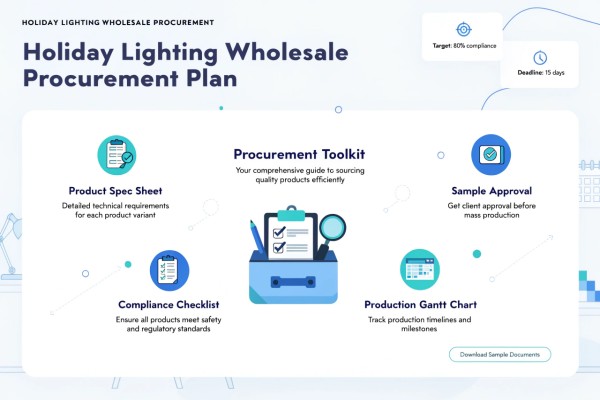
Holiday lighting wholesale planning can become overwhelming when buyers manage many SKUs, markets, and suppliers at the same time. The risk grows when decisions stay inside email threads instead of a clear procurement file. A simple structure can prevent repeated questions and late mistakes.
Buyers can build a safer 2026 plan by using one specification sheet per product, one compliance checklist per market, one sample approval record, one packaging confirmation file, and one production timeline[^9]. This makes supplier communication faster and reduces avoidable rework before peak season.
Start with a product specification sheet
A product specification sheet does not need to be complicated. It needs to be clear. When I receive a well-prepared inquiry, I can quote more accurately and ask fewer follow-up questions.
A useful specification sheet should include:
- Product name
- Product photo or reference drawing
- Size
- LED quantity
- LED color
- Wire or frame color
- Cable material
- Plug type
- Voltage
- Controller or lighting effect
- Indoor or outdoor use
- Waterproof expectation
- Packaging type
- Target market
- Required certification
- Estimated order quantity
- Required delivery date
This is especially useful when buyers compare multiple suppliers. If every supplier quotes the same specification, the buyer can compare price, quality, lead time, and service more fairly.
Separate standard SKUs from custom SKUs
I recommend separating products into three groups:
| Product group | Example | Planning priority |
|---|---|---|
| Standard products | Existing string light or christmas light models | Confirm specification and packaging |
| Semi-custom products | Existing design with new color, length, or packaging | Confirm sample and modified BOM |
| Fully custom products | New motif light or project pattern | Confirm drawing, sample, structure, and timeline |
This separation helps buyers avoid one common mistake: treating all decorative lighting as if it has the same lead time.
A standard string light may move quickly once the specification is confirmed. A fully custom motif light may need drawing review, structure approval, sample production, and packing tests.[^10] The buyer should not place both into the same planning calendar.
Use a decision deadline, not only a shipment deadline
Many buyers set a shipment deadline. Fewer buyers set decision deadlines. I think decision deadlines are more useful.
For example:
- Final product list confirmed by March 15
- Samples approved by April 10
- Packaging artwork confirmed by April 25
- Purchase order confirmed by May 5
- Production starts by May 20
- Inspection completed by July 5
- Shipment arranged by July 15
This format makes delays visible early. If packaging is not confirmed by April 25, everyone can see the risk before production is affected.
Keep communication practical
Good supplier communication does not require long emails. It requires complete decisions. When I work with overseas buyers, the smoothest projects usually have three habits:
- The buyer confirms details in writing.
- The supplier records changes clearly.
- Both sides agree on sample, packaging, and production milestones.
For 2026 holiday lighting wholesale, this kind of discipline may matter more than small price differences. It reduces confusion, protects the schedule, and improves the chance that the final product is compliant, sellable, and deliverable.
Frequently Asked Questions
Will holiday lighting wholesale prices rise or fall in 2026?
I would not make a firm price prediction for 2026. Shipping rates, exchange rates, tariffs, raw materials, and demand can change[^11]. Buyers should verify current variables and focus on controllable risks, such as specifications, compliance, samples, packaging, and production windows.
When should I start sourcing 2026 christmas light products?
Buyers should start several months before the required delivery date, especially for retail programs or custom designs. Standard christmas light products may move faster, but packaging, certification, and inspection still need time. Custom motif and project lighting should begin much earlier.
Are LED string lights and motif lights planned the same way?
No. LED string lights usually have shorter lead times when existing specifications are used. Motif lights need more time for frame design, LED layout, sample approval, packing, and installation planning.[^12] Buyers should separate these categories in their procurement schedule.
What details should I include in a holiday lighting RFQ?
A strong RFQ should include product type, size, LED color, wire or frame material, plug, voltage, indoor or outdoor use, waterproof expectation, packaging, target market, certification requirements, MOQ, order quantity, and delivery deadline. Clear RFQs lead to more reliable quotations.
How can I reduce risk when buying customized holiday lighting?
Start design communication early, confirm drawings, approve samples, define materials, check installation needs, and agree on a realistic production window. Customized holiday lighting needs more coordination than standard products, so late changes can create rework, extra cost, and delivery pressure.
Conclusion
The 2026 outlook for holiday lighting wholesale is not only about whether prices move up or down. The stronger question is whether buyers can confirm the right product, compliance path, customization details, packaging, and production window early enough. Standard string light orders, christmas light retail programs, motif light projects, and customized festivel light designs all need different planning logic. If you are preparing a 2026 purchasing plan, send your product list and target market requirements early so we can help review specifications, samples, and production timing before peak-season pressure begins.

[^1]: "Advanced Procurement - Analyzing Costs Using Total Cost of Ownership", https://psep.smeal.psu.edu/short-courses/supply-chain-accelerator/advanced-procurement-analyzing-costs-using-total-cost-of-ownership. Purchasing research on total cost of ownership supports evaluating supplier offers by acquisition, operating, quality, logistics, and risk-related costs rather than purchase price alone; the evidence is general procurement theory rather than holiday-lighting-specific proof. Evidence role: expert_consensus; source type: paper. Supports: Procurement evaluation commonly considers total cost of ownership and risk factors beyond purchase price.. Scope note: Contextual support from procurement literature, not direct evidence about 2026 holiday lighting wholesale.
[^2]: "Monthly Retail Trade - Sales Report", https://www.census.gov/retail/sales.html. Government retail-trade statistics showing elevated sales activity during the November-December holiday period support the claim that seasonal goods face a narrow selling window; the data are broad retail indicators and not specific to decorative lighting. Evidence role: statistic; source type: government. Supports: Retail activity in many consumer categories is seasonally concentrated around the holiday period, making late delivery commercially risky.. Scope note: Contextual retail-seasonality evidence, not direct measurement of holiday-lighting sell-through.
[^3]: "Test Procedures", https://ista.org/test_procedures.php. Packaging-test standards from bodies such as ISTA or ASTM define drop and distribution-handling tests for packaged products, supporting the inclusion of packaging checks in retail shipment preparation. Evidence role: definition; source type: institution. Supports: Recognized packaging standards include drop and distribution tests used to evaluate whether packaged goods can withstand handling and transport..
[^4]: "IP code", https://en.wikipedia.org/wiki/IP_code. The IEC ingress-protection classification defines degrees of protection against solid objects and water ingress, supporting the need to specify suitable environmental protection for outdoor public electrical decorations. Evidence role: definition; source type: institution. Supports: Ingress-protection standards classify protection against solids and water, which is relevant for outdoor electrical decorations..
[^5]: "Mains electricity by country", https://en.wikipedia.org/wiki/Mains_electricity_by_country. International electrical-standard references document country-level variation in plug types, nominal voltage, and frequency, supporting the claim that an electrical product suitable for one market may require adaptation for another. Evidence role: general_support; source type: institution. Supports: International electrical infrastructure differs by country, including plug types, supply voltage, and frequency, which can affect product readiness for different markets.. Scope note: Supports cross-market electrical variation generally, not the compliance status of any specific lighting product.
[^6]: "AS/NZS 3112", https://en.wikipedia.org/wiki/AS/NZS_3112. Australian electrical-safety guidance and standards information support that imported electrical goods must be assessed against local plug, voltage, and safety requirements, including considerations for products intended for outdoor use. Evidence role: definition; source type: government. Supports: Australian electrical equipment rules and standards address local plug configurations, nominal voltage, and safety requirements relevant to imported lighting products..
[^7]: "EU WEEE_RoHS", https://www.trade.gov/eu-weeerohs. European Commission guidance on CE marking and the RoHS Directive supports that many electrical and electronic products placed on the EU market must meet applicable conformity and hazardous-substance requirements. Evidence role: definition; source type: government. Supports: EU rules require certain electrical and electronic products to meet applicable CE-marking and RoHS obligations before being placed on the EU market..
[^8]: "Waste Electrical and Electronic Equipment Directive", https://en.wikipedia.org/wiki/Waste_Electrical_and_Electronic_Equipment_Directive. European Commission materials on the WEEE Directive and EU packaging-waste rules support that electrical products and their packaging may trigger producer, importer, or distributor obligations, depending on the product and market arrangement. Evidence role: definition; source type: government. Supports: EU WEEE and packaging rules can create obligations for producers, importers, or distributors of electrical products and packaged goods..
[^9]: "ISO 9001 Purchasing Procedure", https://www.thecoresolution.com/8-4-purchasing-iso-explained. Quality-management guidance such as ISO 9001 supports documenting requirements, supplier controls, and retained records to help ensure product conformity and process traceability; the support is procedural and not specific to holiday lighting. Evidence role: expert_consensus; source type: institution. Supports: Quality-management frameworks emphasize documented requirements, supplier communication, and retained records as controls for conformity and process reliability.. Scope note: Contextual support from quality-management practice, not direct evidence that this exact file structure reduces holiday-lighting delays.
[^10]: "Production Readiness Review (PRR) | Adaptive Acquisition ...", https://aaf.dau.edu/aaf/mca/prr/. Product-development research supports the use of design reviews, prototype or sample validation, and production-readiness checks before manufacturing customized products; this supports the workflow generally and does not prove the exact steps required for every motif-light order. Evidence role: mechanism; source type: paper. Supports: Product development literature identifies design review, prototype validation, and production-readiness checks as common steps for customized or newly engineered products.. Scope note: Contextual support from product-development literature, not a product-specific standard.
[^11]: "OECD Supply Chain Resilience Review: Navigating Risks", https://www.oecd.org/content/dam/oecd/en/publications/reports/2025/06/oecd-supply-chain-resilience-review_9930d256/94e3a8ea-en.pdf. International trade and transport reports document that freight costs, currency movements, tariff measures, commodity prices, and demand shifts can materially affect cross-border procurement costs; such sources support the risk category but do not predict specific 2026 holiday-lighting prices. Evidence role: general_support; source type: institution. Supports: International trade reports document that freight rates, exchange rates, tariffs, commodity prices, and demand conditions can vary and affect procurement costs.. Scope note: Supports the existence of variable external cost drivers, not the direction or magnitude of 2026 changes.
[^12]: "Relationship between manufacturing complexity, strategy, and ...", https://pmc.ncbi.nlm.nih.gov/articles/PMC8214087/. Operations and manufacturing studies on product complexity and customization support that added design variables, engineering review, and coordination steps can lengthen production planning and lead times; the evidence is general manufacturing research rather than motif-light-specific measurement. Evidence role: mechanism; source type: paper. Supports: Manufacturing research links product complexity and customization with increased coordination, engineering work, and lead-time uncertainty.. Scope note: Contextual support from manufacturing research, not a direct empirical study of holiday motif lights.
Table of Contents
- 2026 Global Supply Chain Outlook for Holiday Lighting Wholesale?
- Why Should Holiday Lighting Wholesale Buyers Look Beyond Unit Price in 2026?
- Is Ordering Early Enough for Holiday Lighting Wholesale Success?
- How Do Product Types Change Holiday Lighting Wholesale Lead Times?
- What Market-Specific Checks Should Holiday Lighting Wholesale Buyers Make?
- How Can Buyers Build a Safer 2026 Holiday Lighting Wholesale Procurement Plan?
-
Frequently Asked Questions
- Will holiday lighting wholesale prices rise or fall in 2026?
- When should I start sourcing 2026 christmas light products?
- Are LED string lights and motif lights planned the same way?
- What details should I include in a holiday lighting RFQ?
- How can I reduce risk when buying customized holiday lighting?
- Conclusion
- The 2026 outlook for holiday lighting wholesale is not only about whether prices move up or down. The stronger question is whether buyers can confirm the right product, compliance path, customization details, packaging, and production window early enough. Standard string light orders, christmas light retail programs, motif light projects, and customized festivel light designs all need different planning logic. If you are preparing a 2026 purchasing plan, send your product list and target market requirements early so we can help review specifications, samples, and production timing before peak-season pressure begins.