 EN
How to Build a Profitable Christmas Lighting Product Range for Retail Stores
A profitable Christmas lighting product range starts by reframing the problem. Many retailers think more SKUs mean more sales. The real challenge is maximizing sales per display space while protecting margin[^1]. Stock can pile up after Christmas. Customers can meet empty shelves before peak.[^2] The right structure solves both.
A profitable Christmas lighting product range balances core string lights for volume, decorative pieces for margin, themed novelties for differentiation, and outdoor products for broader use cases, all supported by tight price tiers, replenishment planning, verified certifications, and packaging that increases display efficiency while limiting returns and markdown risk.
Great ranges are designed, not accumulated. I see buyers ask for more styles or lower unit prices. I always ask about display space, price ladders, and replenishment windows first. Those answers guide the details far better than a catalog page count ever will.
Do you need more SKUs or a smarter Christmas lighting product range?
Too many buyers chase variety before structure. Displays get crowded. Replenishment slows. Profit suffers. The goal is sell-through, not width. We can stop thinking “more” and start thinking “smarter”: the right products, in the right price tiers, with the right replenishment and packaging.
A smarter range yields more sales per square meter.[^3] Begin with a limited set of core SKUs, then add decorative, themed, and outdoor lines with clear roles. Keep the price ladder clean. Plan mid-season replenishment. Reduce overlap. Create a consistent shopping experience with clear signage and packaging.
Why this reframing matters
In product range discussions, I often hear, “Can you give me five more motifs?” or “Can you take 10 cents off the mini string light?” It is a normal question. But the better lens is display productivity. Seasonal sell-through has a tight window—six to eight weeks in many markets.[^4]
- A crowded rack steals attention from proven sellers.
- A fragmented range increases out-of-stocks on core items.
- A wider assortment raises the chance of heavy markdowns.
I have seen stores win with fewer, better slots. Lead with proven string light and warm white bestsellers. Support with selective decorative SKUs that carry healthy margins. Layer a small number of novel pieces to create excitement. Keep outdoor lines distinct and weather-appropriate. This structure reduces noise and helps staff maintain planograms. It also gives replenishment a fighting chance to hit shelves before the final weekend.
Tip from the aisle: When a category feels “thin,” it is often signage, color temperature clarity, and price tiering—not fewer SKUs—creating that perception.
Why can SKU expansion reduce profit in a Christmas lighting product range?
The temptation is real: add colors, add sizes, add features. But more SKUs can quietly break the model. Demand fragments, display efficiency drops, and the odds of markdowns increase. Buyers end up managing exceptions instead of growing category profit.
SKU expansion fragments demand across near-duplicates, making replenishment less predictable.[^5] It consumes display space that should go to high-velocity core items. It also raises end-of-season residual stock, which pressures margin through markdowns and increased returns.
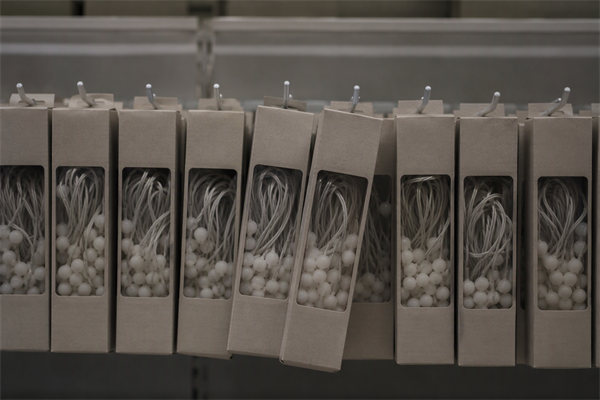
What “too many” costs you
- Demand fragmentation: Shoppers need clear choices. Ten similar warm-white micro string lights add cognitive load. Fewer, clearer options convert better.[^6]
- Replenishment friction: DCs and stores face more case lines, more label changes, more decision points. It slows down the flow.
- Display waste: Larger packs or niche colors block your absolute essentials. Core lines sell through. Niche lines sit.
- Markdown exposure: Every extra niche color risks being on the shelf on December 26th.
Practical steps to right-size
- Audit overlaps. If two SKUs share color temp, length, and function, keep the one with better packaging and past velocity.
- Protect core pegs or shelves. Reserve 50–60% of linear space for top sellers.[^7]
- Enforce a three-tier ladder. Good–Better–Best prevents micro-steps that confuse shoppers.
- Cap unique colors and novelty features. A small, well-chosen set outperforms a sprawling rainbow.
A quick framework
- Keep: 100–200 count warm white string light in standard lengths and indoor/outdoor options.
- Consolidate: Multiple lengths within ±2 meters. Pick one.
- Add selectively: Unique “motif light” designs that carry premium tickets and offer clear differentiation.
I have sat with buyers who removed 20% of SKUs and grew profit because their replenishment hit shelves at the right moment and shoppers found what they needed faster. SKU width feels safe in previews; it is risky in December.
What is the ideal mix for a Christmas lighting product range?
Profit comes from balance. Volume SKUs do the heavy lifting. Decorative pieces bring margin. Themed items create excitement. Outdoor products broaden use cases and tickets. The best ranges structure each role clearly and assign space and budget accordingly.
An ideal mix anchors on core indoor string lights for volume, adds decorative SKUs for margin, includes a small selection of themed/novelty pieces for differentiation, and rounds out with weather-suitable outdoor lines. Assign distinct price tiers and reserve space accordingly to maintain clarity and replenishment speed.
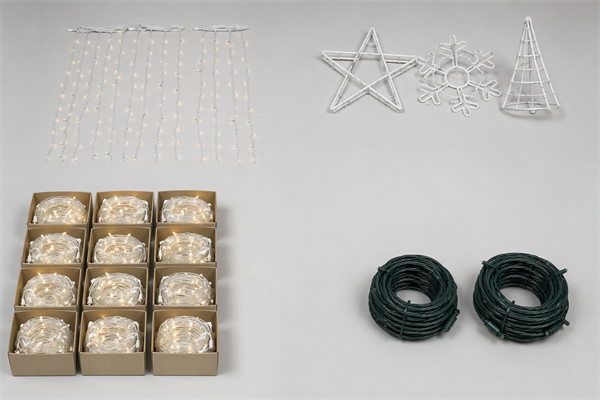
Category roles at a glance
| Role | Example products | Primary job | Space share | Notes |
|---|---|---|---|---|
| Core volume | 100–200 ct warm white string light, micro LED | Drive units and traffic | 50–60% | Stable SKUs; indoor/outdoor variations. |
| Decorative margin | Curtain lights, cluster lights, rope light | Lift average ticket, margin | 20–25% | Color and effects as add-ons. |
| Themed/novelty differentiation | Mini trees, motif light figures, neon motifs | Create excitement | 10–15% | Rotate annually; limited runs. |
| Outdoor/weather-suitable | IP44–IP65 stringers, projector, net lights | Extend use cases | 10–15% | Region-led selection and safety. |
Core volume: keep it simple and strong
- Warm white and multi-color options, clearly labeled color temperature (e.g., 2700–3000K).
- Standard lengths with clear coverage guidance in packaging.
- Indoor vs outdoor versions separated, with ingress protection (IP) ratings visible.
- Consistent packaging sizes to maximize shelf facings.
Decorative margin: design with restraint
- Curtain and cluster products offer margin. Pick a manageable set: one width, two lengths, two colorways.
- Rope light and strip styles can be cross-merchandised with hooks and clips.
- Emphasize pack features: timers, memory functions, low-energy LED drivers.
Themed/novelty: excite without overstocking
- Choose 3–5 motifs that align to your brand and store footprint. Feature them on an endcap.
- Make supply limited. Sell-through is more valuable than leftover novelty pieces on December 26th.
- Use consistent packaging footprints to keep the table neat.
Outdoor: specify for weather
- Match climate: in rainy regions, prioritize IP65 solutions. In dry, cold regions, cable flexibility ratings matter.
- Stakes and clips included to reduce returns due to missing hardware.
- Package warnings: outline safe use; include QR codes to quick-install guides.
I recommend a simple policy: “No product without a role.” Every addition must justify space, add margin, or create differentiation. If it cannot, it stays out of the Christmas lighting product range.
How should price tiers and packaging protect margin?
Buyers feel price pressure from competitors and private labels. Price ladders keep the category coherent. Packaging protects both product and presentation. When pack size and specification align with planograms, stores sell more with fewer returns and less shrink.
Use a clear good–better–best price ladder with visible feature differences.[^8] Design packaging to standard footprints, tamper-evident seals, and durable handles. Clarity reduces returns.[^9] Compactness increases facings per meter. Both protect margin more effectively than shaving a few cents off ex-factory price.
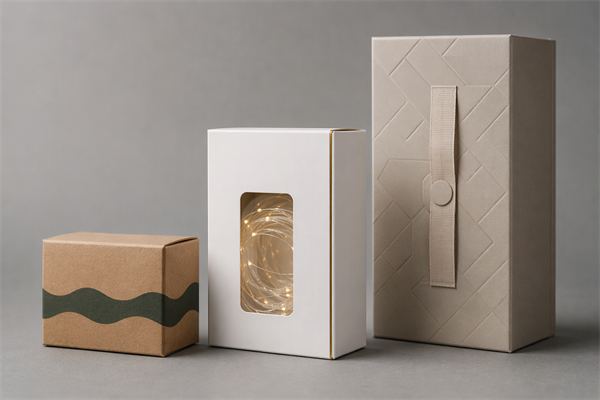
Build the ladder, then fill it
- Good: Entry string light sets with basic functions, strong energy claims.
- Better: Add timer, memory function, thicker cable, or longer length.
- Best: Feature-rich products (app control, RGB), premium finishes, giftable boxes.
Keep price gaps meaningful, not marginal. Better tier should feel like a step up, not a rounding error.
Packaging practices that pay
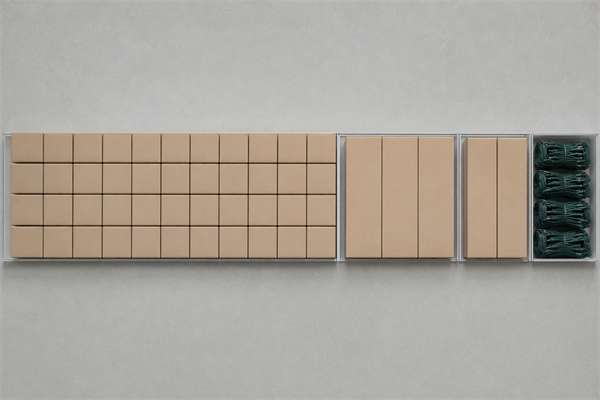
- Standardization: Use two or three master carton and inner pack footprints. DC operations and planograms benefit.
- Visibility: Icons for indoor/outdoor, IP ratings, color temperature, timer features.
- Durability: Reinforced corners and handles for heavier decorative SKUs.
- Returns reduction: Clear install diagrams, QR links to videos, and printed warnings for outdoor use.
- Shrink control: Tamper-evident seals; avoid easy-open boxes for small accessories.
I like to test packaging with store staff. If they can reset a display in under 10 minutes after a busy weekend, the pack design is probably right. Packaging is often cheaper than markdowns. It is cheaper than returns. It is certainly cheaper than chaos on a Saturday.
How do certifications and quality control shape a retail Christmas lighting product range?
Compliance is non-negotiable. Seasonal windows collapse if goods fail inspection or cause returns. Certifications and QC protect shoppers and your P&L. Retail buyers should treat certificates as documents to verify, not marketing claims to accept.
Certify each SKU for market-specific rules (e.g., CE/UKCA, UL, SAA) and verify documents with issuing bodies.[^10] Specify IP ratings for outdoor products. Audit factories for ISO9001 and BSCI. Use pre-shipment inspections with functional tests. Strong QC reduces defect rates, returns, and reputational risk.
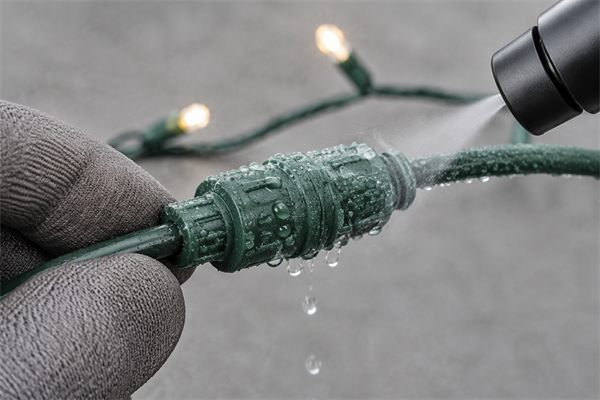
Focus areas for compliance and QC
- Market certifications:
- EU/UK: CE and UKCA with LVD/EMC, RoHS documentation.
- US/Canada: UL/ETL where applicable.
- Australia/New Zealand: SAA and RCM.
- Ingress protection: Outdoor SKUs should carry IP44–IP65 as appropriate; verify gaskets and strain relief.[^11]
- Materials: Flame retardancy standards for indoor decorations; RoHS compliance for LEDs and wiring.[^12]
- Factory audits: ISO9001 and BSCI are good signals. Buyers should verify copies and audit validity dates.
- Testing: Pre-shipment inspections with burn-in tests on a sample basis; verify timer functions and controllers.
Practical steps buyers can implement
- Request a compliance pack per SKU: certificates, test reports, DoC, and component lists.
- Engage a third-party lab for spot checks on first orders or new designs.
- Specify acceptance quality limits (AQL) in purchase orders.
- Align warranty language with QC reality; do not overpromise service on unproven items.
In my experience, returns on christmas light products often link back to vague instructions, poor adapter labeling, or mismatched connectors. Fixing these at source saves the season. We have paused shipments at our own cost when labels did not match specs. It is cheaper than field failures a week before Christmas.
What replenishment and MOQ strategies keep the Christmas lighting product range profitable mid-season?
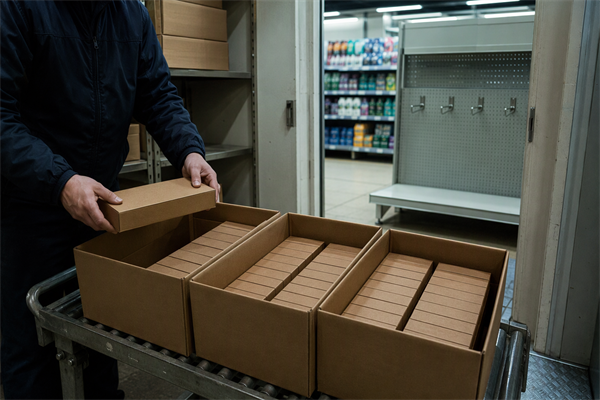
Seasonal success depends on supply timing. Many buyers lock the landing, then forget replenishment until it is too late. The best ranges plan backup quantities, pre-pick cartons, and clear MOQs so stores can refill before the final rush.
Plan a replenishment window with pre-picked reserve stock, aligned MOQs, and DC-ready cartons. Protect core SKUs with early allocations. Use vendor-packaged “assortment top-ups.” Set final order cut-offs based on realistic transit times. This structure reduces both stockout risk and residual inventory.
Build your mid-season plan backwards
- Transit math: Anchor cut-off dates to actual sea or road transit, plus port and DC time. Work from the store landing backward.
- Pre-picked reserves: Keep a buffer at the DC for core SKUs. Use color-coded labels for fast wave-picking.
- MOQ management: Agree carton quantities that match store needs; avoid minimums that force overstocking.
- Assortment top-ups: Bundle small novelty replenishments to protect variety without over-ordering single lines.
Tactics that consistently work
- “Core-only” second drop: Focus the second container or truckload on string light bestsellers. Leave slow movers out.
- DC bypass for urgent stores: Ship direct to large stores when days count. Limit to safest SKUs with stable demand.
- Vendor-managed kits: Pre-assembled mixed-carton kits for smaller formats. They drop in and fill gaps quickly.
- Real-time feedback: Ask stores to flag color/length gaps weekly and align top-ups accordingly. A simple shared dashboard beats guesswork.
I prefer MOQs that match display facings. If a store has four facings of the 200-count warm white, a top-up MOQ of four inners keeps the rack tidy. The logistics team thanks you, and the shelf never looks broken.
How should you plan displays and planograms for a Christmas lighting product range that sells through?
Display planning is where profit shows up in public. Good products in the wrong layout underperform. Shoppers need clarity, not noise. Clear signage, consistent footprints, and an intuitive flow from core to decorative drive conversion and basket size.
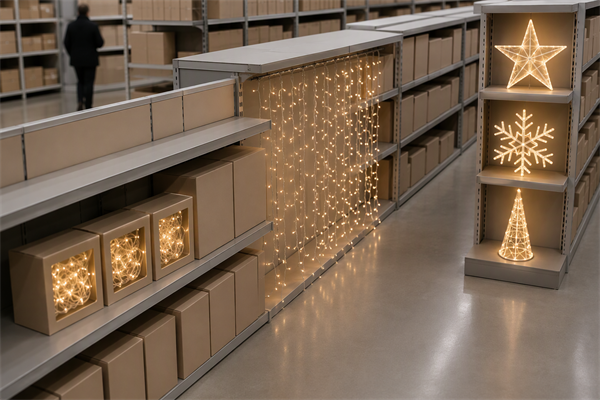
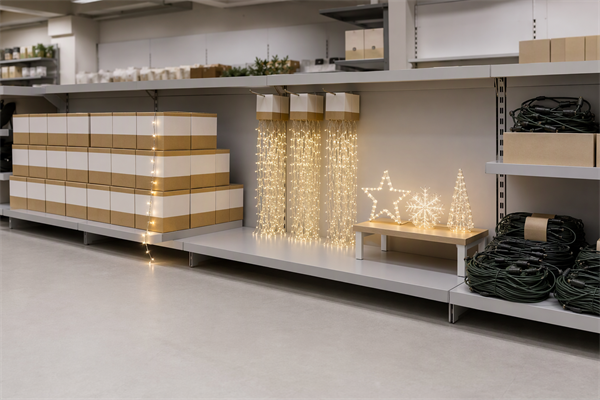
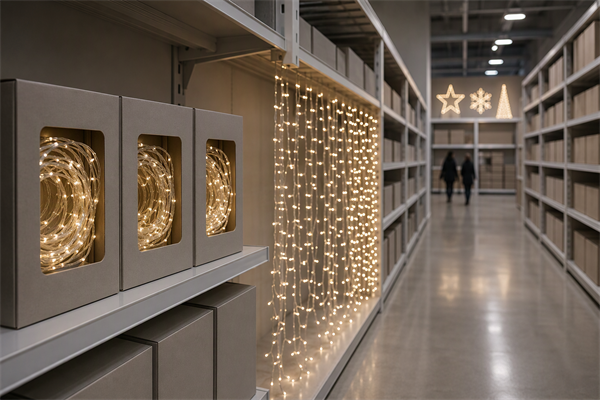
Planograms should group core string lights by color temperature and length. Place decorative and novelty at eye level near complementary SKUs. Use consistent box sizes to maximize facings. Provide comparison cards and clear pricing ladders. This structure simplifies choice and exposes add-on items.
Practical merchandising blueprint
- Flow: Start with core indoor string lights (warm white to multi-color), then outdoor, then decorative curtains and cluster lights, and finish with themed motifs at an endcap.
- Signage:
- Color temp icons: 2700K warm white vs 4000K cool.
- Indoor vs outdoor badges with IP info.
- Good–Better–Best callouts with feature bullets.
- Footprints: Keep consistent pack widths; aim for three facings for top SKUs.
- Attachment: Clips, extension cords, timers near core lines. Place impulse add-ons at checkout during peak weeks.
- Education: A single shelf-edge card helps shoppers pick length and coverage faster than a staff consult.
I keep a small “visual guide” on displays that shows how many meters of string light cover a 2-meter tree, a 3-meter balcony, or a window frame. Shoppers make quicker decisions, and staff field fewer repetitive questions.
Frequently Asked Questions
How many SKUs should a Christmas lighting product range include?
There is no universal number. I start with the display space and target price ladder. Many profitable seasonal sets keep 50–60% of space for core string lights, then add 20–25% decorative, 10–15% themed, and 10–15% outdoor. The goal is clarity and replenishment, not sheer width.
Which certifications should I verify for outdoor christmas light products?
Verify market-specific safety marks and documents: CE/UKCA for Europe/UK, UL/ETL for North America, SAA and RCM for Australia/New Zealand. Confirm IP ratings for outdoor use, ensure RoHS compliance, and request a Declaration of Conformity. Always validate certificates with issuing bodies and consider third-party spot tests.
How do I structure price tiers without confusing shoppers?
Use a clear good–better–best ladder with visible feature differences. Good covers basic string light needs. Better adds timers and longer lengths. Best includes smart control or premium finishes. Keep the price gaps meaningful. Reinforce with simple icons and shelf-edge cards that explain the step-ups.
What reduces returns on festive light products?
Clarity and durability do. Use legible instructions, QR-linked install videos, accurate color temperature labeling, and tamper-evident packaging. Include mounting accessories for outdoor lines. Pre-shipment functional tests and consistent driver/adaptor specs also reduce early failure returns.
How can I prevent end-of-season markdowns on motif light and novelty items?
Limit novelty quantities, feature them on an endcap to front-load sales, and avoid deep duplication. Choose 3–5 strong designs. Time deliveries so novelty arrives with the main set but not in excess. Use assortment top-ups rather than heavy second drops on novelties.
Conclusion
A profitable Christmas lighting product range is not about more SKUs. It is about a balanced structure that drives sales per square meter and protects margin. Anchor on core string lights, layer decorative and themed items with intention, and verify quality and certifications. If you want a practical range-planning discussion or compliance document checklist, reach out and we can map options to your format and timelines.

[^1]: "Shelf Space Allocation for Store Brands | Stanford Graduate School ...", https://www.gsb.stanford.edu/faculty-research/working-papers/shelf-space-allocation-store-brands. Research on retail shelf-space allocation and assortment planning indicates that display space is a constrained resource whose allocation can influence both sales and profit outcomes; this supports the general planning principle rather than proving the exact margin effect for Christmas lighting. Evidence role: general_support; source type: paper. Supports: Retail shelf-space allocation and assortment planning affect sales and profitability.. Scope note: Contextual support; the source may address retail categories generally rather than Christmas lighting specifically.
[^2]: "Newsvendor model", https://en.wikipedia.org/wiki/Newsvendor_model. Seasonal inventory models, including the newsvendor framework, describe the tradeoff between stockout risk during the selling period and leftover inventory after demand has passed; this provides a general mechanism for the article's claim. Evidence role: mechanism; source type: paper. Supports: Seasonal inventory decisions involve balancing shortage costs before demand peaks against leftover inventory after the selling season.. Scope note: The evidence is theoretical or cross-category unless the selected source specifically studies holiday lighting.
[^3]: "A Demand Estimation Procedure for Retail Assortment Optimization with ...", https://faculty.wharton.upenn.edu/a-demand-estimation-procedure-for-retail-assortment-optimization-with-results-from-implementations-workingpaper-file-file/. Retail operations research links assortment and shelf-space allocation decisions with store-level sales productivity, supporting the claim that a more structured range can improve output per unit of display space. Evidence role: general_support; source type: research. Supports: Retail assortment and space-allocation decisions are linked to sales productivity.. Scope note: Contextual support; the source is likely to cover retail space productivity broadly rather than the exact proposed Christmas lighting assortment.
[^4]: "Winter Holiday Data and Trends | 2026 Holiday Consumer Spending Insights", https://nrf.com/research-insights/holiday-data-and-trends/winter-holidays. Holiday retail data from a trade or statistical institution can substantiate that Christmas-related purchasing is concentrated in the November-December period; this supports the short selling-window claim but may not establish a universal six-to-eight-week window for every market. Evidence role: statistic; source type: institution. Supports: Holiday retail sales are concentrated in the November-December shopping season.. Scope note: The timeframe varies by country, retailer format, and product category.
[^5]: "The Effect of Product Variety and Inventory Levels on Retail Sales", https://www.hbs.edu/faculty/Pages/item.aspx?num=37388. Operations-management research on product variety and SKU proliferation shows that expanding assortments can fragment demand and increase forecasting and replenishment complexity; this provides a mechanism for the article's replenishment claim. Evidence role: mechanism; source type: paper. Supports: SKU proliferation can increase inventory-management complexity and make demand forecasting more difficult.. Scope note: The source may address manufacturing or retail inventories generally rather than seasonal lighting specifically.
[^6]: "future research directions in choice overload and its moderators - PMC", https://pmc.ncbi.nlm.nih.gov/articles/PMC11111947/. Consumer-behavior studies on choice overload report that larger or less differentiated assortments can increase decision difficulty and, in some settings, reduce purchasing; this supports the article's claim about near-duplicate lighting options. Evidence role: expert_consensus; source type: paper. Supports: Large or poorly differentiated assortments can make consumer choice harder and may reduce purchasing.. Scope note: Choice-overload effects are context-dependent and do not imply that all assortment expansion reduces conversion.
[^7]: "Shelf Space Allocation for Store Brands | Stanford Graduate School ...", https://www.gsb.stanford.edu/faculty-research/working-papers/shelf-space-allocation-store-brands. Studies of shelf-space allocation support assigning more display space to products with stronger demand or profitability, providing contextual support for prioritizing high-velocity core items. Evidence role: general_support; source type: paper. Supports: Retail shelf space is often allocated according to product sales velocity, demand, and profitability.. Scope note: This would not directly validate the exact 50–60% figure unless the source reports a comparable benchmark.
[^8]: "Impact of Pricing and Product Information on Consumer Buying ...", https://pmc.ncbi.nlm.nih.gov/articles/PMC8710754/. Research on product-line pricing and versioning shows that differentiated tiers can help segment consumer preferences and frame tradeoffs between price and features; this supports the rationale for a good-better-best ladder. Evidence role: mechanism; source type: paper. Supports: Tiered product-line pricing and feature differentiation can structure consumer choice.. Scope note: The source may support the pricing mechanism generally rather than proving effectiveness for Christmas lighting displays.
[^9]: "Consumers pay attention to ingredients on the front of a label", https://pmc.ncbi.nlm.nih.gov/articles/PMC10538469/. Research on product information quality and consumer returns indicates that clearer descriptions and instructions can reduce expectation mismatch and use-related errors, supporting the article's claim about packaging clarity. Evidence role: general_support; source type: research. Supports: Clear product information and instructions can reduce mismatched expectations or user errors associated with returns.. Scope note: The evidence is likely broader than festive lighting and may not isolate packaging clarity from other return drivers.
[^10]: "Seasonal Lighting (Holiday Lights and Decorative Outfits)", https://www.cpsc.gov/Business--Manufacturing/Business-Education/Business-Guidance/Household-Electrical-Products/Seasonal-and-Decorative-Lighting-Products. Official conformity-marking guidance explains that electrical products must meet applicable market requirements before sale, supporting the article's instruction to verify market-specific compliance documentation. Evidence role: definition; source type: government. Supports: Electrical lighting products are subject to market-specific conformity marking, safety documentation, or certification requirements.. Scope note: Requirements differ by jurisdiction and product design, so a single source may not cover CE, UKCA, UL, and SAA together.
[^11]: "IP code", https://en.wikipedia.org/wiki/IP_code. The IEC ingress-protection classification defines IP ratings for resistance to solids and water, providing the technical basis for specifying appropriate outdoor ratings such as IP44 or IP65. Evidence role: definition; source type: institution. Supports: IP ratings classify protection against solid objects and water ingress for electrical enclosures.. Scope note: An IP-rating source defines protection levels but does not by itself determine which rating is legally required for every outdoor lighting use case.
[^12]: "RoHS", https://en.wikipedia.org/wiki/RoHS. Official RoHS guidance states that the directive restricts certain hazardous substances in electrical and electronic equipment, supporting the article's reference to RoHS compliance for LED lighting components. Evidence role: definition; source type: government. Supports: RoHS restricts specified hazardous substances in electrical and electronic equipment, including relevant lighting components where in scope.. Scope note: Applicability depends on jurisdiction, product category, exemptions, and component composition.
Table of Contents
- How to Build a Profitable Christmas Lighting Product Range for Retail Stores
- Do you need more SKUs or a smarter Christmas lighting product range?
- Why can SKU expansion reduce profit in a Christmas lighting product range?
- What is the ideal mix for a Christmas lighting product range?
- How should price tiers and packaging protect margin?
- How do certifications and quality control shape a retail Christmas lighting product range?
- What replenishment and MOQ strategies keep the Christmas lighting product range profitable mid-season?
- How should you plan displays and planograms for a Christmas lighting product range that sells through?
-
Frequently Asked Questions
- How many SKUs should a Christmas lighting product range include?
- Which certifications should I verify for outdoor christmas light products?
- How do I structure price tiers without confusing shoppers?
- What reduces returns on festive light products?
- How can I prevent end-of-season markdowns on motif light and novelty items?
- Conclusion