 EN
EN

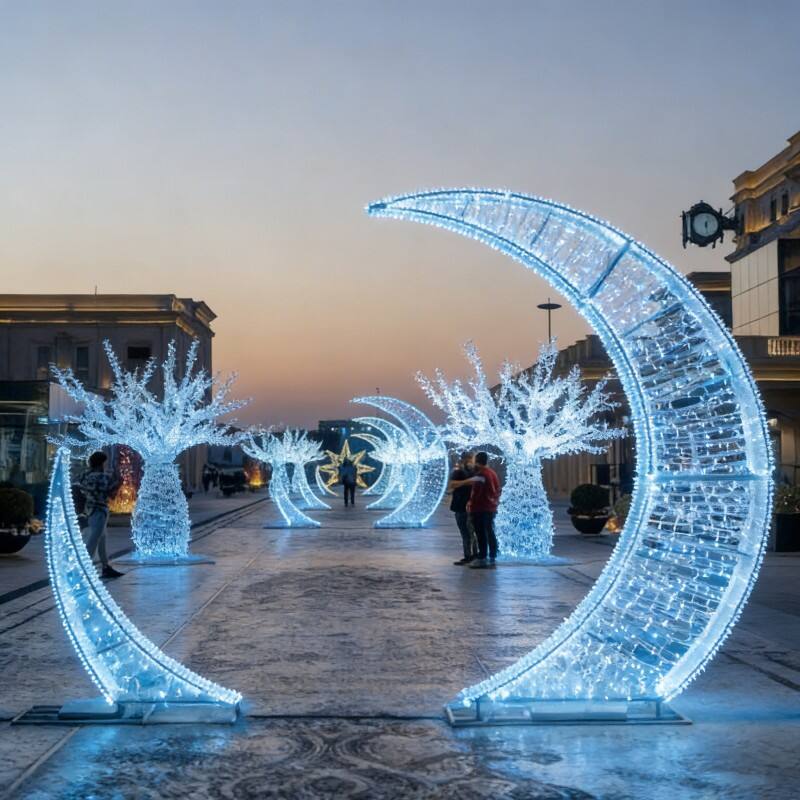
3D Modeling in Festive Lighting: Visualizing Future Wonders?
Struggling to imagine how your festive lighting idea will look in real life? Many clients face this problem. What if there was a way to see it before it's even made?
3D modeling in festive lighting is a powerful decision-making tool.[^1] It helps us visualize your concepts on the actual site, allowing us to test scale, budget, timeline, and installation conditions.[^2] This ensures your impressive vision is practical and achievable.

When we first talk about a new festive lighting project, clients often have amazing ideas. They share photos, sketches, or just describe their vision. My job, and our team's job, is to help bring that vision to life. We need to make sure what looks good on paper also works well in the real world. This is where 3D modeling becomes a critical part of our process.
Is "Beautiful" Enough for a Festive Lighting Design?
You have a stunning design in mind, but will it truly work on site? A beautiful concept alone might not meet all your project needs.
A festive lighting design needs more than just beauty. We must judge it by placement, viewing distance, main angles, people flow, target size, budget, lead time, and if photo impact or long-term stability is the priority. These factors decide if it is a success.
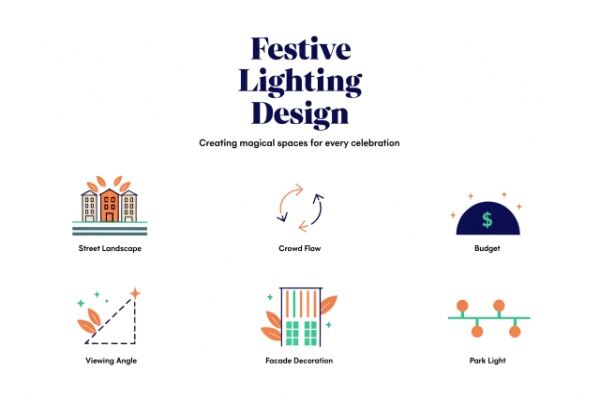
When a client comes to me with an idea, my first question is rarely "Is it beautiful?" Instead, I ask, "Where will it go?" We once had a client who wanted a huge, intricate archway for a narrow street. Visually, it was stunning in their reference image. But when we looked at the actual street dimensions, traffic flow, and building heights, we quickly saw issues. A 3D model helped us show them how the arch, at that scale, would block views and create a cluttered feel. We then adjusted the design to fit the space. It is not just about the look; it is about how the design interacts with its environment. We need to think about who will see it and from what distance.[^3] Is it for people walking by? Or for drivers? A design for a close-up retail window display is very different from a large-scale municipal street decoration. Also, we must consider the budget and the timeline. A very complex design might look great, but if it breaks the bank or takes too long to produce, it is not a practical solution. We often use a table like this to discuss early ideas:
| Factor | Consideration | Impact on 3D Model |
|---|---|---|
| Placement | Street, atrium, building facade, park | Scale, background |
| Viewing Distance | Close-up, medium, far | Detail level |
| Main Angles | From entry, from road, specific photo spots | Camera views |
| People Flow | High traffic, low traffic, static viewing | Durability needs |
| Target Size | Small, medium, large-scale | Proportion |
| Budget | Material, labor, installation costs | Design complexity |
| Lead Time | Design, production, shipping, installation | Material choice |
| Priority | Photo impact vs. long-term stability | Construction type |
This helps us align expectations and ensure we are building something that is not just pretty but also functional and realistic for the client's needs.
How Does 3D Modeling Bridge Imagination and Execution in Festive Lighting?
You have a concept in your head, but how do we turn that into something tangible? Bridging the gap between an idea and a real project can be hard.
3D modeling acts as a vital bridge between imagination and execution. It transforms a client's rough idea or reference image into a clear, discussable lighting concept. This allows our teams to see the design in context, making discussions about details, materials, and feasibility much more productive.
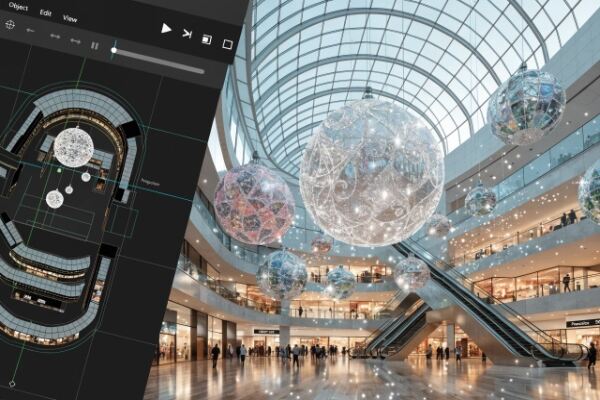
I often find that clients struggle to describe their vision fully, or they have a reference image that needs adapting to their specific site. For example, a client once showed me a beautiful photo of a Christmas tree from a famous European city. They wanted something similar for their shopping mall atrium. The reference was inspiring, but the atrium had a different ceiling height, fewer anchor points, and specific safety regulations.[^4] My team took that reference and created a 3D model of a customized tree within their actual atrium space. This model showed the exact height, width, and how it would interact with escalators and walkways. We could then easily discuss changes, like adding more interactive elements or adjusting the base for better people flow. The 3D model helped everyone on both sides visualize the actual project, not just a dream. It made it easy to point out specific areas for modification, like changing the LED color temperature or adjusting the density of light strings. This also helps us talk about the specific materials we will use, like different types of frames or light covers. We can also show how the design will look from different angles[^5], which is really important for large public spaces. This process saves a lot of time and prevents costly mistakes later on.[^6] It moves us from "I wish it looked like this" to "Yes, this is exactly what we need, and here's how we'll build it."
What Are the Real Limits of 3D Visuals in Festive Lighting Projects?
3D models are powerful tools, but they are not magic. Do you know what they can and cannot truly show?
While 3D renderings help align expectations, they cannot perfectly predict every detail. They do not fully show final brightness[^7], material reflection, specific installation challenges, or the complete real-world atmosphere. We always make sure clients understand these limits to avoid misunderstandings later on.
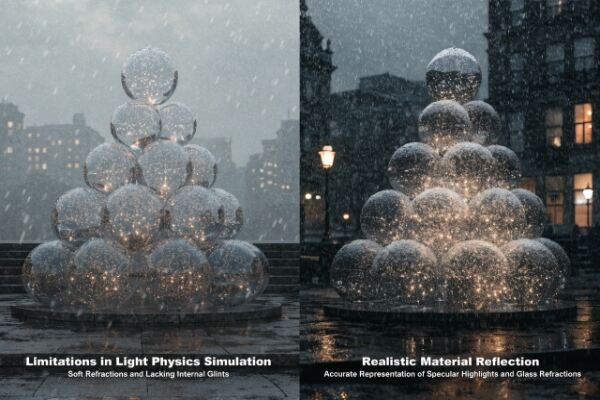
It is important for clients to understand what a 3D model can do and what it cannot do. We use them to show scale, proportion, general layout, and color schemes. For instance, when we design a large-scale outdoor installation for a city park, the 3D model helps the municipal contractors visualize how a series of light sculptures will fit along a pathway, showing their spacing and height relative to existing trees or benches. But I always tell clients that a rendering is a simulation, not a photograph of the finished product. A common question is about brightness. A 3D model can show general light intensity, but it cannot perfectly replicate the exact lumen output of a specific LED chip in different weather conditions or at night. The actual brightness can depend on many real-world factors like ambient light, atmospheric conditions, and even the cleanliness of the light covers.[^8] Also, material reflection is tricky. A shiny surface in a rendering might look slightly different in real life[^9] under varying light sources. I remember a project where a client wanted a highly reflective surface for a giant snowflake. The rendering looked amazing, but I explained that the final material's reflectivity would depend on the specific coating and environmental factors. We also cannot fully model every single installation constraint.[^10] While we can show anchor points, the actual process of getting heavy structures into place, dealing with uneven ground, or connecting power in tricky spots often involves on-site problem-solving that a 3D model cannot capture. It is a tool for planning and communication, not a crystal ball.
How Do 3D Models Improve Communication in Complex B2B Festive Lighting Projects?
Complex B2B projects involve many people. Are you tired of misunderstandings slowing things down?
3D models are essential communication tools for complex B2B projects. They help importers, event companies, municipal contractors, retailers, end clients, and approval teams reduce misunderstandings.[^11] This clarity happens before quotation, sampling, production, or installation, making the entire project smoother for everyone involved.

In our business, we work with many different stakeholders: the client's marketing team, their purchasing department, the city council for approvals, the installation company, and sometimes even local artists. Each group has different needs and concerns. A 3D model becomes a universal language that everyone can understand. For example, we were working on a large retail chain project for their holiday window displays across multiple stores. The marketing team wanted a specific visual impact, the purchasing team worried about costs, and the store managers needed easy installation. Instead of endless email chains with text descriptions, we created 3D models of the displays within a typical store window context. This allowed the marketing team to confirm the visual appeal, the purchasing team to see how modular elements could save costs, and the store managers to understand the installation footprint. The 3D model helped us ask the right questions early on: "Is this size acceptable for your specific window dimensions?" "Do you need access to the back of the display for maintenance?" "Does this fit your brand guidelines?" It helps us get approvals faster because everyone can clearly see the proposal. It also helps us provide more accurate quotations[^12] because the design details are clearer. When we move to sampling and production, there are fewer surprises because the 3D model has already defined the exact shape, size, and general material usage. It is like having a detailed blueprint that everyone has already signed off on, making the whole process from concept to delivery much more efficient and less prone to costly revisions.
Conclusion
3D modeling is a critical decision-making tool in festive lighting. It helps us bridge ideas to reality, ensuring designs are practical, not just pretty. While powerful, it has limits, but it always improves communication across all project stages, making your festive vision come true.
[^1]: "Improving Visualization Design for Effective Multi-Objective Decision ...", https://pubmed.ncbi.nlm.nih.gov/33690120/. University-developed BIM execution guidelines report that model-based visualization improves stakeholder understanding and supports earlier, better-informed decisions during project planning and delivery. Evidence role: expert_consensus; source type: education. Supports: That 3D models/visualizations enhance stakeholder understanding and support earlier, better-informed design decisions.. Scope note: These guidelines address building and infrastructure projects generally rather than festive lighting specifically.
[^2]: "[PDF] BIM Guide For Facility Management - GSA", https://www.gsa.gov/system/files/largedocs/BIM_Guide_Series_Facility_Management.pdf. U.S. General Services Administration BIM guidance describes using 3D/4D models to assess spatial scale and construction sequencing/logistics and to improve cost and schedule planning. Evidence role: general_support; source type: government. Supports: That 3D/4D models are used to evaluate scale, site logistics, scheduling, and improve cost/schedule planning.. Scope note: Evidence derives from building construction practices and may not map one-to-one to decorative installations.
[^3]: "Chapter 3. Legibility Testing - Information As A Source of Distraction ...", https://www.fhwa.dot.gov/publications/research/safety/15027/004.cfm. Transportation signage standards relate legibility and required size to viewing distance, illustrating how observer distance constrains effective visual detail. Evidence role: mechanism; source type: government. Supports: That effective visual design depends on viewing distance, which constrains legibility and required size/detail.. Scope note: Standards address traffic signage; the principle generalizes to other visual installations but is not specific to festive lighting.
[^4]: "[PDF] 2012 LIFE SAFETY CODE HEALTHCARE - CMS", https://www.cms.gov/Medicare/CMS-Forms/CMS-Forms/downloads/cms2786R.pdf. Life safety codes such as NFPA 101 regulate decorative materials and features in public assembly areas (e.g., flame propagation limits and egress clearance), requiring installations to meet specific safety provisions. Evidence role: expert_consensus; source type: institution. Supports: That life-safety codes regulate decorative materials and features in public assembly spaces.. Scope note: Exact requirements and adopted codes vary by jurisdiction.
[^5]: "Bidirectional reflectance distribution function - Wikipedia", https://en.wikipedia.org/wiki/Bidirectional_reflectance_distribution_function. In surface appearance, reflectance and perceived brightness vary with illumination and viewing direction as characterized by the bidirectional reflectance distribution function (BRDF), so objects can look different from different angles. Evidence role: mechanism; source type: encyclopedia. Supports: That surface appearance varies with viewing and illumination direction due to reflectance behavior.. Scope note: This is a general optics principle and not a direct study of festive lighting displays.
[^6]: "[PDF] the impact of building information modeling (bim)", https://ir.ua.edu/bitstreams/0741d860-e466-407b-a3ff-84d2b2a696e6/download. Peer-reviewed reviews of BIM implementation report reductions in design errors, rework, and change orders when models are used for coordination and visualization, which can save time and cost. Evidence role: general_support; source type: paper. Supports: That model-based coordination and visualization are associated with reductions in errors, rework, and change orders.. Scope note: Reported benefits vary by project and implementation and are often synthesized from case studies rather than controlled trials.
[^7]: "[PDF] The Physics of Light Transport - Computer Science", https://cseweb.ucsd.edu/~viscomp/classes/cse168/sp24/readings/LightTransport.pdf. Even physically based renderings approximate light transport using assumed material and lighting parameters; they are not measurements and cannot guarantee exact real‑world luminance or perceived brightness. Evidence role: mechanism; source type: encyclopedia. Supports: That computer renderings approximate light transport based on assumed inputs and are not direct measurements of real luminance/brightness.. Scope note: With calibrated inputs and controlled conditions, renderings can be highly predictive, but results remain input-dependent.
[^8]: "Luminaire Dirt Depreciation (LDD): Field Data from Several Exterior ...", https://www.energy.gov/cmei/ssl/articles/luminaire-dirt-depreciation-ldd-field-data-several-exterior-lighting-projects. Government guidance on lighting maintenance notes that field performance is influenced by environmental conditions and maintenance factors such as luminaire dirt depreciation, which can reduce delivered light over time. Evidence role: mechanism; source type: government. Supports: That environmental conditions and maintenance (e.g., dirt accumulation) affect delivered light levels in actual installations.. Scope note: The magnitude of these effects varies with the environment, fixture design, and cleaning practices.
[^9]: "Gloss (optics) - Wikipedia", https://en.wikipedia.org/wiki/Gloss_(optics). Optical descriptions of gloss note that surface appearance depends on both material microstructure and the illumination and viewing geometry, so glossy objects can appear different under different lights and angles. Evidence role: mechanism; source type: encyclopedia. Supports: That perceived gloss and surface appearance depend on material properties and the illumination/viewing geometry.. Scope note: This is a general optics principle; exact appearance differences depend on specific materials and lighting.
[^10]: "Section 4(f) Policy Paper - Environmental Review Toolkit", https://www.environment.fhwa.dot.gov/legislation/section4f/4fpolicy.aspx. Constructability guidance from transportation agencies notes that design-phase documents and models cannot anticipate all field conditions and means‑and‑methods constraints, so unforeseen issues are commonly resolved during construction. Evidence role: expert_consensus; source type: government. Supports: That design documents and models cannot anticipate all field conditions and means-and-methods constraints.. Scope note: Guidance focuses on civil works; the principle applies broadly but specifics vary by project type.
[^11]: "Impacts of building information modelling (BIM) on communication ...", https://pmc.ncbi.nlm.nih.gov/articles/PMC9553046/. BIM execution planning guides from universities emphasize that shared model visualizations improve interdisciplinary communication and reduce misunderstandings during design coordination and approvals. Evidence role: expert_consensus; source type: education. Supports: That model-based visualization improves interdisciplinary communication and reduces misunderstandings in project coordination.. Scope note: Support is based on industry practice guidance and case experiences rather than controlled experiments.
[^12]: "[PDF] 18R-97: Cost Estimate Classification System - AustinTexas.gov", https://services.austintexas.gov/edims/document.cfm?id=280770. Cost engineering standards (e.g., AACE International's estimate classification system) relate expected estimate accuracy to the level of project definition, indicating that well-defined designs support more accurate quotations. Evidence role: expert_consensus; source type: institution. Supports: That expected estimate accuracy is tied to the level of project definition.. Scope note: The framework is generic and does not account for all market or procurement variables in a specific project.

Table of Contents
- 3D Modeling in Festive Lighting: Visualizing Future Wonders?
- Is "Beautiful" Enough for a Festive Lighting Design?
- How Does 3D Modeling Bridge Imagination and Execution in Festive Lighting?
- What Are the Real Limits of 3D Visuals in Festive Lighting Projects?
- How Do 3D Models Improve Communication in Complex B2B Festive Lighting Projects?
- Conclusion